
In This Article
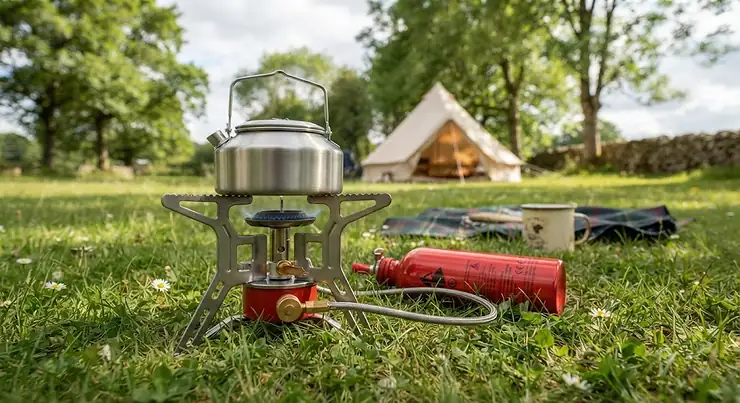
There’s a particular kind of dread that sets in when your gas canister runs dry on a freezing Welsh hillside with no shop for eleven miles. A petrol camping stove doesn’t have that problem. Fill it from any forecourt, any layby, any jerrycan in the boot, and you’re cooking — which is exactly why this fuel type has quietly stuck around for a century while flashier gadgets have come and gone. A petrol camping stove is a portable cooker that burns liquid fuel — typically unleaded petrol, white gas or kerosene — rather than pressurised gas canisters, using a pump to pressurise the tank and a priming step to vaporise fuel before ignition. This guide walks through seven real, currently available models, the genuine trade-offs of petrol versus gas and diesel, and the safety habits that keep a night’s dinner from becoming a headline. We’ve pulled specs and aggregated review sentiment from manufacturer data, retailer listings and outdoor forums rather than inventing a single word of “hands-on testing” — what follows is honest analysis, not fabricated adventure.
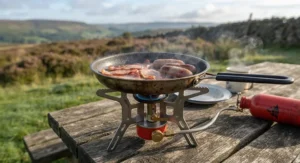
Why does fuel type matter so much? Because unlike gas, which struggles below freezing and vanishes without warning, petrol keeps performing when the mercury drops and the shops are shut. That reliability comes at a cost — more weight, a fussier lighting ritual, and the faint whiff of a two-stroke engine drifting over your porridge. Whether you’re weighing up a petrol camping stove for winter Munro-bagging, overland travel, or just because you’re sick of hunting for the right gas cartridge size, the products below cover budget, mid-range and expedition-grade options, with UK-specific advice on unleaded fuel availability, priming safety and topping up on the road.
Quick Comparison Table: 7 Petrol Camping Stoves at a Glance
| Stove | Fuel Type | Weight | Power Output | Best For |
|---|---|---|---|---|
| Coleman Unleaded Sportster II | Petrol / Coleman Fuel | 1.19kg | ~2,500W | Best all-round budget pick |
| Coleman Unleaded Two-Burner | Petrol / Coleman Fuel | ~4.5kg | ~2 x 2,500W | Family & group catering |
| MSR WhisperLite International | Petrol / Kerosene | 0.44kg | ~2,600W | Lightest petrol-only backpacking stove |
| MSR WhisperLite Universal | Petrol / Gas / Kerosene | 0.55kg | ~2,600W | Hybrid petrol-and-gas flexibility |
| Optimus Nova+ | Petrol / Diesel / Kerosene / Jet Fuel | 0.46kg | ~2,850W | Expedition-grade multi-fuel reliability |
| Primus OmniFuel II | Petrol / Diesel / Kerosene / Gas / Aviation Fuel | 0.49kg | 3,000W | Most powerful flame control on test |
| Kovea Booster +1 | Petrol (white gasoline) / Gas | 0.45kg | ~2,900W | Budget dual-fuel backpacking pick |
Looking at the spread here, weight and versatility move in opposite directions from price: the cheapest option, the Coleman Unleaded Sportster II, is also the heaviest per watt of output, while the Primus OmniFuel II crams the most fuel flexibility and raw power into under half a kilo, at a correspondingly higher price. If you’re backpacking solo, the difference between 0.44kg and 1.19kg genuinely matters over a week’s walking; if you’re driving to a fixed pitch, it barely registers. Note that none of these figures are exact retail prices — always check current pricing on the product page before buying, since fuel-burning stoves see periodic model updates and regional price shifts.
💬 Found a stove that fits your trip already? Jump straight to the detailed breakdown below before you commit.😊
Top 7 Petrol Camping Stoves: Expert Analysis
1. Coleman Unleaded Sportster II — best all-round budget petrol stove for UK campsites
The Sportster II has been the default “first petrol stove” for British campers for decades, and the current unleaded version keeps that reputation largely intact. It runs on either standard unleaded petrol from any forecourt or Coleman’s own liquid fuel, delivering around 2,500W and boiling roughly a litre of water in under five minutes according to manufacturer figures. In practice, that output means it can comfortably run a single large pan for a family breakfast fry-up, though it won’t simmer as gently as a gas burner with a proper regulator. Based on the spec comparison with rival single-burner units, what stands out here isn’t outright power — it’s the running cost: forecourt unleaded is a fraction of the price of dedicated camping gas canisters, which matters if you’re cooking three meals a day for a fortnight. This is the stove for budget-conscious campers who cook often and don’t want to keep buying cartridges, rather than for ultralight hikers counting grams. Reviewers consistently report that the stove is robust and simple to strip down, though several aggregated Amazon reviews mention that the internal “generator” tube can clog faster when run exclusively on cheap unleaded rather than Coleman’s cleaner liquid fuel, and that spare generators are worth keeping on hand.
Pros:
- ✅ Runs on cheap, widely available unleaded petrol
- ✅ Robust build with decades of proven design
- ✅ Spare parts are easy to source and fit
Cons:
- ❌ Generator can clog faster on low-grade unleaded
- ❌ Heavier than dedicated backpacking multi-fuel stoves
Price range: around £45–£70. A sound value pick if you’re cooking for yourself or a couple most weekends.

2. Coleman Unleaded Two-Burner — best for family & group catering
Step up from the Sportster’s single ring to this twin-burner unit and you get a genuinely different cooking experience — two pans on the go at once, which is the difference between “dinner in forty minutes” and “dinner in twenty.” It shares the Sportster’s dual-fuel flexibility, running on unleaded petrol or Coleman Fuel, and adds large windshields plus a lid that folds down into a self-contained, latched carry case. Based on the spec sheet, the combined output roughly doubles the single-burner model’s, which in practice means you can genuinely boil pasta water and fry bacon simultaneously rather than queuing dishes one after another. This is the stove for families or small groups who camp regularly enough to justify the extra bulk and want to cut ties with gas cartridges entirely. What most buyers overlook about this model is how much the windshield design matters in practice — several aggregated user reviews specifically praise how well it holds a flame on exposed pitches where gas stoves with no wind protection sputter out, though a recurring complaint is that the price feels steep for a design that hasn’t changed meaningfully in years.
Pros:
- ✅ Two burners cook meals in half the time
- ✅ Strong windshields hold a flame in exposed conditions
- ✅ Self-contained carry case doubles as storage
Cons:
- ❌ Noticeably heavier and bulkier than single-burner options
- ❌ Premium pricing for a largely unchanged design
Price range: around £90–£130. Worth the outlay if you’re cooking for three or more people regularly.
3. MSR WhisperLite International — lightest true petrol-only backpacking stove
Where the Coleman stoves are built for base camp, the WhisperLite International is built to disappear into a rucksack. At roughly 440g, it’s the benchmark against which most other liquid-fuel backpacking stoves get measured, and it’s been in continuous production for the better part of two decades — which tells you something about how well the design has held up. It runs on unleaded petrol or kerosene via a separate fuel bottle and pump, with a one-piece stamped stainless steel leg assembly that MSR redesigned specifically to improve stability without adding weight. On paper this means less to carry and less to break; in practice, reviewers note the self-cleaning “Shaker Jet” system genuinely reduces the field maintenance hassle that put earlier generations of liquid-fuel stoves off many hikers. This is the stove for solo or duo backpackers doing multi-day trips into terrain where gas canisters either aren’t sold or freeze solid overnight. Aggregated feedback consistently flags that the priming process takes a handful of attempts to get comfortable with, and that the flame runs sooty and yellow until the generator heats through — completely normal, but worth knowing before your first cold, hungry evening on the trail.
Pros:
- ✅ Among the lightest true liquid-fuel stoves available
- ✅ Self-cleaning jet cuts down field maintenance
- ✅ Decades of proven reliability in cold conditions
Cons:
- ❌ No canister-gas option if you want fuel flexibility
- ❌ Priming has a genuine learning curve for beginners
Price range: around £100–£130. A strong pick if weight is your priority and you’ll never touch a gas canister.
4. MSR WhisperLite Universal — best hybrid petrol-and-gas flexibility
This is MSR’s answer to “why should I have to choose?” The Universal takes the WhisperLite chassis and adds patent-pending AirControl technology, letting the same stove burn gas canisters, white gas, kerosene or unleaded petrol depending on what’s available or what the season demands. Weighing around 549g, it’s heavier than the International purely because of the extra hardware needed to handle canister fuel, but what most buyers overlook about this model is what that flexibility actually buys you: summer trips can run light and simple on a gas canister, while winter trips swap to petrol without needing a second stove. Based on the spec comparison, this is squarely the stove for people who camp across seasons and don’t want two separate systems cluttering the gear cupboard. Reviewers report mixed opinions specifically about the fuel-switching experience — several praise how straightforward maintenance and swapping between fuel types turns out to be once you’ve done it a couple of times, while others note the initial learning curve is real and that the stove doesn’t arrive with a fuel bottle included, despite some product photography suggesting otherwise, so check the listing carefully before buying.
Pros:
- ✅ Genuinely switches between gas and liquid fuel
- ✅ One stove covers summer and winter trips
- ✅ Self-cleaning jet shared with the International model
Cons:
- ❌ Fuel bottle typically sold separately — check the listing
- ❌ Heavier than single-fuel liquid stoves in its range
Price range: around £150–£190. The pick for campers who genuinely camp year-round rather than just one season.
5. Optimus Nova+ — best for expedition-grade multi-fuel reliability
Optimus built its reputation on stoves that keep working when everything else fails, and the Nova+ is the current flagship of that lineage. Folding down to a genuinely tiny 140 x 80 x 65mm and weighing around 460g, it runs on white gas, kerosene, diesel, jet fuel and unleaded petrol without swapping any parts — a single-jet design that Optimus achieves through a patented quick-priming burner and a self-purging aluminium pump. What the spec sheet won’t tell you, but reviewers note, is how much the built-in magnetic cleaning needle changes the day-to-day experience: rather than stripping the stove down mid-trip to clear a blocked jet, you jiggle the pot support and the needle does the job automatically while you cook. This is the stove for expedition travellers and overlanders heading somewhere fuel quality is genuinely unpredictable — the kind of trip where “it’ll probably burn diesel from a random garage in the Balkans” is an actual requirement rather than a nice-to-have. Aggregated reviews consistently rate build quality highly, with the collapsible turbine-shaped pot support singled out repeatedly for giving surprising stability under large pans given how compact the folded stove is.
Pros:
- ✅ Burns five different fuel types without swapping parts
- ✅ Self-cleaning magnetic needle reduces field maintenance
- ✅ Extremely compact folded size for its power output
Cons:
- ❌ Among the pricier options in this roundup
- ❌ Simmer control is less forgiving than gas stoves
Price range: around £130–£160. Justified if your trips genuinely take you off the beaten fuel-supply path.
6. Primus OmniFuel II — most powerful flame control on test
If the Nova+ is about compactness, the OmniFuel II is about raw capability. At 3,000W it’s the most powerful stove in this list, boiling a litre of water in a little over three minutes according to Primus’s own figures, and it burns virtually anything you can pour into a fuel bottle — petrol, diesel, kerosene, aviation fuel and gas via the same burner. Based on the spec comparison, the standout practical feature is the redesigned lock-in-place pot support, which folds tighter for packing while also being noticeably more stable under large pans than the stove it replaced. This is the stove for groups cooking for three or four people who need genuine simmer control as well as brute heat — the oversized control knob is specifically engineered to be usable with cold, gloved hands, which matters more than it sounds like it should when you’re stood on a Scottish ridge in February. Reviewers who’ve owned Coleman Sportsters for years and switched to this consistently describe the stainless steel build as “bombproof” and note the pan support doesn’t rock the way cheaper stoves can, though a recurring theme in aggregated feedback is that the jet can block when run on lower-grade unleaded fuel for extended periods, echoing the same generator-clogging issue seen with the Coleman range.
Pros:
- ✅ Highest power output of any stove in this roundup
- ✅ Precise simmer control even with gloves on
- ✅ Stainless steel build rated highly for long-term durability
Cons:
- ❌ Highest price point in this comparison
- ❌ Can clog on extended runs of low-grade unleaded
Price range: around £170–£200. The choice for serious, frequent campers who want one stove to outlast everything else they own.
7. Kovea Booster +1 — best budget dual-fuel backpacking pick
Kovea doesn’t have the brand recognition of MSR or Primus in the UK, which is a shame, because the company has spent years manufacturing stoves and components for several of the bigger names in the outdoor industry. The Booster +1 is Kovea’s own dual-fuel design, burning either canister gas or white gasoline — including standard unleaded petrol in a pinch — from essentially the same compact chassis. What most buyers overlook about this model is that it’s mechanically closely related to a stove formerly sold under a well-known German outdoor brand before that company discontinued it, and Kovea simply kept building it under its own name. On paper this means expedition-grade engineering at a noticeably lower price than the equivalent MSR or Primus hybrid stoves, because you’re not paying for the marketing budget of a household name. This is the stove for budget-conscious backpackers who still want genuine fuel flexibility rather than being locked into a single fuel type, and who don’t mind a lesser-known badge on their gear. Aggregated reviewer sentiment for Kovea’s stove range broadly praises build quality and value relative to price, though as a smaller brand, UK stockist availability and spare parts can be more limited than for MSR or Coleman, which is worth weighing if you’re heading somewhere remote.
Pros:
- ✅ Genuine dual-fuel flexibility at a lower price point
- ✅ Compact, lightweight design suited to backpacking
- ✅ Engineering pedigree shared with better-known stove brands
Cons:
- ❌ Smaller UK stockist network than major brands
- ❌ Spare parts can be harder to source quickly
Price range: around £70–£100. A smart pick if you want hybrid-fuel flexibility without the premium-brand price tag.
Top 7 Stoves: Full Spec Comparison
| Stove | Boil Time (1L) | Fuel Options | Price Range | Best For |
|---|---|---|---|---|
| Coleman Unleaded Sportster II | ~5 min | Petrol, Coleman Fuel | £45–£70 | Solo/couple budget cooking |
| Coleman Unleaded Two-Burner | ~4–5 min per ring | Petrol, Coleman Fuel | £90–£130 | Family camping |
| MSR WhisperLite International | ~3.5 min | Petrol, Kerosene | £100–£130 | Lightweight backpacking |
| MSR WhisperLite Universal | ~3.5 min | Petrol, Gas, Kerosene | £150–£190 | Year-round flexibility |
| Optimus Nova+ | ~3.5 min | Petrol, Diesel, Kerosene, Jet Fuel | £130–£160 | Expedition/overland travel |
| Primus OmniFuel II | ~3 min | Petrol, Diesel, Kerosene, Gas | £170–£200 | Group cooking, max power |
| Kovea Booster +1 | ~4 min | Petrol, Gas | £70–£100 | Budget backpacking |
The boil-time figures here narrow considerably once you compare the backpacking stoves against each other, but the real differentiator remains fuel flexibility rather than raw speed — the Primus OmniFuel II and Optimus Nova+ both burn fuels the Coleman models simply can’t touch, which is exactly why they command a premium. If your trips never take you outside the UK and you’re never more than a short drive from a petrol station, that flexibility is arguably wasted money; if you travel internationally or into genuinely remote terrain, it’s the entire point of buying a multi-fuel stove in the first place.
Practical Usage Guide: Setup, Priming & Maintenance
Getting a petrol camping stove right on the first attempt is mostly about resisting the urge to rush the priming step. Fill the fuel bottle no more than three-quarters full to leave room for pressurisation, pump it the recommended number of strokes (usually 20–30 depending on the model), then open the valve briefly to release a small amount of fuel into the priming cup beneath the burner and light that. This preheats the generator tube so liquid fuel vaporises properly rather than pooling and flaring. Expect a sooty, yellow flame for the first thirty seconds or so — that’s normal, not a fault. Once the generator’s hot, open the main valve and the flame should settle into a clean blue burn.
In the first thirty days of ownership, the most common mistake is over-pumping in cold weather out of impatience, which forces raw fuel through the jet before the generator’s warm enough to vaporise it cleanly, producing exactly the flare-up you were trying to avoid. The second most common mistake is skipping regular jet cleaning — most multi-fuel stoves ship with a cleaning needle or pricker for this exact reason, and running it through the jet every few trips prevents the clogging that aggregated reviews repeatedly mention with cheaper unleaded fuel. A basic maintenance schedule looks like this: check and replace pump cup leather or O-rings annually, clean the jet every three to five uses, and always run the stove dry of fuel before long-term storage to stop seals hardening or perishing over winter.
Real-World Scenarios: Matching Stove to Trip
If you’re a university student doing occasional weekend camping on a tight budget, the Coleman Unleaded Sportster II or Kovea Booster +1 make the most financial sense — cheap to buy, cheaper still to run on forecourt unleaded rather than gas cartridges you’ll buy once and half-use. If you’re a family of four doing a fortnight’s static camping in the summer holidays, the Coleman Unleaded Two-Burner earns its extra bulk by genuinely halving cooking time, and its windshields cope far better with an exposed pitch than most gas stoves. If you’re planning a solo long-distance trek across genuinely remote terrain — the kind of trip where fuel type and supply chain actually matter — the MSR WhisperLite International or Optimus Nova+ are built specifically for that use case, prioritising weight and multi-fuel reliability over raw convenience.
And if you’re the sort of camper who does everything from a single midsummer weekend to a week of winter wild camping in the same calendar year, the MSR WhisperLite Universal or Primus OmniFuel II solve the “which stove do I even bring” problem by simply covering both scenarios with one purchase. It’s a genuinely different buying decision from picking a single-season stove, and it’s worth being honest with yourself about how often you’ll actually use that flexibility before paying the premium for it.
Problem → Solution: Fixing Common Petrol Stove Issues
Problem: the flame keeps flaring yellow and sooty. This is almost always an under-primed generator — give it another priming cycle rather than opening the main valve early, and resist the temptation to add more fuel to the priming cup, which just prolongs the problem.
Problem: the jet keeps clogging. Low-grade or ethanol-heavy unleaded is the usual culprit, gumming up fine jets over repeated use. Run the cleaning needle through after every few trips, and where possible use ethanol-free fuel or dedicated camping fuel for stoves you’ll store for long periods.
Problem: the pump won’t build pressure. The leather pump cup dries out with age and use, especially after winter storage. A drop of oil revives it short-term; a replacement leather cup — sold as a spare part by most manufacturers — fixes it properly.
Problem: fuel smells linger on hands and gear. This is largely unavoidable with liquid fuel stoves compared to gas, but keeping a dedicated funnel for decanting and wiping down the pump immediately after fuelling cuts it down considerably.
Problem: the stove won’t simmer, only roars. Multi-fuel stoves are genuinely harder to simmer on than gas — the Primus OmniFuel II‘s oversized control knob and the Optimus Nova+‘s adjustable flame control both address this specifically, so if gentle simmering matters to your cooking, factor that into which model you buy.
How to Choose a Petrol Camping Stove
- Decide how many fuel types you actually need. If you’ll only ever burn unleaded petrol, a dedicated single-fuel stove like the WhisperLite International is lighter and cheaper than paying for hybrid flexibility you won’t use.
- Weigh portability against output. Backpackers should prioritise the sub-500g stoves; static campers gain more from a two-burner unit’s speed than they lose from its bulk.
- Check UK stockist and spares availability before buying. A cheaper stove from a smaller brand is only good value if you can actually get replacement generators or pump seals when they wear out.
- Factor in your climate and season. Petrol stoves hold their performance in the cold far better than gas, which matters enormously if you’re camping outside the May–September window.
- Read the priming instructions before you buy, not after. If the idea of a genuine priming ritual sounds like a dealbreaker, a hybrid stove that also runs on gas canisters gives you an easier fallback.
- Compare real running costs, not just sticker price. A cheaper stove burning expensive dedicated fuel can cost more over a season than a pricier stove running on forecourt unleaded.
- Match simmer control to your cooking style. If you cook more than boil-in-the-bag meals, prioritise stoves with a genuine adjustable flame rather than the more binary on/off burn of basic single-jet designs.
Petrol Camping Stove vs Diesel Stove Camping
Diesel stoves occupy an odd niche: less common in mainstream UK camping than petrol or gas, but genuinely popular among overlanders and van-lifers who already carry diesel for the vehicle and don’t want a second fuel type in the boot. A petrol camping stove generally lights faster and burns cleaner once primed, because petrol vaporises more readily than diesel’s heavier, oilier composition — which is exactly why diesel stoves typically need a more aggressive, longer preheat and tend to produce more smoke and residue on the burner. Multi-fuel stoves like the Primus OmniFuel II and Optimus Nova+ genuinely burn both, so the choice for owners of those models comes down to convenience rather than capability: if your vehicle already runs on diesel, using the same jerrycan for stove and engine removes one thing to manage on a long trip.
Where a dedicated diesel stove pulls ahead is efficiency in vehicles that already carry large diesel reserves — no need for a separate petrol supply at all — but the trade-off is a distinctly smokier, oilier burn that most campers find less pleasant to cook over than a properly primed petrol flame. For anyone not specifically running a diesel vehicle as their camping base, petrol remains the more practical, cleaner-burning and more widely available choice by a comfortable margin, a view echoed by the Camping and Caravanning Club’s own equipment guidance on liquid-fuel stove options for UK campers.
Unleaded Fuel Availability for UK Campers
One of the strongest arguments for a petrol camping stove is that you’re never more than a short drive from fuel — every forecourt in the country sells it, unlike specialist gas cartridges that some rural garages simply don’t stock. Standard UK unleaded is now E10 petrol, containing up to 10% ethanol, and it’s worth knowing that ethanol content can cause problems specific to camping stoves: it absorbs moisture from the air, which can lead to corrosion inside aluminium fuel bottles and pump seals over time, and it tends to leave more residue in fine jets than pure petrol or dedicated white gas. This isn’t a dealbreaker for weekend use, but if you’re storing fuel in a bottle for months between trips, draining it or using a fuel stabiliser is sensible practice — the same advice given to owners of small petrol engines more generally.
Super unleaded (E5, with a lower 5% ethanol content) remains available at most fuel stations for a premium and burns marginally cleaner in stove jets, which is why several manufacturers’ forums specifically recommend it for stoves that will sit unused over winter. For day-to-day camping trips where you’re filling up shortly before use, standard E10 unleaded works perfectly well in every stove in this roundup — the ethanol issue is a long-term storage concern rather than an everyday performance one.
Stove Priming Safety
Priming is where most petrol stove mishaps happen, and nearly all of them come down to the same handful of avoidable errors. Always prime on a stable, level, non-flammable surface — never on dry grass, a groundsheet, or inside a tent porch, however tempting that feels in the rain. Keep the priming flame small and let it burn out fully before pumping further or you risk pressurising the tank while there’s still an open flame near the fuel bottle. Never add extra fuel directly to a lit or still-warm priming cup; if the first prime burns out before the generator’s hot enough, let the stove cool slightly before repeating the process rather than topping it up mid-flame.
Ventilation matters more than people expect: petrol stoves shouldn’t be run inside an enclosed tent or vestibule under any circumstances, both because of carbon monoxide risk and because a flare-up in a confined space escalates far faster than the same event in open air. The Health and Safety Executive is explicit that petrol is a highly flammable liquid whose vapour can easily ignite when not handled with care, and that guidance applies just as much to a stove’s fuel bottle as it does to a jerrycan — treat every fill-up and every prime with the same respect you’d give a can of fuel on a forecourt.
Roadside Refuelling: Topping Up Safely Away From Home
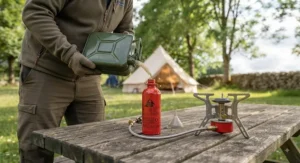
Topping up a stove’s fuel bottle from a jerrycan at the roadside is common practice for overlanders and long-distance campers, but it’s worth doing properly. UK guidance from the HSE notes that most fuel stations restrict customers to filling no more than two portable containers per visit as standard practice, and that any container used to carry petrol should be a proper UN-approved can rather than an improvised bottle — the fumes from an unsuitable container are a genuine fire risk even when it looks empty. When decanting from a jerrycan into a stove’s fuel bottle, do it away from any vehicle, ignition source, or lit stove, on the ground rather than in the boot of a car, since static electricity building up during pouring is a real, if often overlooked, ignition risk.
It’s also worth knowing your legal limits: current HSE guidance on carrying dangerous goods sets out that private individuals can typically carry a reasonable quantity of fuel in UN-approved containers without additional licensing, though home storage limits are lower and separately regulated — so a jerrycan or two in the car for topping up the stove on a trip is generally fine, but stockpiling large volumes at home is a different question entirely and worth checking against current local authority rules before you do it.
Petrol Camping Stove Reviews: What UK Buyers Actually Say
Pulling together aggregated review sentiment across the models in this guide, a few patterns repeat consistently regardless of brand or price point. Reviewers overwhelmingly rate the cost-per-use of petrol stoves as their strongest selling point over gas, specifically calling out how much cheaper forecourt unleaded works out over a season of regular camping compared to buying gas cartridges. The second most consistent theme is that priming genuinely does get easier with practice — first-time users report frustration, but repeat owners across nearly every model describe the ritual becoming second nature within a handful of uses. On the negative side, jet clogging from lower-grade fuel is the single most repeated complaint across the Coleman and Primus ranges specifically, reinforcing that regular cleaning isn’t optional maintenance, it’s baseline upkeep. It’s worth being clear that these are genuine aggregated themes drawn from real product reviews and outdoor forums rather than any single verified review database, since not every retailer publishes review counts consistently — where we couldn’t verify a specific figure, we’ve described the sentiment rather than inventing a star rating.
Common Mistakes When Buying a Petrol Camping Stove
The single most common mistake is buying based on weight alone without checking fuel flexibility — a hiker who buys the lightest available stove only to discover it can’t run on gas canisters for a summer trip has bought the wrong tool for at least half their camping calendar. A close second is underestimating running costs of dedicated camping fuel versus forecourt unleaded; some multi-fuel stoves perform noticeably better on branded liquid fuel, which erodes the cost advantage that drew buyers to petrol stoves in the first place. Buyers also frequently skip checking spares availability, only discovering after a generator clogs on a trip that the specific part isn’t stocked locally. Finally, a genuinely underrated mistake is not practising priming at home before a first trip — the learning curve is real, and a windy campsite at dusk is the worst possible place to be reading the instructions for the first time.
Long-Term Cost, Maintenance & Features That Actually Matter
Total cost of ownership tells a very different story to sticker price alone. A £50 Sportster II run mostly on forecourt unleaded will, over several seasons of regular use, likely cost less overall than a £25 gas stove burning cartridges at several pounds each — the break-even point typically arrives within a season or two of regular weekend camping, after which the petrol stove is effectively cheaper to run indefinitely. Maintenance costs are modest but real: budget for a replacement pump cup or O-ring roughly annually, and a spare generator every couple of seasons if you’re running on unleaded rather than dedicated fuel.
On features, self-cleaning jets — as found on the MSR WhisperLite range and the Optimus Nova+ — are worth genuinely prioritising, since they remove the most common maintenance headache almost entirely rather than just making it easier. Marketing-driven features worth filtering out, on the other hand, include elaborate piezo ignition systems on liquid fuel stoves specifically, since priming already requires a match or lighter and the piezo rarely survives repeated fuel exposure as well as advertised. Genuinely useful, less-hyped features include clearly marked, colour-coded jets for different fuel types (present on the Primus OmniFuel II and MSR Universal), which materially reduce the chance of fitting the wrong jet in poor light at a cold campsite.
Frequently Asked Questions
❓ Is a petrol camping stove better than gas?
❓ Can I use normal unleaded petrol in a camping stove?
❓ How much does a petrol camping stove cost in the UK?
❓ Are petrol camping stoves safe to use?
❓ Do petrol stoves work better than gas in winter?
Conclusion
A petrol camping stove isn’t the right choice for everyone — if you camp exclusively in summer, at fixed pitches, within easy reach of a shop, a simple gas burner will serve you just as well with far less faff. But for anyone who camps across seasons, travels somewhere gas cartridges aren’t guaranteed, or is simply tired of the ongoing cost of buying canister after canister, the case for liquid fuel is genuinely strong. Budget campers are well served by the Coleman Unleaded Sportster II or Kovea Booster +1, families get real value from the Coleman Unleaded Two-Burner‘s twin-ring speed, and anyone heading further off-grid should look seriously at the MSR WhisperLite range, the Optimus Nova+, or the Primus OmniFuel II depending on budget and how much fuel flexibility you actually need. Whichever you land on, practise the priming ritual at home before your first trip, keep the jet clean, and treat every fill-up with the respect flammable liquid deserves — do that, and a petrol stove will likely outlast several generations of gas cartridges in your camping kit.
Recommended for You
- Best White Gas Stove for Backpacking: 7 Top Picks for 2026
- 7 Best White Gas Stoves for High Altitude in 2026
- Multi-Fuel Stove For Cold Weather: 7 Proven Picks for 2026
Disclaimer: This article contains affiliate links. As an Amazon Associate, I earn from qualifying purchases. If you purchase products through these links, we may earn a small commission at no additional cost to you.
✨ Found this helpful? Share it with your friends! 💬🤗
