
In This Article
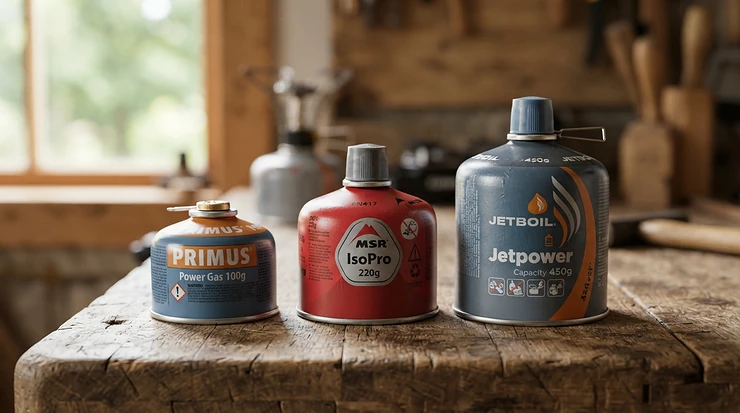
Camping gas canisters under £10 are sealed, single-use cartridges of butane, isobutane and propane that fuel portable camping stoves. Most hold 100g to 230g and use the EN417 screw-thread valve, which closes itself when you unscrew the stove. At single-digit prices, they cover most weekend cooking.

Fuel is the least glamorous item in your kit and the one that can wreck a trip fastest. You can borrow a tent and layer up in a thin sleeping bag, but a stove with nothing to burn is an expensive paperweight. The good news is that the budget end of the market is genuinely decent. Screw-thread canisters are reportedly made by only a handful of factories worldwide, so the differences between a bargain can and a premium one usually come down to gas blend, labelling and how well the size suits your trip.
What trips people up is the connection type. The gap between pierceable and self-sealing valve cartridges catches out more first-timers than any other mistake, and it can leave you standing in a campsite shop holding the wrong can.
So here is how this guide works. I’ve compared seven real canisters using published specs, retailer information and aggregated review themes. I haven’t tested them myself, and I won’t pretend otherwise. Prices are ranges captured at the time of research, so check current price before buying. Along the way we’ll cover entry-level canister sizes, stove-canister compatibility, weekend trip fuel needs and what camping gas canister reviews tend to agree on, plus camping gas fuel for backpacking.
Quick Comparison: Camping Gas Canisters Under £10 at a Glance
| Product | Size | Connection | Best For | Price Range* |
|---|---|---|---|---|
| Go System PowerSource 220g | 220g | Screw-thread, self-sealing | Cheapest full-size fuel | Around £5-£8 |
| Coleman C300 Performance | 230-240g | Screw-thread, resealable | Mild-weather weekends | Around £8-£10 |
| Coleman C100 Xtreme | 97-100g | Screw-thread, resealable | Cold, short trips | High single digits |
| Primus Power Gas 230g | 230g | Screw-thread (EN417) | Spring and autumn camping | Around £8-£10 |
| Jetboil Jetpower 100g | 100g | Screw-thread, self-sealing | Jetboil users, solo trips | Around £7-£10 |
| Campingaz C206 GLS | 190g | Pierceable (not screw-thread) | Older Campingaz 206 stoves | Check per-can price |
| Zoozio 230g Butane-Propane Screw-On | 230g | Screw-thread, resealable | Multipack stockpiling | Check per-canister price |
*Ranges reflect what was visible at the time of research and vary by seller.
Reading across the table, the Go System PowerSource 220g and the Coleman C300 Performance are the value anchors. Both are full-size canisters that suit warm-season weekends. If your trips stretch into the shoulder seasons, the Primus Power Gas 230g earns its slightly higher price through an isobutane-heavy blend, while the Coleman C100 Xtreme is the pocket-sized cold-weather option. Jetboil owners should eye the Jetboil Jetpower 100g, though its fill is roughly 10% lighter than 110g rivals.
The Campingaz C206 GLS is a special case. It only suits stoves built for pierceable cartridges, so it’s the wrong choice for most modern backpacking stoves. The Zoozio 230g Butane-Propane Screw-On trades brand familiarity for multipack economy. If you remember one rule, make it this: match the valve first, the blend second and the size third.
💬 Just one click — help others make better buying decisions too!😊
Top 7 Camping Gas Canisters Under £10: Expert Analysis
1. Go System PowerSource 220g — lowest-cost route to a full-size can
The headline here is price per gram. A retailer listing for a Go System 220g threaded cartridge sat at around £5 at the time of research, making it the cheapest full-size option in this round-up. The 220g fill is a premium butane/propane mix (the High Performance variant adds isobutane for lower temperatures), with a threaded, self-sealing double-skin valve.
In practice, one UK retailer guide estimates a 230g canister gives roughly 40-50 minutes at full power, or about 20 boils of 500ml. That comfortably covers a weekend for two on a small stove. Go System sells several variants, so check the label for the exact blend before you buy.
Reviewers on the larger Go System 445g listing describe using it for campervan hobs and small screw-on burners with a kettle on top. One reviewer reported gas failing in freezing conditions abroad, a reminder that blend matters once temperatures drop. Verified review data for the 220g size specifically is thin, so treat that as a themed hint rather than a verdict.
Pros:
- ✅ Lowest price per gram in this round-up
- ✅ Self-sealing valve allows safe removal
- ✅ Full weekend capacity for two campers
Cons:
- ❌ Several variants make labels easy to confuse
- ❌ Cold-weather reliability depends on the blend
Price: around £5-£8 at the time of research. Value verdict: excellent for warm-season trips.
2. Coleman C300 Performance — widely stocked mild-weather workhorse
The Coleman C300 Performance is the canister you’ll find on the most shelves. It holds roughly 230-240g depending on the listing and is rated for use up to freezing point. The exact blend is described inconsistently: one Amazon listing says 60/40 butane/propane, while a retailer says 70/30. Treat the ratio as approximate.
The real-world meaning is simple. From May to September in Britain you’re unlikely to notice any difference, but as nights approach zero the pressure drops and the flame weakens. The resealable double-safety valve means you can swap it between stoves and lanterns without a leak.
One thing the spec sheet won’t tell you comes from a reviewer on Trailspace. They reported that the valve pin on Coleman cans sits slightly deeper than on some rival brands, which may prevent certain stoves from opening it. Older MSR PocketRocket variants, the Soto Windmaster and the BRS-3000T were named. That report dates from 2020, so check your stove’s compatibility before buying in bulk. Also note that some UK retailers restrict gas sales to over-18s.
Pros:
- ✅ Easy to find across UK retailers
- ✅ Resealable valve suits multiple appliances
- ✅ Good value for mild-season use
Cons:
- ❌ Quoted blend ratios vary between listings
- ❌ Weakens as temperatures approach freezing
Price: around £8-£10 (one major UK retailer’s Coleman gas range starts at about £8). Value verdict: dependable, provided your stove accepts it.
3. Coleman C100 Xtreme — pocket-sized and built for the cold
The Coleman C100 Xtreme holds about 97-100g in a can roughly 9 x 7cm, weighing around 194g in total. Coleman states its Xtreme blend keeps working down to -27°C, which is the big differentiator against standard Performance blends. Listing titles are inconsistent, with some saying Performance and others Xtreme, so check the label on the pack.
What does that mean at a campsite? A 100g can is a one-night, solo-cook proposition, or a sensible emergency spare. Jetboil’s own guidance suggests 100g gives around 12 litres of boiled water in its system, and other stoves will vary. If you’re heading up a hill in March with a small pot, this fits inside most cookware and won’t bulk out your pack.
I couldn’t verify a robust review sample for this listing, so I won’t attribute sentiment to it. What’s verifiable is the spec and the manufacturer’s cold-temperature claim.
Pros:
- ✅ Cold-weather blend rated to -27°C
- ✅ Small enough to nest inside a pot
- ✅ Resealable valve for repeated stove swaps
Cons:
- ❌ Highest cost per gram of the group
- ❌ Too small for multi-day cooking
Price: high single digits at the time of research. Value verdict: pay the premium only if cold matters.
4. Primus Power Gas 230g — isobutane-rich blend for shoulder seasons
The Primus Power Gas 230g uses an 80% isobutane, 20% propane mix. Primus states an operating range of -10°C to +25°C and a standard EN417 thread that fits most canister stoves. It also comes in 100g and 450g sizes, which makes it easy to scale up.
Isobutane vaporises at a lower temperature than butane (about -11.7°C versus roughly -1°C), so pressure holds better on a frosty April morning. Primus also claims fewer residues, which is marketing worth taking with a pinch of salt but plausible.
For verified sentiment, the retailer WildBounds names it a favourite for backpacking and wild camping, praising its behaviour in cold conditions and as the canister empties. That’s a retailer’s view rather than a buyer sample, and I couldn’t confirm a review count.
Pros:
- ✅ Isobutane-heavy blend suits cooler nights
- ✅ Three sizes for different trip lengths
- ✅ Standard thread fits most stoves
Cons:
- ❌ Sits on the £10 line depending on seller
- ❌ Not rated for deep winter
Price: often around £8-£10, tipping over at some sellers. Value verdict: best all-rounder if the price lands under £10.
5. Jetboil Jetpower 100g — maker-recommended fuel for Jetboil stoves
The Jetboil Jetpower 100g is a propane/isobutane four-season blend. Jetboil UK says the 100g size gives about 12 litres of boiled water. It has a self-sealing valve and nests inside Jetboil pots, which means you’re less likely to leave it behind.
Jetboil says it can only claim safe operation with its own fuel, though it also states that several other brands share the same mixture and valve. The Jetboil Jetpower 100g is an EN417 canister, so it screws onto virtually any standard stove.
The most consistent complaint among reviewers is quantity. Jetboil’s can holds 100g where MSR and others hold 110g, so you get roughly one fewer boil. A Packstack review from June 2026 scored it 7.5/10, praising compatibility while noting that trade-off.
Pros:
- ✅ Nests neatly inside Jetboil pots
- ✅ Four-season blend from the stove maker
- ✅ Works with any standard screw-thread stove
Cons:
- ❌ 100g fill is about 10% below 110g rivals
- ❌ Often costs more than generic cans
Price: around £7-£10 at the time of research. Value verdict: sensible for Jetboil owners, not essential for anyone else.

6. Campingaz C206 GLS — the pierceable legacy classic
The Campingaz C206 GLS holds 190g of an 80/20 butane/propane mix, but it isn’t a screw-thread can. It’s a pierceable cartridge made for Campingaz 206 stoves and lanterns, and it must be completely empty before you remove it. Otherwise the remaining gas escapes, which is why this is a specialist rather than universal choice.
If you own an older Bleuet-style or 206 stove, this is your canister. If you own a Jetboil, a Fire-Maple or anything with a threaded connector, it is the wrong purchase.
For sentiment, the Campingaz store page on Amazon UK showed a 3-pack at 4.8 stars from 116 reviews at the time of research. That’s a strong score on a modest sample.
Pros:
- ✅ Strong aggregated rating from a modest sample
- ✅ Suits classic Campingaz 206 stoves and lanterns
- ✅ Widely available across the UK
Cons:
- ❌ Cannot be removed until fully empty
- ❌ Incompatible with screw-thread stoves
Price: sold in packs, so work out the per-can cost, as I couldn’t confirm a single-can price. Value verdict: good for legacy stoves, otherwise skip.
7. Zoozio 230g Butane-Propane Screw-On — multipack value from a lesser-known seller
This one is sold by Zoozio Tv in 3-, 6- and 12-packs, with an EN417 screw-thread and resealable valve. The listing describes a butane-propane mix but doesn’t state the ratio. That matters, because cold-weather performance can’t be judged without knowing the blend. Treat it as warm-season fuel until proven otherwise.
Buyers on the listing report it working with a Fire-Maple stove and fitting inside a Jetboil pot. The self-closing valve gets particular praise, since older blue cans had to be used up before removal. One complaint concerned Prime delivery arriving late rather than the product itself.
The catch is pack pricing. Your total outlay may exceed £10, so compare on a per-canister basis. For a family stocking up for a summer of weekends, that can work out well.
Pros:
- ✅ Multipacks lower the per-canister cost
- ✅ Standard EN417 thread and resealable valve
- ✅ Buyers report fitting popular stoves
Cons:
- ❌ Blend ratio isn’t stated on the listing
- ❌ Lesser-known seller with limited brand history
Price: check the per-canister cost, as pack totals vary. Value verdict: fine for warm months, less so for cold.
Comparing these products side by side shows the trade-offs more clearly.
| Product | Fill | Cold Guidance | Valve Type | Best For |
|---|---|---|---|---|
| Go System PowerSource 220g | 220g | Premium mix; check variant | Threaded, self-sealing | Budget weekends |
| Coleman C300 Performance | 230-240g | Up to freezing point | Threaded, resealable | Summer camping |
| Coleman C100 Xtreme | 97-100g | Rated to -27°C (maker) | Threaded, resealable | Cold overnighters |
| Primus Power Gas 230g | 230g | -10°C to +25°C | EN417 threaded | Shoulder seasons |
| Jetboil Jetpower 100g | 100g | Four-season claim | Threaded, self-sealing | Jetboil users |
| Campingaz C206 GLS | 190g | Not directly comparable | Pierceable | Legacy Campingaz gear |
| Zoozio 230g Butane-Propane Screw-On | 230g | Not specified | Threaded, resealable | Multipack buyers |
The table makes one thing plain: only the Primus Power Gas 230g and the Coleman C100 Xtreme publish clear cold-weather figures. If your camping stretches beyond summer, those two are the safest bets. Meanwhile the Campingaz C206 GLS is an outlier on connection type, and the Zoozio 230g Butane-Propane Screw-On is the least transparent on blend.
✨ Ready to Stock Up?
🔍 Take your next trip further with fuel matched to your stove. Click any highlighted product name to check current pricing and availability, and make sure the connection type matches your stove before you buy.
Weekend Trip Fuel Needs: A Simple Calculator You Can Actually Use
Guessing fuel is how people end up eating cold beans. A better method is to count boils, then add a buffer.
Start with published benchmarks. A UK retailer guide suggests a 230g canister gives about 40-50 minutes of full-power burn, roughly 20 boils of 500ml. Jetboil says its 100g can boils around 12 litres in its own system. A reviewer on REI measured about 7g per half-litre boil in a Jetboil MiniMo, which stretches to roughly 14 boils per 100g in good conditions.
Now map that to a typical weekend for two:
- Friday dinner: 1-2 boils
- Saturday breakfast: 2 boils (porridge plus brews)
- Saturday lunch: 1 hot drink
- Saturday dinner: 2 boils
- Sunday breakfast: 2 boils
That’s around 8-10 half-litre boils. A single 230g canister covers it with plenty to spare, and a 100g can is marginal for two but comfortable for one. Add a 20% buffer for wind, cold and forgotten pasta.
Cold matters here too. Below about 5°C the propane in a blend burns off first, and performance falls as the canister empties. If you’re camping in spring or autumn, choose a can with a stronger cold blend or carry a small spare. Realistic weekend trip fuel needs are almost always less than beginners fear, but buffer matters more than precision.
Which Canister for Which Camper: Three Real-World Scenarios
These are illustrative profiles rather than named individuals, but each maps a budget, environment and frequency to a sensible pick.
The family car camper (four people, summer, six weekends a year). Cooking is frequent and big pots are the norm. The Zoozio 230g Butane-Propane Screw-On in a multipack lowers the per-canister cost, or the Coleman C300 Performance if you want a known brand. Warm-season blends are fine here, and weight doesn’t matter. Keep a spare in the car boot, but not in direct sun.
The solo backpacker (two nights in the Lake District, April). Weight and cold both matter. The Primus Power Gas 230g covers the trip with buffer, or the Coleman C100 Xtreme if you’re travelling ultralight and cooking sparingly. A cold spring night can slow a poorly blended can, so blend beats brand loyalty.
The festival camper with an older stove. If you’re using a Campingaz 206-style stove inherited from a relative, the Campingaz C206 GLS is the only match. Buy a small pack, use each can fully, and never try to force a screw-thread canister onto it.
The pattern across all three is that the right canister follows the stove and the season, not the price tag. A £5 can that doesn’t fit is more expensive than a £9 one that does.
Common Canister Problems and How to Fix Them
Most gas headaches have simple fixes. Here are the ones that crop up most often.
Problem: the flame weakens partway through cooking. As a canister empties or cools, pressure drops. Stand the can in a shallow bowl of lukewarm water (never a flame) or keep it in your jacket before use. Isobutane-heavy cans like the Primus Power Gas 230g cope better than butane-heavy ones.
Problem: hissing when you attach the stove. A brief hiss as threads engage is normal, but a persistent one means a bad seal. Turn the stove off, unscrew, check the rubber seal for grit, and try again outdoors, away from flames.
Problem: the stove won’t screw on or won’t open the valve. This usually comes down to thread type or valve depth. If you’ve bought a Campingaz C206 GLS for a screw-thread stove, it won’t fit, full stop. If you’ve got a screw-thread can that won’t open the valve, a Trailspace reviewer’s report suggests valve pin depth can differ between brands.
Problem: the canister frosts over. Rapid evaporation chills the can. Lower the flame, use a windshield sparingly and never wrap the can in foil.
Problem: you can smell gas. Move away from any ignition source, turn the stove off and check the connection outdoors. If in doubt, don’t use it.
How to Choose Camping Gas Canisters Under £10
Follow these six steps in order, and you’ll rarely buy the wrong can.
- Identify your stove’s connection. Screw-thread (EN417), Easy-Clic or pierceable? This is non-negotiable, because a mismatch makes everything else irrelevant.
- Check the season. Butane-heavy blends are fine in summer, but choose isobutane-rich or “Xtreme” blends for spring, autumn or higher ground.
- Match the size to your trip. Use the boil-counting method above rather than guessing.
- Compare per-gram cost, not sticker price. A £5 can with 220g beats a £7 one with 100g.
- Read the label on delivery. Variants often share near-identical names, and one wrong letter changes the blend.
- Check the seller. Third-party listings can vary, so favour clearly labelled products and check that delivery windows suit your trip.
Following this order saves money and frustration. It also filters out the most common trap: buying on price alone and discovering, at a windy pitch on Friday night, that the can doesn’t fit.
Camping Gas Canisters vs Other Fuel Types
Screw-thread canisters aren’t the only way to cook outdoors, and it’s worth knowing what else is out there.
| Type | Connection | Removable Part-Used? | Best For |
|---|---|---|---|
| EN417 screw-thread canisters | Screw-on Lindal valve | Yes | Backpacking, weekends |
| Campingaz Easy-Clic (CV Plus) | Push-and-turn | Yes | Campingaz stoves and grills |
| Pierceable cartridges (C206) | Pierces on attach | No, must be empty | Legacy Campingaz stoves |
| Thin bayonet butane cartridges | Bayonet fit | Varies | Tabletop stoves, blowtorches |
The screw-thread family wins on flexibility, because most lightweight stoves accept it and you can swap part-used cans freely. Pierceable cartridges are cheaper to make but lock you into using every gram before removal. Thin bayonet cartridges, found in supermarkets and DIY stores, are often cheaper for their contents, but a Lindal-style stove can’t connect to them, as one outdoor blogger pointed out.
For most UK campers, the screw-thread family is the sensible default, and that’s where every entry in this guide except one sits. The Campingaz CV 300 Plus (240g, Easy-Clic) is also popular but sat at roughly £11 on one listing, just above our ceiling.
Entry-Level Canister Sizes: 100g, 230g or 450g?
Entry-level canister sizes are simpler than they look. Most brands sell three: about 100g, 230g and 450g.
100g cans suit solo overnighters and emergency spares. Vango’s own guide puts a 110g can at about 35 minutes of burn on its stove, so it’s a one-night proposition. The Coleman C100 Xtreme and Jetboil Jetpower 100g both live here.
230g cans are the sweet spot for most UK campers. They give a weekend for two, fit inside many pots and stay light enough for a day pack. The Go System PowerSource 220g, Coleman C300 Performance, Primus Power Gas 230g and Zoozio 230g Butane-Propane Screw-On all sit here.
450g cans suit families or week-long trips, but they’re heavy and usually cost over our £10 ceiling. Vango’s figures put a 450g can at about 145 minutes on its stove.
A good entry-level rule is one 230g can for a weekend, one 100g can as a spare in cold weather, and a bigger can only when you’re cooking for four or more. Weigh the trade-off honestly, because carrying unused fuel is a tax on your shoulders.

Stove-Canister Compatibility: What Fits What
Stove-canister compatibility is the single biggest source of buyer regret. Get it right and everything else is easy.
- EN417 Lindal screw-thread: used by Jetboil, Go System, Coleman and most lightweight stoves, according to a UK retailer guide. Most cans in this article fit here.
- Campingaz Easy-Clic and CV Plus: designed for Campingaz appliances, with a push-and-turn connection. Not interchangeable with screw-thread stoves.
- Pierceable cartridges: the Campingaz C206 GLS and its ilk fit only stoves built for them.
- Cross-brand mixing: generally works within the EN417 family, but manufacturers’ stances differ. Jetboil says it can only claim safe operation with its own fuel, though it names several brands sharing the same mixture and valve.
Before you buy, look at your stove’s instructions and the connection type. The Camping and Caravanning Club’s advice on changing cartridges safely stresses knowing exactly how a cartridge fits your appliance. And do the swap outdoors, away from any naked flame.
If in doubt, take the stove to the shop, or check the listing for named stove compatibility. A two-minute check beats a wasted trip.
Camping Gas Fuel for Backpacking: Weight, Cold and Resupply
Camping gas fuel for backpacking is a game of grams. A full 230g canister weighs well over 350g in total, and the empty can still comes home with you. That’s why many hikers carry 100g cans on short trips.
Cold is the other constraint. Propane keeps pressure up in the cold, so blends with more propane and isobutane behave better. The Primus Power Gas 230g and Coleman C100 Xtreme both publish cold figures. Butane-heavy cans like the Coleman C300 Performance, rated to freezing point, are better left for summer.
Resupply matters too. Standard EN417 canisters are sold widely in outdoor shops, so you’re rarely stranded in the way you might be with proprietary fittings. Jetboil’s own guidance names other brands sharing its valve, which is handy if you find only a different can in a small shop.
Finally, remember where you cook. The British Mountaineering Council’s guidance on camping stove safety advises that gas stoves are generally safer than liquid or solid fuel ones, but still carry risk in enclosed spaces. Ventilate, stay out of your sleeping bag while cooking, and don’t block your only exit.
Camping Gas Canister Reviews: What Buyers Keep Saying
Camping gas canister reviews tend to circle the same handful of themes, and none of what follows is a direct quote. It’s aggregated sentiment from the listings I could verify.
Compatibility is the top talking point. Buyers praise cans that fit their stove first time, and complain loudly when they don’t. A Trailspace reviewer’s note about Coleman valve depth is a good example.
Self-sealing valves get consistent praise. Reviewers on the multipack listing describe the self-closing valve as a big improvement over older blue cans.
Fit inside cookware is a small joy. Several buyers note their canister nests inside a Jetboil pot, which is why the 100g and 230g sizes remain popular.
Cold performance divides opinion. One buyer on the Go System listing reported failure in freezing conditions, which supports the case for cold-rated blends.
Delivery complaints are about service, not product. A late Prime delivery is annoying but says nothing about the canister.
The caveat is that review pools for individual canister sizes can be thin, and I’ve flagged where I couldn’t verify a sample. Where reviews are scarce, spec sheets and stove compatibility matter more than star ratings.
Long-Term Cost: Cost per Boil and Storage
Sticker price is the obvious number, but cost per boil tells the real story. If a canister around £8 delivers the roughly 20 half-litre boils suggested for a 230g size, that works out at about 40p per boil. A £5 can with a similar fill drops to roughly 25p. These are illustrative sums rather than test results, since real figures vary with stove, wind and temperature.
Cost per gram is a useful cross-check. Smaller cans cost more per gram, so a 100g can is best treated as a convenience rather than a saving. A 230g can from the Go System PowerSource 220g or Coleman C300 Performance typically wins on this measure.
Storage protects your investment. Keep cans upright, out of direct sunlight and away from heat, and never leave one in a hot car boot. A canister with residue at the bottom is worth keeping as a spare, because you can still burn what’s left.
Multipacks like the Zoozio 230g Butane-Propane Screw-On cut the per-canister cost but tie up money in stock. If you camp six or more weekends a year, that’s sensible. If you go twice, buy one at a time.
Safety, Storage and Rules for Using Camping Gas
Gas is safe when treated with respect. Fire services are clear on the basics.
Cheshire Fire and Rescue’s camping safety advice says never to use fuel-burning devices such as stoves, heaters and lanterns inside a tent, because of carbon monoxide risk. Place your stove on an even, non-flammable surface, and always turn off the gas before changing a cylinder. Change cylinders outdoors where possible and store them outside, away from direct sunlight and freezing temperatures.
A few UK-specific points are worth knowing. Some retailers sell gas cartridges to over-18s only, and some restrict them to in-store purchase with ID. Campingaz listings on Amazon UK also carry an age restriction. Gas canisters generally can’t travel by air, so always check your airline’s rules before packing one.
Carbon monoxide is colourless, tasteless and odourless, and symptoms can mimic flu. If anyone feels unwell after cooking in an enclosed space, ventilate immediately and get to fresh air. And never dispose of a part-used can in household waste. Take it to a suitable recycling point.
FAQ
❓ Can I take camping gas canisters on a plane?
❓ Are 100g canisters worth it compared with a 230g can?
❓ Do I need the same brand of canister as my stove?
❓ Can I use budget canisters in winter in the UK?
❓ How many canisters do I need for a week's camping?
Conclusion
Camping gas canisters under £10 don’t need to be a gamble. The seven options here cover the main scenarios: the Go System PowerSource 220g for cheap warm-season weekends, the Coleman C300 Performance as the widely stocked all-rounder, the Coleman C100 Xtreme for small, cold trips, the Primus Power Gas 230g for shoulder-season reliability, the Jetboil Jetpower 100g for Jetboil owners, the Campingaz C206 GLS for legacy pierceable stoves, and the Zoozio 230g Butane-Propane Screw-On for multipack economy.
If you take three things away, make them these. Match the connection type to your stove before anything else. Choose the blend to suit the season, and size the can to the trip using the boil-counting method. Then buy a small buffer, store it safely and cook outdoors.
Prices and availability change, so check current price on each listing before you commit. And if your stove isn’t listed above, check its instructions for the connection type first. Nothing else in this guide matters until you’ve done that.
✨ Your next brew is just a click away! ⛺
🔥 Pick the canister that fits your stove and season, click any highlighted product name to check current pricing and availability, and get ready for a hot drink at sunrise.
Recommended for You
- Camping Gas For Cold Weather: 7 Best Picks for UK Winters (2026)
- Value Camping Gas Canisters: 7 Best Budget Picks UK (2026)
- Single Hob Portable Induction Cooker: 7 Brilliant UK Picks (2026)
Disclaimer: This article contains affiliate links. As an Amazon Associate, I earn from qualifying purchases. If you purchase products through these links, we may earn a small commission at no additional cost to you.
✨ Found this helpful? Share it with your friends! 💬🤗
