In This Article
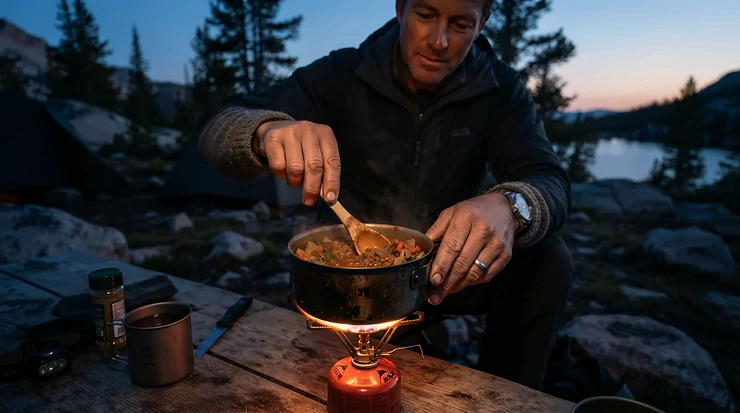
There is a particular kind of despair that arrives at 6:47am on a frosted campsite, when you’ve unzipped the tent, filled the pan, cracked the valve on your stove, and got… a wheeze. Not a flame. A wheeze, like the stove has caught your cold. This is the moment most people discover that camping gas for cold weather is not the same product as camping gas for a balmy July bank holiday, even though it often looks identical sitting on the shelf at the outdoor shop.
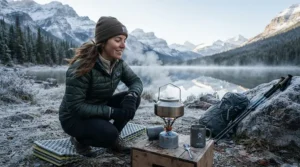
The culprit is physics, not bad luck. Gas canisters rely on liquid fuel turning into vapour inside a sealed tin, and that process needs warmth to happen efficiently. Drop the temperature far enough and ordinary butane simply refuses to play along, leaving you with cold porridge and a bruised sense of competence. Britain’s shoulder seasons — those long, damp stretches either side of summer — are exactly where this problem bites hardest, because you’re neither in reliable summer warmth nor prepared with proper winter kit.
This guide walks through what actually determines whether your stove lights on a frosty morning: the difference between a camping gas canister and a refillable bottle, how to read canister sizes without guessing, why vaporisation in low temperatures is the whole ballgame, some genuinely useful insulation tricks, and how to gear up sensibly for shoulder-season trips. Along the way we’ll look at seven real fuel systems that between them cover budget runabouts, mid-range four-season blends, and the liquid-fuel setups serious winter campers reach for. Prices below are given as ranges rather than fixed figures, since retailer pricing shifts constantly — always check the current price before buying.
What Is Camping Gas For Cold Weather?
Camping gas for cold weather is LPG fuel — usually a blend of isobutane and propane, sometimes with added butane — specifically formulated or selected to keep vaporising and producing usable pressure when air temperatures drop towards or below freezing. Standard summer butane loses effectiveness well before that point, so cold-weather blends lean on gases with much lower boiling points.That gap matters more than it looks. Once ambient temperature drops below a fuel’s boiling point, it stops turning into usable gas efficiently, and your stove starts to sputter or die entirely. This is the single most important thing to understand before buying anything below.
Quick Comparison Table
| Product | Fuel Type | Cold-Weather Rating | Best For |
|---|---|---|---|
| Coleman C500 Performance | 70/30 butane/propane | Down to around 0°C | Budget three-season campers |
| Primus Power Gas 230g | 80/20 isobutane/propane | Down to around -10°C | All-round shoulder-season use |
| Jetboil Jetpower 230g | Isobutane/propane 4-season blend | Reliable below freezing | Jetboil systems, fast boils |
| MSR IsoPro 227g | 80/20 isobutane/propane | Consistent to canister’s last gasp | Serious canister stove users |
| Kovea Spider (remote stove + canister) | Any EN417 canister, invertible | Down to roughly -9°C liquid-feed | Winter backpacking on a budget |
| MSR WhisperLite Universal + fuel bottle | White gas / unleaded petrol / canister hybrid | Effective well below -20°C | Expedition and deep-winter camping |
| Optimus Polaris OptiFuel | Canister, propane, or liquid fuel | Genuine four-season, sub-zero | Multi-fuel flexibility, travel abroad |
Looking at the spread above, the pattern is fairly blunt: pure butane canisters like entry-level Coleman fuel are fine for most of the British camping calendar but start to struggle exactly when shoulder-season mornings turn properly cold. The isobutane/propane blends in the middle of the table buy you real headroom into single-digit and sub-zero temperatures without demanding you learn a new skill set. The liquid-fuel systems at the bottom exist for a different kind of trip entirely — genuine winter camping, snow-melting, or anywhere a failed stove isn’t just inconvenient but risky.
💬 Found this comparison useful? Bookmark it before your next cold snap catches you out!
Top 7 Camping Gas Options: Expert Analysis
1. Coleman C500 Performance — the safe, familiar starting point
The Coleman C500 Performance is the canister most people already own without necessarily choosing it — it’s the one your local outdoor shop stocks by the shelf-load, and for good reason. It uses the EN417 Lindal valve standard, the near-universal threading fitting Jetboil, Primus, MSR, Vango, and most modern lightweight stoves, which fits Jetboil, Primus, MSR, Vango, and most modern lightweight stoves, so compatibility is never the issue here.
Under the cap, the C500 Performance runs a 70/30 butane/propane blend manufactured at Coleman’s own factory in Lyon, a detail that means quality is consistent rather than outsourced across contract manufacturers. In practice, this translates to dependable performance from March through October, but propane’s contribution starts doing the heavy lifting once October evenings dip — and truly cold conditions, the kind you’d meet camping in the Cairngorms in January, will need something with a higher isobutane content. Reviewers consistently note that this canister lights first time and burns cleanly in typical UK weekend conditions, with complaints clustering specifically around frosty mornings rather than general reliability.
Who should buy it: anyone doing standard three-season UK camping — festivals, family trips, Duke of Edinburgh expeditions in spring or autumn — where genuinely sub-zero cooking isn’t on the cards. Anyone eyeing a late-October or November trip should treat this as a warm-weather companion, not the whole solution.
Pros:
- ✅ Universal EN417 fitting works with almost every major stove brand
- ✅ Consistent factory quality, widely stocked across UK retailers
- ✅ Reliable performance across the core camping season
Cons:
- ❌ Butane-heavy mix struggles once temperatures approach freezing
- ❌ Not the canister to rely on for winter or high-altitude trips
At around £6-£9 for the standard mid-size canister, the Coleman C500 Performance represents solid value for anyone who camps mostly in the warmer months and just wants a canister that won’t let them down.
2. Primus Power Gas 230g — the shoulder-season workhorse
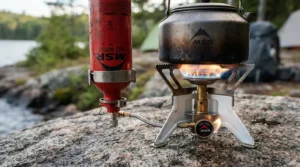
If there’s a canister built specifically to answer the “camping gas for cold weather” question without pushing you into liquid-fuel territory, it’s this one. The Primus Power Gas 230g uses a carefully balanced 80% isobutane, 20% propane mixdesigned for use with most camping stoves available on the market, and Primus states it delivers reliable performance from -10°C to +25°C.
That -10°C figure is worth pausing on. Isobutane’s much lower boiling point compared with plain butanemeans it performs well in colder temperatures and offers a stable flame, and because propane adds even more headroom on top, this blend genuinely covers the awkward months — late September through to early spring — that catch out butane-only canisters. Based on the spec comparison with the Coleman above, the trade-off is a slightly higher price point for meaningfully better cold-weather margin, which is exactly the swap most shoulder-season campers should be happy to make.
Aggregated retailer feedback and product data consistently describe this canister as the “most versatile blend” in the Primus range, sitting between the summer-only and genuinely arctic options. It’s also worth noting for sustainability-minded buyers that Primus offsets emissions from this fuel through a forestry project, a detail that occasionally sways buyers choosing between near-identical isobutane blends.
Who it’s for: hillwalkers, wild campers, and anyone doing multi-day trips where the forecast might swing from a mild afternoon to a hard overnight frost — which, frankly, describes most of the British outdoor calendar outside midsummer.
Pros:
- ✅ 80/20 isobutane/propane mix rated to -10°C
- ✅ Available in 100g, 230g and 450g to match trip length
- ✅ Carbon-neutral fuel with self-sealing safety valve
Cons:
- ❌ Costs more per gram than basic butane canisters
- ❌ Below around -10°C, performance still tails off without warming tricks
Expect to pay somewhere in the £6-£9 range for the 230g size, with the smaller and larger sizes priced proportionally — solid value given the extended temperature window you’re buying into.
3. Jetboil Jetpower 230g — built for fast boils when it’s freezing
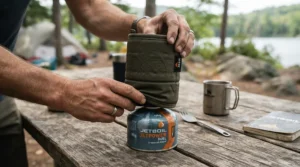
The Jetboil Jetpower 230g canister is designed around one obsession: getting water boiling fast, even when conditions are against you. Jetboil describes it as a high-performance propane/isobutane blend designed for efficient outdoor cooking, delivering reliable performance even in cold weather, and rates the 230g size at approximately 24 litres of water-boiling capacity.
What the spec sheet won’t tell you outright, but retailer performance charts do, is how boil count degrades with fuel level — one UK stockist’s own testing shows the canister delivering roughly 55 boils at full capacity, dropping to 41 at 75%, 27 at 50%, and just 13 boils once down to a quarter full. That’s a useful planning number: don’t assume a “half-used” canister gives you half the trips, because pressure and efficiency both fall away as the tin empties, especially in the cold.
Reviewers are split along predictable lines: those using it in ordinary UK autumn or spring conditions report it working brilliantly with Jetboil’s own integrated cooking systems, while a smaller group testing it at or below freezing describe noticeably slower burns — one aggregated review on a major retailer explicitly flagged poor performance in low temperatures, underlining that even a “four-season” canister has its limits once you’re deep into proper winter.
Who it’s for: Jetboil system owners who want matched, warrantied fuel, and anyone prioritising fast hot drinks over long simmering — this is not the canister for a leisurely fry-up, but it is the one for melting snow into drinking water quickly.
Pros:
- ✅ Optimised specifically for Jetboil’s heat-exchanger cooking systems
- ✅ Clear boil-count data available for trip planning
- ✅ 4-season blend with genuinely useful cold-weather vapour pressure
Cons:
- ❌ Some users report sluggish performance right at or below 0°C
- ❌ Jetboil canisters run slightly less fuel-dense than direct rivals like MSR
Pricing generally sits in the £7-£12 range for the 230g size depending on retailer promotions — a fair mid-tier price for a fuel matched precisely to a popular cooking system.
4. MSR IsoPro 227g — the purist’s cold-weather canister
MSR pitches the IsoPro 227g as containing an 80/20 blend of isobutane and propane… clean burning, delivering superior performance throughout the life of the canister and in colder temperatures. What sets it apart from broadly similar 80/20 blends on this list is purity: MSR’s isobutane fraction is described elsewhere as containing very little n-butane contamination, which is the technical reason this fuel keeps its pressure curve flatter as the canister empties.
Here’s what most buyers overlook about this spec sheet: MSR publishes an actual pressure curve rather than a vague marketing claim, noting the fuel maintains pressure from 55psi per gram down to 30psi per gram, so it functions well even as the canister empties. That’s a genuinely useful number if you’re the kind of camper who plans fuel budgets to the gram for multi-day trips, because it tells you performance doesn’t cliff-edge halfway through a canister the way cheaper blends sometimes do.
The built-in float gauge is a small but real quality-of-life feature — dunk a partially-used canister in water and the printed markings show roughly how much fuel remains, useful for deciding whether to pack a spare. Reviewers consistently rate this among the most dependable canister fuels for serious backpacking use, with the most common complaint being price rather than performance.
Who it’s for: anyone running an MSR PocketRocket, WindPro, or similar canister stove who wants the fuel engineered specifically alongside their equipment, plus anyone doing multi-day trips where predictable fuel depletion matters.
Pros:
- ✅ Purer isobutane blend maintains pressure more consistently
- ✅ Published pressure curve aids realistic fuel-planning
- ✅ Built-in float gauge shows remaining fuel level
Cons:
- ❌ Among the pricier canister options on this list
- ❌ No meaningful advantage over rivals once genuinely sub-zero
Expect to pay in the £8-£11 bracket for the 227g size — a premium over basic butane, though one that buys measurable consistency for anyone tracking fuel use closely.
5. Kovea Spider (remote canister stove system) — inversion changes the game
This entry works a little differently from the others because the Kovea Spider is a stove rather than a fuel — but it belongs on this list because it fundamentally changes what “cold-weather gas” even means. Unlike an upright canister stove where the burner screws directly onto the tin, the Kovea Spider connects via a hose, which lets you do something upright stoves can’t: invert the canister so it feeds liquid fuel rather than vapour into a preheat tube next to the burner, vapourising the liquid fuel before it reaches the burner as gas.
Field testers report this genuinely extends the usable range of an ordinary EN417 canister; one reviewer measured it performing well while inverted at roughly 10 degrees Fahrenheit, about -12°C, and a gear-magazine test described the preheat loop as extending cold-weather performance down to about 15°F by letting you safely invert the canister to burn the fuel as liquid. On paper this means you can carry the same cheap, widely available canisters as everyone else and still cook when the mercury falls well below where an upright stove would give up.
There’s an honest caveat here worth stating plainly: reviewers disagree on how smoothly inversion actually goes. Some describe flawless performance, describing it as filling a gap in my winter kit… this does so flawlessly, while at least one reviewer reported sputtering just like the much cheaper option I could have purchased when inverted. The honest takeaway: it’s a genuine cold-weather upgrade over standard canister stoves, but not magic, and you still need to keep the canister warm enough to light before you invert it.
Who it’s for: winter backpackers and wild campers who want liquid-fuel-style cold performance without the weight, mess, or priming ritual of a full liquid-fuel stove.
Pros:
- ✅ Inverts to run canisters as liquid feed, extending cold performance
- ✅ Wide, stable legs support larger pots than upright canister stoves
- ✅ Lightweight (around 170-190g) for what it delivers
Cons:
- ❌ Inversion performance is inconsistent between individual units
- ❌ Requires warming the canister before you can safely invert it
Typical UK pricing for the Spider stove itself sits around £46-£65, on top of whatever canisters you already run — a mid-range outlay that buys meaningfully more cold-weather margin than swapping fuel blends alone.
6. MSR WhisperLite Universal with fuel bottle — the hybrid for serious winter trips
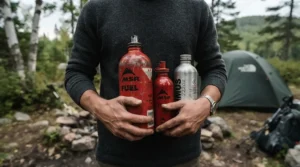
When canisters of any blend start to struggle, the MSR WhisperLite Universal is where experienced winter campers turn. MSR’s own description frames it plainly: the hybrid-fuel WhisperLite Universal stove delivers the ease and simmering capabilities of canister fuel, and switches easily over to liquid fuels for longer trips, cold-weather, and international use. It burns white gas, kerosene, or unleaded petrol from a refillable pump-pressurised bottle, sidestepping the vaporisation problem entirely because liquid fuel doesn’t need ambient warmth to reach the burner — a hand pump does the pressurising instead.
This is genuinely the answer to the “camping gas canister vs refillable bottle” question for anyone serious about deep-winter or international trips: MSR states the AirControl technology delivers outstanding performance with all compatible fuels, and one long-term UK user reported it kept cooking when the temperature dropped to –5°C on a week-long trek across the Isle of Skye even after running out of gas canisters entirely. That’s the core appeal: liquid fuel is sold in ordinary petrol stations worldwide, so you’re never hunting for a specific canister brand in a remote village.
The honest trade-off, and this is where the “vs” really bites: liquid-fuel stoves need priming, occasional field maintenance, and produce noticeably more soot than a clean-burning canister — one long-term reviewer noted plainly that it’s difficult to avoid getting sooty fingers when using it — if you want clean you should try gas. You’re also trading weight and simplicity for reliability at temperature extremes, which is exactly the calculation expedition campers are willing to make.
Who it’s for: winter mountaineers, expedition campers, and anyone travelling internationally where isobutane canisters of a known brand may not be available.
Pros:
- ✅ Genuinely reliable well below freezing, unlike any gas canister
- ✅ Runs on widely available fuel — petrol, kerosene, white gas
- ✅ Field-maintainable with self-cleaning jet technology
Cons:
- ❌ Sootier and messier than canister stoves
- ❌ Needs priming and more hands-on operation than screw-top canisters
Combo kits with a fuel bottle typically run in the £120-£160 range — a significant step up in price, but one that buys genuine four-season, any-fuel security that no canister blend can fully match.
7. Optimus Polaris OptiFuel — the multi-fuel all-rounder
Rounding out the list is a stove built around total flexibility. The Optimus Polaris OptiFuel is marketed as burning canister, propane, and liquid fuel interchangeably, with an all 4-season cold-weather mode and an ISPO award recognising its design for global expedition use.
Reviewers consistently note this bridges the gap between a lightweight canister setup and a dedicated liquid-fuel stove, essentially letting you carry one stove and decide at the last minute — or mid-trip — which fuel to use depending on what’s available and how cold it is. What most buyers overlook is what this flexibility actually buys in practice: if you start a trip in relatively mild conditions running an isobutane canister, and the forecast turns, you can switch fuel sources without swapping stoves or carrying two separate systems. That’s a meaningful weight and complexity saving for anyone doing genuinely variable-condition trips, like a spring trek that starts at sea level and finishes above the snowline.
The trade-off is complexity of a different kind: multi-fuel stoves have more parts, more potential failure points, and a steeper learning curve than a simple screw-on canister burner. This is a stove for people who’ve already decided winter and shoulder-season camping is a serious, recurring part of their outdoor life, not an occasional dabble.
Who it’s for: expedition planners, mountain guides, and frequent international travellers who need one stove to cover every fuel scenario they might encounter.
Pros:
- ✅ Genuinely burns canister gas, propane, or liquid fuel
- ✅ Purpose-built cold-weather mode for sub-zero reliability
- ✅ Includes cleaning needle for field maintenance
Cons:
- ❌ More expensive and complex than single-fuel alternatives
- ❌ Overkill for casual or fair-weather campers
Pricing typically sits in the £150-£200 range, positioning it as a premium, buy-once tool for anyone whose camping plans routinely span multiple seasons and countries.
Camping Gas Canister vs Refillable Bottle: Which Should You Actually Buy?
This is the decision most cold-weather campers get stuck on, so it deserves proper unpacking rather than a one-line verdict.
A camping gas canister — like the Coleman C500, Primus Power Gas, or MSR IsoPro above — is a sealed, non-refillable pressurised tin. You screw it onto a stove, use what you need, and either finish it or store it for next time. Its great strength is simplicity: no priming, no pump, no spilled fuel, and a clean burn that leaves your pots soot-free. Its weakness, as covered throughout this guide, is that it depends entirely on ambient temperature to vaporise the fuel inside — which is precisely why blend matters so much.
A refillable liquid fuel bottle, as used with the MSR WhisperLite Universal, sidesteps that dependency altogether. A hand pump pressurises the bottle mechanically, forcing liquid fuel through a line to the burner regardless of how cold the air is. This is why liquid-fuel stoves remain the choice for genuine expedition and deep-winter use — the fuel doesn’t care what temperature it is, only whether you’ve pumped enough pressure into the bottle.
The practical trade-offs stack up like this: canisters win on convenience, cleanliness, and low weight for weekend trips; refillable bottles win on cold-weather reliability, fuel availability abroad, and total cost over many trips, since a litre of unleaded petrol costs a fraction of an equivalent-energy gas canister. Reviewers and long-term users are consistent on one point — the ready availability of fuel and the reliability outweigh the downsides of liquid fuel for anyone doing serious cold-weather trips, even though canister stoves remain far more popular for ordinary UK camping because they’re simpler and cleaner to use.
If your camping rarely dips below freezing and you value simplicity, stick with a good isobutane/propane canister. If you’re planning genuine winter expeditions, multi-week international trips, or trips where fuel resupply is uncertain, a refillable liquid system like the WhisperLite Universal earns its extra weight and complexity.
Camping Gas Canister Size Guide For Buyers
Canister sizing confuses more first-time buyers than almost anything else in this category, mostly because the numbers on the label refer to fuel weight, not the size of the tin itself.
Gas canisters for backpacking stoves are commonly available in three sizes: 100g, 230g (or 227g for some brands) and 450g, referring to the net weight of fuel inside, with all three sizes using the same EN417/Lindal valve thread and interchangeable across compatible stoves — the size difference is purely fuel quantity, not connection type. That’s a genuinely useful thing to know: you’re never locked into one canister size by your stove.
To translate those numbers into real trip planning: during a typical weekend trip involving morning coffee, evening meals, and occasional brews throughout the day, a 230g canister comfortably serves one person for 2-3 days or two people sharing for 1-2 days, a rough but genuinely useful benchmark for most UK weekend campers. Solo overnight bivvies suit the 100g size, while base-camp cooking for a group justifies stepping up to 450g.
One detail that catches people out: total canister weight (fuel plus the metal tin itself) is always noticeably higher than the fuel weight printed on the label, which matters when you’re trying to work out how much usable fuel remains in a partially used canister by weighing it. A cheap kitchen scale and knowing the empty canister’s tare weight solves this instantly — MSR’s own IsoPro packaging even prints a float-gauge chart for exactly this purpose.
For cold-weather trips specifically, size your canister generously. Cold performance degrades faster as a canister empties, since the temperature of the actual canister matters — cold gas burns less efficiently, so melting snow and heating water take longer, so a “just enough” calculation done for mild weather can leave you short once frost sets in. Seasoned winter backpackers routinely pack a spare canister for exactly this reason, bringing at least two full small canisters or one full large canister for cold conditions on overnight trips.
Gas Vaporisation In Low Temperatures: The Science That Actually Matters
Understanding why gas canisters fail in the cold isn’t academic trivia — it directly informs which fuel and which techniques you should choose.The chain above is the whole story in one line: cold air stops the liquid boiling, which drops internal pressure, which starves the burner. Two variables sit under your control — which fuel you buy, and how warm you keep it — and both are cheaper fixes than buying a new stove.
There’s a second factor worth flagging: canisters get colder as you use them, sometimes visibly frosting on the outside, because the fuel absorbs heat energy as it evaporates — so a stove that lit fine can start struggling twenty minutes into a long simmer even if the air temperature hasn’t changed. This is why long snow-melting sessions in particular tend to stall out, and why experienced winter campers rotate between two canisters rather than running one continuously.
Isobutane’s real-world advantage over plain butane comes down to that boiling-point gap: butane stops vaporising altogether around -1°C, its boiling point, while isobutane continues vaporising effectively down to roughly -11.7°C. Add propane, which is useful down to around -10°C and delivers a higher pressure than butane, and a blended canister buys meaningful margin below freezing without switching fuel systems entirely.
Canister Insulation Tips That Actually Work
There’s a lot of folklore around insulating gas canisters, and some of it is genuinely useful while some of it is well-meaning nonsense. Here’s what’s grounded in real technique rather than internet myth.Working through those four steps in more detail: the simplest and most effective trick costs nothing — the simplest way to boost the effectiveness of your canister stove in the cold is to store the fuel in your sleeping bag or inside your jacket prior to use, which lets your own body heat pre-warm the fuel before it ever meets the burner. Do this the night before a frosty morning brew and you’ll notice the difference immediately.
Putting closed-cell foam or a section of a sleeping mat under the canister does two jobs at once: it stops heat leaching away into frozen ground, and it stops the canister toppling on uneven or icy surfaces — put some insulation under the canister, protect the stove from wind. A simple foam disc cut to size costs almost nothing and lives permanently in a stove bag.
The water-bath trick sounds counterintuitive but works on solid physics: to heat food or water using a canister stove in below freezing temperatures, all you need to do is place the canister in a small amount of water, because liquid water can’t drop below 0°C, which is comfortably above the point where isobutane stops vaporising, so the water acts as a stable heat reservoir feeding warmth into the canister throughout the cook. One important caution accompanies this and every other warming technique: make sure the canister doesn’t get more than hand warm, and never apply direct flame or any external heat source to a sealed pressurised canister — the goal is gentle ambient warming, not active heating, since canisters are only rated to withstand temperatures up to 50°C before the safety risk becomes real.
Finally, and this is more logistics than insulation, budget for redundancy: for one-night trips bring at least two full small canisters or one full large canister for cold conditions, because cold performance genuinely degrades faster as a canister empties, and running out of usable pressure with no backup is a far bigger problem in December than in June.
Shoulder-Season Camping Gear: Building The Rest Of Your Kit
Fuel is only half the cold-weather equation — the stove and canister choices above only pay off if the rest of your shoulder-season setup is pulling its weight too.
Sleep system first. If you’re feeling cold in your tent, wrap up with extra layers, and if you’re camping properly outside high summer, it’s worth considering a four-season sleeping bag and camping blanket for extra warmth. A stove that lights perfectly is no substitute for not being cold overnight in the first place — layer up before you reach for the gas.
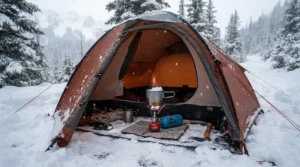
Ventilation is non-negotiable, whatever the temperature outside. This is the single most serious safety point in this entire guide, so it deserves blunt language: never use a stove inside a sleeping tent, and only cook in enclosed spaces you absolutely have to, ventilating as much as possible throughout. Camping stoves are essential kit for outdoor adventures, but they can also be dangerous if used incorrectly, and there have been many near-misses and serious incidents, especially when stoves are used inside enclosed spaces like tents and bothies. Carbon monoxide has no smell and no colour, and the warning signs — light-headedness, forgetfulness or confusion, dizziness, and headaches — can be mistaken for simple tiredness after a long day outdoors. If anyone starts to feel unwell after cooking in an enclosed space, ventilate immediately by opening a tent door or window to let the gas escape, and treat it as a genuine emergency, not a nuisance. Tragically, this isn’t theoretical: two climbers and three separate campers have died from carbon monoxide poisoning in tent-related incidents reported this year alone, and UK fire services have specifically warned that camping stoves are designed to be used outside only, cautioning against bringing them indoors even as an emergency heat source during cold snaps.
Windproofing matters more in shoulder season than in summer, because wind strips heat from both the flame and the canister simultaneously. Coastal paths, mountain ridges, and Scottish Highlands routinely experience strong gusts that turn basic stoves into frustrating gas-guzzlers, so a simple foil windscreen — kept clear of the canister itself, never wrapped around it — pays for itself many times over on an exposed pitch.
Layer your cooking plan around realistic timings. Cold gas burns less efficiently, so melting snow and heating water take longer than the summer boil-times printed on stove packaging, and building in extra time (and extra fuel) for shoulder-season cooking prevents the stress of a rushed, half-warmed meal in failing light.
💬 If this gear breakdown helped you plan your next trip, sharing it helps other campers avoid a cold, gas-starved morning too.
How To Choose Camping Gas For Cold Weather
Cutting through the marketing, here’s the practical decision process:
- Check the fuel blend first, not the brand. Look for isobutane and propane percentages on the label rather than trusting “winter” or “four-season” branding alone — an 80/20 isobutane/propane mix genuinely outperforms a 70/30 butane/propane mix in the cold, whatever the packaging claims.
- Match canister size to trip length, not habit. Oversizing slightly for cold trips is cheap insurance against mid-trip pressure loss; running a 100g canister down to its last 25% in freezing conditions is a common cause of failed morning brews.
- Decide whether you need liquid fuel at all. If your coldest trips rarely dip below -5°C, a good isobutane blend is genuinely sufficient; below that, a remote inverting stove or a full liquid-fuel system starts paying for itself.
- Factor in where you’re travelling. International trips, especially anywhere canister availability is uncertain, tip the balance towards a multi-fuel or liquid system that can run on locally available petrol.
- Buy a spare before you need it. The single most common cold-weather stove failure isn’t a bad canister — it’s an empty one with no backup.
- Practise the warming technique before you’re relying on it. Learning to use a water bath or body-warming trick on a cold morning at home is far less stressful than discovering it for the first time on a mountainside.
- Check compatibility. Confirm your stove and canister share the same EN417 threaded fitting; this covers the vast majority of brands sold in the UK, with a small number of proprietary exceptions worth checking before you buy.
Common Mistakes When Buying Camping Gas For Cold Weather
The same handful of errors show up again and again in forums and reviews, and most are easy to avoid once you know to look for them.
Buying on brand loyalty rather than blend. A trusted brand’s basic butane canister will still struggle in the cold — what matters is the isobutane/propane percentage printed in small text, not the logo on the tin.
Assuming a half-used canister has half the performance. As covered above, boil count and available pressure both fall away disproportionately as a canister empties, especially in cold weather — a “half full” canister in December can behave more like a quarter-full one in June.
Ignoring canister size for the trip length. Buyers frequently underbuy fuel for cold trips because they’re mentally pricing for summer consumption, not accounting for slower boils and the temptation to run the stove longer for warmth.
Storing canisters in an exterior rucksack pocket. Carrying the canister deep inside your rucksack, not in an outside pocket, keeps it insulated by your other gear; an outer pocket exposes it directly to wind chill all day.
Trying to heat a canister with direct flame. This bears repeating because it’s a genuine safety hazard rather than a performance tip: never attempt to heat a cold fuel canister with flame or any direct heat source — gentle ambient warming only.
Overlooking liquid-fuel options out of unfamiliarity. Many campers assume liquid-fuel stoves are only for mountaineering experts, when in practice they’re simply a different, more hands-on tool — genuinely worth it for anyone whose trips regularly meet sub-zero mornings.
Practical Usage Guide: Setting Up Cold-Weather Gas Cooking
Getting a cold-weather setup right in your first few outings prevents most of the frustration new buyers report.
Before you leave home: weigh your canisters (empty tare weight noted on the base, or found from the manufacturer) so you can check remaining fuel by weighing on a small kitchen scale mid-trip. Pack at least one spare canister for any trip where overnight temperatures might approach freezing, and test your stove’s ignition at home rather than discovering a faulty piezo igniter for the first time on a frosty morning.
On arrival at camp: pitch with the stove’s cooking area sheltered from wind but never inside the sleeping compartment of the tent. If you’re using an upright canister stove, place a foam pad or similar under the canister before connecting it, both for stability on frozen or uneven ground and for a first layer of insulation.
Overnight: bring the canister you’ll use for the morning brew into your sleeping bag or a warm layer of clothing rather than leaving it in the tent porch overnight — this single habit solves the majority of “why won’t my stove light” complaints on cold mornings.
During extended cooking or snow melting: rotate between two canisters if you have them, giving each a chance to recover some ambient warmth while the other is in use, and keep sessions shorter than you would in summer to avoid the canister cooling faster than the air around it.
Common first-30-days mistakes to avoid: running a single canister down to empty before realising performance had already degraded well before it ran dry; forgetting that self-sealing valves mean a partially used canister can be safely removed and swapped mid-trip; and packing only summer-rated butane for what turns out to be a genuinely cold trip.
Real-World Scenario: Matching Fuel To Camper Type
The weekend family camper, pitching at a lowland site March to October: the Coleman C500 Performance covers nearly every trip comfortably, with a spare canister only needed for a cold snap in early spring or late autumn.
The solo wild camper doing Lake District and Peak District overnighters year-round: the Primus Power Gas 230g, paired with genuine cold-weather technique (body-warming overnight, foam insulation underneath), handles the unpredictable shift from mild afternoons to hard frosts that defines British shoulder seasons.
The winter hillwalker heading into the Scottish Highlands for multi-day trips below freezing: either the Kovea Spider run inverted on standard canisters, or for anyone melting significant snow for water, the MSR WhisperLite Universal — the added weight and complexity earns its keep the moment temperatures drop hard enough that canister blends alone stop being reliable.
Long-Term Cost & Maintenance
Canister fuel carries no maintenance burden beyond storage in a cool, dry place away from direct sunlight, but it does carry an ongoing per-use cost that liquid fuel undercuts substantially over time. A 230g isobutane canister at roughly £6-£9 delivers around 20-24 litres of boiled water depending on conditions; liquid fuel bottles refilled with ordinary unleaded petrol cost a fraction of that per litre of boiled water once you own the stove and bottle outright. For occasional weekend campers, canisters remain the more economical overall choice once the low upfront stove cost is factored in. For frequent, multi-week, or expedition-length users, the higher upfront cost of a liquid-fuel or multi-fuel stove like the MSR WhisperLite Universal or Optimus Polaris OptiFuel is typically recovered within a season or two of regular use, purely on fuel cost.
Safety, Regulations & Compliance Guide
A few regulatory and safety points are worth knowing before you buy or travel with camping gas.
Standards: the vast majority of screw-top gas canisters sold in the UK and Europe comply with the EN 417 standard, which governs non-refillable metallic cartridges for liquefied petroleum gases and covers the Lindal valve threading shared by MSR, Primus, Jetboil, GSI Outdoors, Coleman, and SOTO. Campingaz is the main exception, using a proprietary bayonet fitting rather than the standard thread.
Carrying gas by rail, road, and ferry: small gas cartridges are routinely carried in rucksacks on UK domestic rail and road without issue, though quantities and rules tighten for ferries and international travel — always check your specific carrier’s current policy before travelling with fuel.
Air travel: gas canisters of any kind cannot be carried in checked or hand luggage on commercial flights; buy locally at your destination instead.
Storage at home: the Health and Safety Executive publishes guidance for small-scale users of LPG in cylinders, noting that LPG is heavier than air and can collect in drains, gullies, and cellars if it leaks — store spare canisters upright, away from heat sources, and in a well-ventilated space.
In-tent safety: the British Mountaineering Council’s technical committee is unambiguous on this point — the main risks of camping stoves include fire, trapped escape routes if a stove malfunctions or is knocked over, and carbon monoxide poisoning from incomplete combustion, and the safest practice remains cooking outside the sleeping compartment wherever conditions allow.
Frequently Asked Questions
❓ What temperature does camping gas stop working?
❓ Is isobutane or propane better for cold weather camping?
❓ Can I use a regular gas canister in freezing temperatures?
❓ Do I need a liquid fuel stove for UK winter camping?
❓ How do you keep a gas canister warm while camping?
Conclusion
Cold-weather camping gas isn’t really about buying the most expensive canister on the shelf — it’s about matching fuel chemistry, canister size, and technique to the actual conditions you’ll meet. For most British campers navigating typical shoulder-season chills, a well-chosen isobutane/propane blend like the Primus Power Gas or MSR IsoPro, combined with simple warming habits, solves the problem entirely. For genuine winter expeditions or international travel, stepping up to an inverting remote stove like the Kovea Spider or a full liquid-fuel system like the MSR WhisperLite Universal buys a level of reliability that no canister blend alone can match.
What ties every product on this list together is the same underlying physics: vaporisation needs warmth, and everything from fuel selection to insulation tricks to stove design exists to manage that one variable. Get that right, and a frosty morning becomes a mildly satisfying inconvenience rather than a cold, porridge-less start to the day. Whichever system you choose from the seven above, always check the current price before buying, since availability and promotions shift constantly across UK retailers.
✨ Ready to gear up for whatever the forecast throws at you this season? Check the current prices on the picks above and get your cold-weather cooking sorted before the next frost catches you out! 🔥⛺
Recommended for You
- Value Camping Gas Canisters: 7 Best Budget Picks UK (2026)
- Single Hob Portable Induction Cooker: 7 Brilliant UK Picks (2026)
- Portable Induction Hobs Under £100: 7 Best UK Picks (2026)
Disclaimer: This article contains affiliate links. As an Amazon Associate, I earn from qualifying purchases. If you purchase products through these links, we may earn a small commission at no additional cost to you.
✨ Found this helpful? Share it with your friends! 💬🤗
