
In This Article
There’s a particular kind of suffering that only British campers know. You’ve just scrambled up a rain-lashed fell in the Lake District, your waterproofs are doing their valiant best, and all you want — with every fibre of your soggy being — is a hot brew and something edible. That’s the precise moment your cheap stove decides to splutter, cough, and produce a flame roughly equivalent to a birthday candle. Sound familiar?
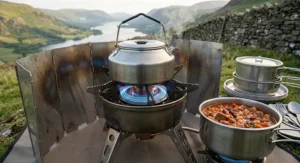
A genuinely good high output camping stove changes everything. We’re talking about stoves that deliver serious heat — measured in watts (W) or BTU per hour — and critically, stoves that keep delivering that heat when the wind is doing its worst across Dartmoor or the Cairngorms. In practice, a high output camping stove is one that produces 2,500W (roughly 8,500 BTU/h) or more from a single burner, can boil a litre of water in under five minutes, and maintains meaningful performance in the breezy, damp conditions that define outdoor cooking in Britain.
This guide cuts through the noise. We’ve researched seven real, currently available products on Amazon.co.uk — covering everything from budget-conscious backpacking stoves under £50 to precision-engineered systems north of £130 — and given you the expert commentary that matters for UK buyers: wind resistance, fuel availability in British outdoor shops, cold-weather performance in March on Snowdonia, and whether the whole thing packs down small enough for your already-overstuffed rucksack.
Whether you’re a weekend wild camper in the Scottish Highlands, a festival-goer in a Somerset field, or a Duke of Edinburgh supervisor quietly dreading another fortnight in the Brecon Beacons, there’s a stove here for you. Let’s get into it.
Quick Comparison Table: High Output Camping Stoves at a Glance
| Stove | Output | Boil Time (1L) | Weight | Price Range | Best For |
|---|---|---|---|---|---|
| Jetboil Flash 1.0L | 1,500W / 5,100 BTU | ~4–5 min | 371g | £100–£130 | Speed & wind resistance |
| MSR PocketRocket Deluxe | 3,260W / 11,000 BTU | ~3.5 min | 83g | £70–£90 | Ultralight versatility |
| MSR WindBurner Personal | 1,800W / 6,100 BTU | ~4.5 min | 415g | £120–£160 | Extreme wind conditions |
| SOTO WindMaster | 2,800W / 9,500 BTU | ~4 min | 67g | £60–£80 | Windproof + ultralight |
| Primus Firestick | 2,500W / 8,500 BTU | ~3.5 min | 105g | £75–£100 | Regulated cold-weather use |
| Campingaz Twister Plus | 2,600W / 8,900 BTU | ~4.5 min | 100g | £25–£45 | Budget-conscious campers |
| Coleman FyreStorm PCS | 2,200W / 7,500 BTU | ~4–6 min | 390g incl. pot | £45–£65 | Beginners, all-in-one |
What jumps out from this table is the enormous range of output versus weight trade-offs on offer. The MSR PocketRocket Deluxe packs 11,000 BTU into 83g — an almost absurd power-to-weight ratio — but leaves you to sort your own cookware. The Jetboil Flash, meanwhile, weighs considerably more but hands you a complete, wind-resistant system right out of the box. Budget buyers should note that the Campingaz Twister Plus delivers respectable performance at a fraction of the premium price — though it will feel the wind rather more acutely than the integrated systems above it.
✨ Don’t Miss These Exclusive Deals!
🔍 Take your camping setup to the next level with these carefully selected high output camping stoves. Click any highlighted product name to check current pricing and availability on Amazon.co.uk — these picks have been chosen to help you find exactly what you need, whatever the British weather has planned.
💬 Just one click — help others make better buying decisions too! 😊
Top 7 High Output Camping Stoves: Expert Analysis
1. Jetboil Flash 1.0L Fast Boil System
The Jetboil Flash is one of those stoves that turns up on every serious kit list for a reason: it does exactly what it says on the box with minimal fuss, which is exactly what you need when you’re fumbling with freezing fingers somewhere above 600 metres.
The integrated FluxRing system is the key here — a heat exchanger built into the base of the 1.0-litre cooking cup that concentrates heat transfer brilliantly and significantly reduces fuel waste. Rated at around 1,500W with its regulated burner, the Flash won’t win a raw BTU contest, but the clever enclosed design means that output stays surprisingly consistent in gusting winds that would leave a conventional burner whimpering. In real-world terms, you’re getting boiling water in around four to five minutes in calm conditions; add a decent British crosswind and it still performs where less thoughtfully designed stoves start to struggle. The colour-changing heat indicator on the neoprene cozy is genuinely useful — it turns from blue to orange when your water is near boiling, meaning you can attend to other camp duties rather than staring at the pot.
Who is this for? It’s an ideal choice for the solo hiker or two-person team who primarily wants fast, reliable hot drinks and rehydrated meals. It’s heavier than a standalone burner — the complete system including pot and lid sits around 371g — so committed gram-counters might find it a bit much, but for anyone who values a neat, self-contained system, it’s hard to beat. Prime-eligible on Amazon.co.uk with UK stock usually available.
UK reviewers consistently praise it for reliability on multi-day routes across Scotland and Wales, with several noting it performed well through cold autumn conditions.
✅ Enclosed, windproof design performs well in British conditions
✅ Colour-indicator is genuinely practical, not a gimmick
✅ Everything nests inside the pot — compact for rucksack packing
❌ Can’t easily use your own preferred cookware with it
❌ Not the lightest option if you’re counting every gram
A solidly mid-range investment that delivers premium reliability — well worth the asking price in the £100–£130 range.
2. MSR PocketRocket Deluxe
If the Jetboil Flash is the all-in-one family hatchback of camping stoves, the MSR PocketRocket Deluxe is the sports car engine you drop into your own chassis. Small, fierce, and somewhat legendary in UK hill-walking circles.
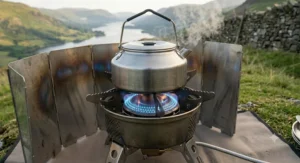
The headline figure here is 3,260W / 11,000 BTU, which puts it among the most powerful stoves of its physical size anywhere on the market. That raw number means genuinely fast boil times — around 3.5 minutes for a litre — but the more interesting upgrade over the standard PocketRocket 2 is the built-in pressure regulator. In practice, this matters enormously for UK campers: when you’re on the Pennine Way in October and the temperature is hovering just above zero, an unregulated canister stove loses pressure and performance quickly as the butane in the gas mix starts to behave unhelpfully. The Deluxe’s regulator maintains consistent output even as the canister cools or empties. The piezo igniter has also earned a fine reputation — reviews from UK climbing sites note it fires reliably far more often than similar budget alternatives.
At just 83g (not including the carry case), this is a remarkable power-to-weight achievement. The WindClip windshield helps, but let’s be honest: this is still a conventional exposed-burner design, and in a serious Scottish gale it will need shelter or a dedicated windscreen to give of its best.
This stove suits the lightweight backpacker who already owns good cookware and doesn’t want to be locked into a system. Available on Amazon.co.uk, typically Prime-eligible.
UK hill-walking reviewers are consistently enthusiastic, rating it highly for ease of use and ignition reliability across a range of conditions.
✅ Outstanding power-to-weight ratio — best in class for BTU per gram
✅ Pressure regulator is essential for cold British autumns and winters
✅ Works with a wide range of pots and pans
❌ No integrated pot — budget for cookware separately
❌ Still an exposed burner; needs shelter in severe wind
In the £70–£90 range, it’s arguably the best pure-performance stove per pound spent on Amazon.co.uk right now.
3. MSR WindBurner Personal Stove System
Some stoves compromise. The MSR WindBurner does not. It was built for one purpose — performing in weather that breaks other stoves — and it does so with the quiet confidence of something engineered rather than assembled.
The radiant burner technology here is genuinely different from everything else on this list. Rather than an open flame heating the bottom of a pot, the WindBurner uses a glowing radiant element inside an enclosed windproof cylinder. The cooking vessel locks onto the stove body and canister, and the whole arrangement is aerodynamically sealed. The result is a stove that treats wind as largely irrelevant — something that will delight anyone who has tried to cook in coastal Wales or on an exposed Highland ridge in autumn. The pressure regulator ensures consistent performance even as temperatures drop and fuel canisters lose pressure.
The 1.0-litre pot is the only compatible vessel for the personal system (there is a 1.8-litre Duo version for pairs), which is a meaningful limitation — this is a water-boiling system first and a cooking system second. Simmering is possible but basic; if you want to fry an egg or produce anything resembling actual cuisine, you’ll need a different stove. What the WindBurner excels at is the single task most solo hikers need most often: producing boiling liquid in any weather, with exceptional fuel efficiency. UK outdoor reviewers on UKClimbing and UKHillWalking consistently place it at the top of their wind-resistance rankings. Prime-eligible on Amazon.co.uk.
This is the stove for the Munro-bagger, the winter camper, or anyone who regularly ventures into genuinely exposed terrain.
✅ Radiant burner is essentially windproof — best wind resistance on this list
✅ Excellent fuel efficiency for extended trips
✅ Pressure regulator maintains output in cold and low-fuel conditions
❌ Only compatible with WindBurner cookware — no flexibility
❌ Heavier system; simmer control is limited
Available in the £120–£160 range — a premium worth paying if your camping takes you to genuinely challenging conditions.
4. SOTO WindMaster Stove
Japan’s SOTO brand is less of a household name in Britain than MSR or Jetboil, but serious UK hikers who’ve spent any time on the UKHillWalking forums will know the WindMaster well. It deserves a wider audience.
The burner head design is the interesting bit: the concave shape recesses the flame and, combined with a uniquely low pot-support height that brings your cookware closer to the heat source, creates a meaningful wind-resistance advantage over conventional open-burner designs. It’s not a sealed system like the WindBurner, but it sits in a very useful middle ground — better in the wind than a PocketRocket, lighter and less expensive than a full integrated system. Output sits around 2,800W (approximately 9,500 BTU), and with a standard pot and moderate British weather, you’re looking at a four-minute boil for a litre. The four-pronged 4Flex pot support (which comes included) is notably stable with a range of pot diameters — useful if you use different cookware — and a lightweight TriFlex alternative is available separately for those obsessing over every gram.
At 67g for the stove alone (the lightest standalone option on this list), this is a stove that serious backpackers reach for on longer routes where fuel and weight both matter. The built-in igniter has earned consistently positive reviews for reliability, which is more than can be said for some competitors. Available on Amazon.co.uk, usually Prime-eligible.
UK hillwalking reviewers on UKHillWalking.com praised it specifically for reliable ignition in cold, wet conditions — exactly the kind of endorsement that means something in this country.
✅ Best-in-class wind resistance for an open-burner design
✅ Lightest stove on this list — 67g is remarkable for the performance
✅ Works with a wide range of cookware; highly versatile
❌ Pot support arms (TriFlex version) are small and can feel precarious with large pots
❌ Less well-known brand means fewer UK stockists for in-store purchase
In the £60–£80 range, it’s genuinely excellent value for a technically sophisticated stove.
5. Primus Firestick TI Stove
Primus is a Swedish brand with well over a century of stove-making behind it, and the Firestick is probably their most refined expression of the ultralight canister stove concept. The titanium version weighs just 89g; the standard steel model sits at 105g — either way, it’s impressively compact when folded.
What sets the Firestick apart from more basic single-burner designs is the pressure regulator — the same story as the MSR PocketRocket Deluxe, but Primus’s implementation is quietly effective and delivers consistent output down to temperatures where a budget stove would become unreliable. Rated at 2,500W with a respectable boil time of around 3.5 minutes, it performs well in the middle range of this list. The control valve is notably large and easy to use — an underrated feature when you’re wearing gloves in the rain, as British campers regularly are. The steel version comes with a small wool pouch that doubles as a pot gripper, a clever little detail that suggests Primus actually thinks about how people use these things in the field.
This stove is best suited to the hiker who wants reliable cold-weather performance without committing to a full integrated system. It pairs beautifully with a 0.9-litre titanium mug or heat-exchanger pot. Available on Amazon.co.uk.
UK users note it performs well on multi-day routes and appreciate the cold-weather reliability over cheaper alternatives that lose power in low temperatures.
✅ Pressure regulator ensures consistent cold-weather performance
✅ Large control valve — practical for gloved hands in British conditions
✅ Titanium version achieves ultralight weight without sacrificing quality
❌ Wool pouch/pot gripper is included with steel version only
❌ Pricier than similar-output rivals like the SOTO WindMaster
Well positioned in the £75–£100 range — a solid mid-to-premium choice with excellent cold-weather credentials.
6. Campingaz Twister Plus Camping Stove
Let’s talk about the budget option, because not everyone needs — or should spend — north of £70 on a camping stove. The Campingaz Twister Plus makes a compelling argument for accessible performance.
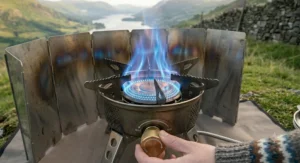
Rated at 2,600W (roughly 8,900 BTU), this little stove punches above its price class in raw output terms. It runs off Campingaz CV 470 cartridges, which are one of the most widely available gas formats in the UK — you’ll find them in any camping shop, most large supermarkets, and widely on Amazon.co.uk. That fuel availability is genuinely worth factoring in: exotic proprietary canisters might be harder to source if you run out unexpectedly mid-trip. The piezo ignition is reliable enough for the price, and the folding pot supports, while not the most sophisticated engineering on the market, are stable enough for a 1-litre pot. The stove weighs around 100g and packs down neatly into a rucksack side pocket.
What you don’t get, frankly, is cold-weather resilience. Without a pressure regulator, performance drops as the canister cools — in the depths of a December wild camp, you’ll notice. And wind resistance is limited; this is very much a sheltered-cooking stove. But for three-season UK camping at lower altitudes — festivals, family sites, DofE expeditions, short overnight trips — it does a perfectly decent job at a price that doesn’t make you anxious every time you set it down on a rock.
This is the stove for the first-time buyer, the occasional tripper, or anyone who wants a reliable backup stove without spending much.
✅ Excellent value for money — strong output at a budget price
✅ Uses widely available Campingaz CV cartridges (easy to find in UK shops)
✅ Compact and light enough for most rucksacks
❌ No pressure regulator — cold-weather performance drops noticeably
❌ Limited wind resistance; needs careful positioning on exposed ground
In the £25–£45 range, it’s hard to argue with as a starter or backup stove.
7. Coleman FyreStorm PCS (Personal Cook System)
The Coleman FyreStorm PCS takes a different approach from everything else on this list. Rather than a standalone burner you pair with separate cookware, this is a complete integrated system — burner, 1.3-litre pot, insulating sleeve, lid, and windshield — that all nests together for storage and travel.
The remote canister design is the first thing to note: rather than screwing your gas canister directly beneath the burner (as most canister-top stoves do), the FyreStorm sits the burner on its own tripod legs, with the canister attached off to the side via a hose. This meaningfully lowers the centre of gravity and makes the setup more stable on uneven ground — a more common situation than product photography usually acknowledges. The WindBlock system provides 360-degree wind protection at the base of the burner, and Coleman’s HyperFlame burner design delivers a downward-stepped flame that’s more sheltered than conventional designs. Rated at 2,200W, it won’t win a straight BTU race, but real-world wind performance is respectable. Reviews from UK wild campers who tested it on multi-night Scottish island trips (including the Isle of Arran) reported reliable operation in genuinely cold conditions.
The neoprene pot cover is a practical touch — the handle means you can hold the pot without burning yourself, and the lid has both a pouring spout and a strainer hole. A thoughtful feature set for the price. Available on Amazon.co.uk.
This is particularly well suited to the beginner or intermediate camper who wants everything sorted in one purchase without complication.
✅ Complete system — pot, lid, windshield, and insulating sleeve all included
✅ Remote canister design improves stability; low centre of gravity
✅ 360-degree WindBlock gives meaningful shelter from the elements
❌ At 390g including pot, heavier than standalone stove alternatives
❌ 2,200W output is the lowest on this list — won’t satisfy speed-obsessed boilers
Priced in the £45–£65 range, it’s excellent value for a complete beginner-friendly cooking system.
How to Get the Most from Your High Output Camping Stove in British Conditions
Buying the right stove is only half the story. Getting consistent performance out of it — particularly in the variable, frequently uncooperative conditions that define UK outdoor cooking — requires knowing a few things that the instruction manuals politely neglect to mention.
Warmth is your gas canister’s best friend. This is the single most overlooked piece of advice for cold-weather UK camping. Isobutane/propane canisters lose pressure as they cool, and a canister that’s been sitting in your tent porch on a February night will produce a feeble flame compared to one at a comfortable temperature. Keep your canister in your sleeping bag overnight, or tuck it inside your jacket for ten minutes before cooking. The difference in boil time can be dramatic.
Find your shelter. Even the best wind-resistant stove on this list will appreciate a thoughtfully chosen cooking spot. A dry-stone wall, a boulder, the lee side of your tent, or a purpose-made aluminium windscreen (lightweight and costs a few pounds) will cut boil times significantly and protect the piezo igniter from the kind of gust that renders it temporarily useless. In genuinely exposed British conditions — coastal campsites, highland ridges, the Brecon Beacons on a January morning — good positioning does more work than extra BTUs.
The first-use routine matters. On a brand new stove, do your first test burn in the garden before heading into the field. Confirm the igniter works, check the valve action, understand how the simmer range feels. This takes about three minutes at home and prevents nasty surprises at altitude.
Routine maintenance for British weather. After each trip, dry the stove thoroughly before storage — moisture in the burner head is the enemy of reliable ignition. Remove the canister when not in use (the O-ring seal benefits from not being under constant pressure), and occasionally clean the burner head with a fine needle if carbon deposits start to affect the flame pattern. This is more relevant in damp British conditions than manufacturers often acknowledge.
Altitude adjustments. Few British wild campers venture above 1,000 metres, but for those who do — Ben Nevis, Scafell Pike, Snowdon’s higher approaches — remember that lower air pressure at altitude affects combustion. Regulated stoves handle this better than unregulated ones. Expect somewhat longer boil times above 800 metres regardless of what the specification sheet suggests at sea level.
UK Camper Profiles: Which Stove Should You Actually Buy?
A stove that’s perfect for a solo Scottish Munro-bagger is completely wrong for a family of four at a Cornish campsite. Here are three realistic UK user profiles matched to the best options from our list.
Profile 1: The Lightweight Hill Walker (Scotland/Wales) Jamie packs every gram carefully, walks Munros solo from September through March, and wants hot food reliably in genuinely terrible weather. Wind and cold are constants, not exceptions. The SOTO WindMaster is the answer here — 67g, excellent wind resistance for an open-burner design, and the built-in igniter has a strong UK reputation. Pair it with a 900ml heat-exchanger pot for maximum efficiency. If the budget stretches and conditions are regularly severe, the MSR WindBurner’s radiant technology is the no-compromise choice, though at the cost of cookware flexibility.
Profile 2: The Occasional Weekend Camper (England, 3 seasons) Sarah camps five or six times a year, mainly at established sites in the Peak District and Dartmoor, uses a two-person tent, and wants a stove that’s easy to use and reliable without costing a fortune. The Coleman FyreStorm PCS is a near-perfect fit — complete system, stable remote-canister design, nothing to forget, and a 360-degree WindBlock that handles typical English breezes adequately. If she wants more raw performance without the all-in-one commitment, the Campingaz Twister Plus is a reliable step-up.
Profile 3: The Serious Backpacker (Multi-Day Routes) Marcus thru-hikes the Pennine Way and South Downs Way, carries everything on his back for up to a week, and cooks proper meals rather than just rehydrating sachets. He needs simmer control, cold-weather regulation, and low weight. The MSR PocketRocket Deluxe hits this brief precisely — 11,000 BTU output, pressure regulator for cold mornings, excellent simmer control, and 83g. Paired with a 0.9-litre titanium mug, the whole cooking kit comes in well under 200g. The Primus Firestick TI is a close competitor in titanium if he wants a slightly different aesthetic and build philosophy.
How to Choose a High Output Camping Stove in the UK: 7 Key Criteria
1. Output (watts or BTU) versus actual wind resistance. Raw output numbers are measured in laboratory conditions with no wind. A 3,000W stove with poor wind shielding can be outperformed in a breeze by a 1,800W stove with intelligent design. Always look at the design alongside the headline figure — does the burner have a protective lip? Is the pot-to-burner distance minimal? For UK conditions, real-world wind performance matters more than peak BTU.
2. Pressure regulation. If you camp between October and March, this is non-negotiable. Regulated stoves maintain consistent output as the canister cools; unregulated stoves don’t. The Campingaz Twister Plus will struggle on a cold Dartmoor morning; the MSR PocketRocket Deluxe will not.
3. Fuel availability. Some stoves use proprietary gas formats that are awkward to source outside of specialist outdoor retailers. EN417-compatible threaded canisters (used by MSR, Jetboil, Primus, SOTO, and most premium brands) are now widely available across UK outdoor shops and online. Campingaz CV cartridges are even more ubiquitous, found in Halfords, Tesco, and camping shops nationwide. For international or remote UK travel, verify your gas format in advance.
4. Integrated system versus standalone burner. A complete system (Jetboil Flash, MSR WindBurner, Coleman FyreStorm PCS) gives you everything you need in one box but locks you into specific cookware. A standalone burner (PocketRocket Deluxe, SOTO WindMaster, Campingaz Twister Plus) offers flexibility but requires you to source compatible pots. Neither is objectively better — it depends on your existing kit and how much you value freedom of choice.
5. Weight and packed size. If you’re carrying everything, every gram eventually matters. The difference between 67g (SOTO WindMaster) and 415g (MSR WindBurner system) is the difference between barely noticing your stove is there and feeling it in your knees on descent.
6. Simmer control. If you cook actual meals rather than just boiling water, simmer capability matters. Integrated systems like the Jetboil Flash are notoriously poor at simmering. The MSR PocketRocket Deluxe, SOTO WindMaster, and Primus Firestick all offer genuine simmer control. Ask yourself honestly how ambitious your camp cooking is before deciding.
7. Budget in context. Consider total cost of ownership, not just the purchase price. A £25 Campingaz Twister Plus plus a compatible gas cartridge (around £8–£12 for a 450g mix) is a very affordable entry into high-output camping. A £140 MSR WindBurner requires the same cartridge type but delivers such significantly better performance in wind that it earns back its premium in fuel savings and reliability over time. According to The British Mountaineering Council’s gear guidance, investing in quality kit suited to the demands of your activity is consistently the advice that experienced hillgoers give beginners.
Common Mistakes When Buying a High Output Camping Stove
Chasing raw BTU numbers without considering wind. A 15,000 BTU camp stove with no wind protection is a garden accessory in Britain, not a camping tool. The UK’s Met Office data shows that exposed areas above 500 metres experience wind gusts exceeding 50 km/h on a significant proportion of days year-round. Wind resistance — either through design (recessed burner, low pot-to-flame distance) or through integrated enclosure — matters more than the BTU figure for most UK use.
Buying an unregulated stove for year-round use. Cheap canister stoves without pressure regulators are essentially three-season tools in the UK. They’ll work adequately in summer and into early autumn, but as temperatures approach and dip below 5°C, butane-heavy gas mixes perform poorly. The difference isn’t marginal; it’s genuinely the difference between a hot meal and a tepid disappointment.
Ignoring fuel compatibility. Some buyers purchase a stove without checking whether EN417 threaded canisters or Campingaz-style push-in cartridges are available locally. If you regularly camp in the Scottish Islands or other more remote UK locations, availability of specific gas types can be limited. Check before you buy — and consider carrying a spare canister on longer trips.
Underestimating the importance of stability. On uneven ground — which is most ground in the British uplands — a tall, top-heavy stove (canister screwed directly underneath) can tip disturbingly easily, especially with a full 1-litre pot of boiling water on top. Remote canister designs (like the Coleman FyreStorm PCS) or ground-mounted systems (like the MSR WindBurner) are inherently more stable. If you cook on uneven terrain, factor this in.
Buying a US-spec product that uses propane tanks. Some powerful stoves popular on American camping forums use large propane canisters with a different valve standard that’s incompatible with EN417 canisters sold in the UK. Verify that any stove you purchase on Amazon.co.uk is compatible with isobutane/propane blend canisters using the standard EN417 thread before checkout.
High Output Camping Stoves vs Standard Camping Stoves: Is the Upgrade Worth It?
The honest answer is: it depends on what “standard” looks like for you. A basic 1,200W canister stove costing £15 will boil water and heat soup. Eventually. In reasonable conditions. But the gap between budget and high output isn’t just speed; it’s reliability under pressure.
| Feature | Standard Stove (≤1,500W) | High Output Stove (2,500W+) |
|---|---|---|
| Boil time (1L, calm) | 6–10 minutes | 3–5 minutes |
| Wind performance | Poor — flame extinguishes easily | Good to excellent depending on design |
| Cold-weather use | Unreliable below 5°C | Reliable with regulated models |
| Fuel efficiency | Lower — longer burn time needed | Better — less gas per litre boiled |
| Weight (stove only) | Often similar (80–120g) | Similar (67–120g for top picks) |
| Price range | £10–£25 | £25–£160 |
The real-world cost comparison is more nuanced than the purchase price suggests. A high output stove with a pressure regulator — costing perhaps £70–£90 — consistently uses less fuel per litre boiled than a cheap stove that performs poorly in the cold and wind, burning gas inefficiently while you wait. Over a season of regular camping, the fuel savings alone begin to narrow the price difference. According to Mountaineering Scotland’s kit recommendations, gear suited to Scottish conditions specifically is worth treating as a long-term investment rather than a one-season expense.
The analysis is fairly clear: if you camp more than a handful of times a year, in any conditions more demanding than a sheltered summer evening, a high output stove with meaningful wind resistance and cold-weather regulation will repay its cost in performance, reliability, and frankly the simple pleasure of not standing over a barely-lit flame in a horizontal Lakeland drizzle wondering if it’ll ever boil.
✨ Don’t Miss These Exclusive Deals!
🔍 Ready to upgrade your camp kitchen? Click any highlighted product to check current pricing and availability on Amazon.co.uk — free next-day delivery available for Prime members on all products in this guide.
FAQ: High Output Camping Stoves — UK Buyers’ Questions Answered
❓ What BTU output is considered high for a single-burner camping stove?
❓ Are isobutane camping stove canisters widely available in the UK?
❓ Do high output camping stoves work in cold British winter temperatures?
❓ Can I use any camping stove at UK campsites and national parks?
❓ How do I get free delivery on camping stoves from Amazon.co.uk?
Conclusion: The Right High Output Camping Stove for British Adventures
Britain is not a country that makes outdoor cooking easy, and that’s rather the point. The fells are dramatic, the coasts are wild, the moors are magnificently bleak, and the weather ensures that nobody gets complacent about their kit. A quality high output camping stove is one of the few pieces of gear that earns its place on every single trip — not as an optional extra, but as the thing standing between you and a miserable cold evening in a wet tent.
If money is no object and you regularly venture into exposed terrain, the MSR WindBurner is the premium choice for windproof reliability, and the MSR PocketRocket Deluxe is the performance leader for lightweight versatility. The SOTO WindMaster offers a compelling middle ground that experienced UK hillwalkers increasingly reach for. First-timers or occasional campers will find the Coleman FyreStorm PCS a thoughtfully complete package, and the Campingaz Twister Plus remains a solid budget entry point for anyone building their first kit on a modest budget.
Whatever you choose, pair it with a wind-considered cooking spot, a warm canister, and the reasonable expectation that British outdoor cooking will always involve a small element of absurdity. That’s part of the charm.
✨ Don’t Miss These Exclusive Deals!
🔍 Found your perfect stove? Click any highlighted product name to check the latest prices on Amazon.co.uk. Prime members get next-day delivery — so your next camping trip is closer than you think.
Recommended for You
- Best Mini Gas Stove for Travelling Light in 2026 (UK Guide)
- 7 Best Compact Camping Stoves UK 2026 – Lightweight Picks Tested
- Campingaz 206 Stove: 7 Best Models for UK Campers in 2026
Disclaimer: This article contains affiliate links. As an Amazon Associate, I earn from qualifying purchases. If you purchase products through these links, we may earn a small commission at no additional cost to you.
✨ Found this helpful? Share it with your mates! 💬🤗
