In This Article
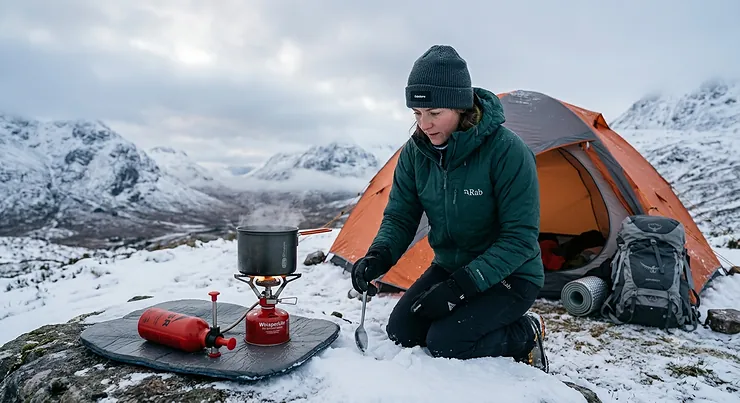
Picture this: you’re somewhere on the Cairngorm plateau, the temperature has dropped to -5°C, the wind is cutting in from the north-west like it has a personal grudge, and your trusty three-season canister stove — the one that served you so brilliantly on that sunny weekend in the Lake District back in August — is producing a feeble, flickering flame that couldn’t heat a mug of instant coffee, let alone the bowl of hot porridge standing between you and hypothermia. This is not a moment of minor inconvenience. This is a moment where gear genuinely matters.
Choosing the right camping stove for winter camping isn’t simply a case of grabbing the cheapest option on Amazon.co.uk and hoping for the best. Standard butane canisters lose pressure rapidly as temperatures fall below freezing — butane’s boiling point sits at around -1°C, which means on a cold Scottish hillside, it can essentially stop vaporising altogether. The result? A stove that hisses weakly, takes twelve minutes to half-boil water, and eventually gives up entirely. Not ideal.
A proper cold weather camping stove is one designed to work when the mercury plunges: pressure regulators that maintain consistent output, isobutane-propane fuel blends that remain functional well below 0°C, inverted canister setups that feed liquid fuel directly, or liquid-fuel systems that laugh at subzero temperatures. In this guide, we’ve rounded up the seven best stove for winter camping options currently available on Amazon.co.uk — from budget-friendly beginner picks to the kind of bombproof kit that mountaineers trust on alpine ascents. Whether you’re a Munro bagger planning a February overnight, a wild camper who refuses to hibernate, or simply someone who wants reliable hot food after a punishing winter walk, there’s something here for you.
What is a camping stove for winter camping? Put simply, it’s a portable cooking device specifically engineered to maintain consistent fuel pressure and heat output in temperatures at or below 0°C, using fuel blends, pressure regulators, or liquid fuel systems that remain stable in cold conditions.
Quick Comparison: Top 7 Winter Camping Stoves at a Glance
| Stove | Fuel Type | Pressure Regulator | Best For | Approx. Price (GBP) |
|---|---|---|---|---|
| MSR WindBurner Personal | Canister (isobutane) | ✅ Yes | Solo winter wild camping | £120–£140 |
| Jetboil Flash | Canister (isobutane) | ❌ No | Three-season / mild winter | £80–£100 |
| MSR WhisperLite Universal | Liquid / multi-fuel | N/A (pump) | Expeditions, extreme cold | £130–£160 |
| Primus Lite+ Stove System | Canister (isobutane) | ✅ Yes | Ultralight winter solo | £75–£95 |
| MSR Reactor 1.7L | Canister (isobutane) | ✅ Yes | Snow-melting, alpine winter | £165–£200 |
| Fire-Maple FMS-X2 | Canister (isobutane) | ❌ No | Budget 3-season/mild winter | £30–£50 |
| MSR PocketRocket 2 | Canister (isobutane) | ❌ No | Budget with windscreen | £35–£55 |
From the table above, a clear split emerges: stoves with integrated pressure regulators (the WindBurner, Primus Lite+, and Reactor) maintain consistent heat output as the canister chills and empties — the feature that separates true cold weather camping stoves from three-season kit pressed reluctantly into service. Budget options like the PocketRocket 2 and Fire-Maple FMS-X2 can handle mild UK winters competently with the right fuel blend, but they’ll struggle when temperatures drop significantly below zero. For anyone heading above 700 metres in Scotland between November and March, the regulator-equipped and liquid-fuel options should be your starting point.
💬 Just one click — help others make better buying decisions too! 😊
✨ Don’t Miss These Exclusive Deals!
🔍 Take your winter camping to the next level with these carefully selected stoves. Click on any highlighted product to check current pricing and availability on Amazon.co.uk. Prices vary — always worth a look!
Top 7 Winter Camping Stoves: Expert Analysis
1. MSR WindBurner Personal Stove System
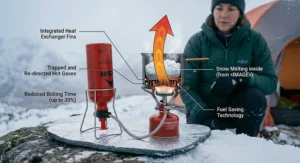
The MSR WindBurner is, in many respects, the benchmark against which every other best 4 season camping stove gets measured. Its radiant burner — the same technology found in the professional-grade MSR Reactor — creates a fully enclosed combustion chamber that is effectively impervious to wind and cold. In one independent field test, it maintained virtually identical boil times in both calm conditions and a 30 km/h wind; most open-burner stoves, by contrast, slow dramatically the moment a breeze arrives.
The WindBurner boils 1 litre of water in around four and a half minutes under normal conditions, which sounds modest until you consider it achieves this consistently at -10°C, at altitude, and in full Scottish gale conditions where competitors are barely producing a visible flame. The built-in pressure regulator ensures even fuel consumption regardless of canister temperature or remaining fuel level — the flame stays strong from the first boil to the last drop. The 1-litre integrated pot with locking mechanism, heat-resistant sleeve, and straining lid makes the whole system a neat, self-contained unit. Pack weight sits at around 440g for the stove and pot combined, which is heavier than bare-bones options but reasonable for what it delivers.
In practice, the WindBurner is best suited to solo UK adventurers tackling serious winter terrain — Munro-baggers, winter mountaineers in Snowdonia or the Brecon Beacons, or wild campers who want the confidence of a stove that works in a blizzard. It won’t let you simmer a sauce with any great precision; this is a boil-water machine, not a culinary platform. But for rehydrated meals, hot drinks, and snow-melting on Scottish winter overnights, it is genuinely superb.
UK customer feedback praises its consistency in cold and wind, with several Highland walkers noting it as the first stove that “just works” in winter conditions. One reviewer mentioned using it reliably in -8°C on a Ben Nevis winter route.
Available on Amazon.co.uk, typically Prime-eligible with next-day delivery.
✅ Truly windproof radiant burner design
✅ Consistent output via pressure regulator in cold
✅ Neat, self-contained system — minimal setup
❌ No simmering capability — boil-only
❌ Heavier than open-burner alternatives
Around £120–£140 for the personal system — one of the best-value performance winter stoves on Amazon.co.uk.
2. Jetboil Flash Cooking System
The Jetboil Flash has been the default choice for fast-boil camp cooking for over a decade, and it remains one of the most recognisable inverted canister stove options in the UK market. Its FluxRing heat exchanger — a corrugated aluminium band bonded to the base of the 1-litre insulated cup — dramatically increases heat transfer efficiency, letting the Flash boil 500ml of water in around 100 seconds under good conditions. That’s genuinely impressive.
However, here’s the honest caveat that most Amazon listings won’t tell you: the Jetboil Flash does not have a pressure regulator. In temperatures below about -5°C, or when a canister is more than half depleted in cold weather, performance degrades noticeably. The flame becomes inconsistent, boil times stretch, and you can find yourself coaxing a half-hearted blue ring of fire to muster enough heat for a mug of tea. On mild British winters — temperatures hovering around 0°C to 5°C, as is typical for most of England and lower-altitude Wales — this is rarely catastrophic. On a January bivouac in the Cairngorms, it becomes a genuine limitation.
The Flash also features a push-button piezo igniter and a heat-colour indicator on the neoprene sleeve that changes colour when the contents are hot — small touches that matter when you’re fumbling in gloves at 6 AM. The system nests tidily into itself with room for a 100g canister, making it one of the more packable options here.
For most UK winter campers who stay below the snowline and camp between November and February in typical British conditions (wet and cold, rarely brutal), the Jetboil Flash paired with an isobutane-propane blend canister performs admirably. Using Jetboil’s own JetPower canisters (70% isobutane / 30% propane) helps maintain lower-temperature performance. Just keep the canister in your sleeping bag overnight — a trick every experienced UK winter camper knows.
UK reviews are consistently positive for three-season use; winter-specific reviewers note the performance dip but appreciate the overall speed and convenience.
✅ Fastest boil time of all seven stoves in ideal conditions
✅ Self-contained, neat, compact packing
✅ Integrated igniter and heat indicator
❌ No pressure regulator — struggles below -5°C
❌ Limited to one pot size and boil-focused cooking
Around £80–£100 — strong value for UK mild-winter campers. Check current price on Amazon.co.uk.
3. MSR WhisperLite Universal
Some gear transcends trends. The MSR WhisperLite has been a staple of expedition packs since the 1980s, and the Universal variant — which burns both liquid fuels and isobutane-propane canisters — remains the most versatile cold weather camping stove on this list by some considerable margin. As a liquid fuel stove winter option, it operates on white gas, unleaded petrol, kerosene, and isobutane-propane canisters via a simple jet swap. That fuel flexibility is, in practice, far more important than it sounds.
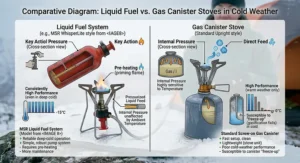
Here’s why this matters specifically for UK winter campers: liquid fuel stored in a bottle at -15°C is unaffected by temperature — unlike gas canisters, where the fuel must vaporise inside the canister before burning. A liquid fuel stove pumps pressurised fuel directly to the burner, meaning consistent, powerful output regardless of ambient temperature. On serious winter expeditions in the Scottish Highlands, Snowdonia, or indeed anywhere in the northern uplands, the WhisperLite Universal will outperform every canister option on this list when temperatures fall well below freezing.
The trade-off is complexity. The WhisperLite requires priming (burning a small amount of fuel to warm the vaporiser before lighting fully), occasional field maintenance, and a clean-ish fuel supply. It’s not the stove you hand to a nervous beginner and walk away. It’s the stove you choose when reliability in genuine extremes is non-negotiable. Weight sits at around 370g without fuel bottle, and it delivers approximately 9,500 BTU — powerful enough to cook real food, not just boil water.
For UK alpinists, winter mountaineers, and anyone planning multi-day wild camping in genuinely cold terrain, this is arguably the most important stove to consider. The WhisperLite Universal has been around long enough that field repair manuals, spare parts, and community knowledge are ubiquitous.
UK reviewers consistently cite it as a “proper expedition stove” that rewards learning its quirks.
✅ Works reliably in extreme cold — unaffected by canister temperature
✅ Multi-fuel: white gas, petrol, kerosene, isobutane
✅ Repairable in the field; decades of reliability record
❌ Requires priming and occasional maintenance
❌ Not for beginners — setup learning curve
Around £130–£160 — excellent long-term value for serious winter use. Available on Amazon.co.uk with Prime delivery.
4. Primus Lite+ Stove System
The Primus Lite+ is the Scandinavian entry in this list — and Primus, a Swedish brand with over 130 years in the outdoor cooking business, knows rather a lot about performing in cold weather. The Lite+ is a semi-integrated system: it combines an efficient burner with a 0.5-litre hard-anodised pot and features an auto-igniter recessed into the burner housing, which is specifically designed to light in wind. In testing by Outdoor Life, it was the only stove in a head-to-head comparison that could self-ignite reliably in a full wind. At a winter campsite in the Pennines, that’s a remarkably welcome feature.
What sets the Lite+ apart for winter use is its pressure regulator. Like the WindBurner, it maintains consistent gas flow as the canister cools and depletes, delivering predictable performance down to around -10°C with an appropriate isobutane-propane blend. This makes it a best 4 season camping stove in the truest sense: reliable from a summer evening in the Peak District to a blizzard night in Glencoe.
The 0.5-litre pot is the main limitation — it’s sized for a solo camper heating a single serving, not a pair. Primus claims it can boil 10 litres of water from a single 100g gas canister, and independent UK testing has largely validated this figure. That fuel efficiency is partly why long-distance walkers doing the Cape Wrath Trail or Coast to Coast in winter favour this system: fewer canisters to carry.
The included neoprene cosy sleeve keeps contents warm for over thirty minutes — appreciated when you’re faffy about getting into your sleeping bag before the soup cools. The entire system nests into itself with a 100g canister for packing.
UK user feedback highlights its build quality, with Scottish winter climbers particularly appreciating the wind-resistant igniter. One reviewer called it “the first stove I’ve trusted on a multi-day winter route.”
✅ Pressure regulator for consistent cold-weather performance
✅ Wind-resistant integrated piezo igniter
✅ Exceptional fuel efficiency — 10 litres per 100g canister
❌ Small 0.5-litre pot — solo use only
❌ Slightly fiddly pot-locking mechanism
Around £75–£95 — superb mid-range value for serious solo winter campers.
5. MSR Reactor 1.7L Stove System
If the WindBurner is the everyday winter stove, the MSR Reactor is the specialist. This is the best stove for winter camping when you need industrial-grade performance: melting litres of snow for a mountaineering camp above the snowline, cooking for a small group in sustained blizzard conditions, or simply refusing to allow weather to have any say in whether your meal gets made. Its radiant burner — the original and most powerful version of the technology also used in the WindBurner — delivers around 9,000 BTU with an efficiency and weather resistance that remains unmatched among canister systems.
The Reactor boils 1 litre of water in under three minutes, comfortably faster than any other stove on this list, and maintains virtually that performance regardless of wind, cold, or elevation. The 1.7-litre pot is sized for two people comfortably — or a solo camper who needs to melt significant volumes of snow for drinking water. The integrated pressure regulator, heat exchanger, and pot-lock mechanism create a system that functions almost identically whether you’re cooking in a sun-warmed tent in Dartmoor or on a windswept winter ledge in the Cuillin.
It is a one-trick pony, to borrow from TGO Magazine’s assessment — simmering is not its strong suit, and the price point is the highest on this list. But as a purpose-built cold weather performance system for UK alpinists, winter mountaineers, and experienced wild campers who take January hillwalking seriously, it justifies every penny.
UK reviewers from Scottish winter climbing circles consistently rate it as one of the most reliable stoves available, with several noting it “beat its own quoted boil times” in field conditions.
✅ Fastest boil time and best cold-weather performance on the list
✅ Virtually unaffected by wind, cold, or elevation
✅ 1.7L pot — suitable for two people or heavy snow-melting
❌ Most expensive option — premium investment
❌ Cannot simmer; purely a boil-water system
Around £165–£200 — the premium choice for UK winter mountaineers. Available on Amazon.co.uk; check for Prime availability.
6. Fire-Maple FMS-X2 Personal Cooking System
Not every UK winter camper heads out in January with mountaineering ambitions. Some want a reliable stove for November bivouacs at modest altitude, cold-but-not-extreme Dartmoor overnights, or off-season Scottish island camping where temperatures hover around 2–5°C and the greater challenge is horizontal rain rather than deep frost. For that user profile, the Fire-Maple FMS-X2 is a quietly excellent choice that often gets overlooked in favour of the big-name American brands.
Fire-Maple is a Chinese outdoor brand with genuine technical credibility — their stoves are manufactured to a standard that compares reasonably well with mid-tier Western alternatives, and the FMS-X2 features an integrated heat exchanger system that delivers meaningful efficiency gains over basic open-burner designs. The system includes the stove, a 350ml hard-anodised pot, insulated sleeve, and a lid with strainer — everything neatly nested for packing. The piezo igniter is adequate, and the pot sits stably on the folding supports.
The honest caveat: the FMS-X2 has no pressure regulator, so genuine sub-zero performance requires either pre-warming the canister or using a quality isobutane-heavy blend. For UK lowland and mid-altitude winter camping — where nights regularly dip to -2°C rather than -12°C — this is manageable. For Scottish winter mountaineering, you’d be better served by options 1, 4, or 5.
Where the FMS-X2 earns its place is value. At around £30–£50, it offers considerably more than comparably priced stoves from lesser-known brands, and enough capability to serve the majority of UK winter campers who aren’t operating at extremes. Amazon.co.uk stocks it reliably, and UK reviewer feedback notes it as a “brilliant starter kit” and “genuinely decent for the money.”
✅ Outstanding value for money
✅ Complete cooking system — pot, lid, stove included
✅ Heat exchanger improves efficiency over basic alternatives
❌ No pressure regulator — cold-weather limits below ~-5°C
❌ Smaller pot — not suited for two-person cooking
Around £30–£50 — the budget pick for UK mild-winter camping. Check Amazon.co.uk for current stock.
7. MSR PocketRocket 2
The MSR PocketRocket 2 is about as simple as camping stoves get. A compact burner head — weighing just 73g — with folding pot supports, a precision-machined valve for simmer control, and no igniter, no integrated pot, no electronics. Just a reliable, well-engineered bit of kit that screws onto an isobutane-propane canister and works. It’s been one of the most popular lightweight camping stoves in the UK for years, and for good reason.
As a winter camping stove, it requires honest qualification. No pressure regulator means that in sustained cold (below -5°C), performance drops as the canister chills. However, the PocketRocket 2 is compatible with all standard EN417 Lindal-valve canisters, including Coleman’s C100 Performance blend (propane-dominant, rated to -27°C) and Primus’s Winter Gas cartridge. Using one of these lower-temperature blends transforms the PocketRocket 2 into a remarkably capable mild-winter option — and inverted canister use with a remote hose adapter (sold separately) further extends its cold-weather range.
What distinguishes the PocketRocket 2 from cheaper competitors is fit, finish, and reliability. The serrated pot supports grip cookware securely, the flame valve gives genuine simmer control (rare in this price range), and MSR’s manufacturing quality means this stove will last a decade with basic care. UK reviewers note it boils 500ml of water in around 90 seconds under good conditions — impressive for such a minimal, lightweight design.
For UK wild campers who want a lightweight, versatile stove at a sensible price — and are happy to choose their fuel canister thoughtfully for winter use — the PocketRocket 2 represents excellent value. Prime-eligible on Amazon.co.uk.
✅ Lightweight (73g) and minimal — easy to pack
✅ Excellent simmer control for the price
✅ Compatible with a wide range of canisters including winter blends
❌ No pressure regulator — fuel choice critical for cold weather
❌ No integrated pot — requires separate cookware purchase
Around £35–£55 — the best budget winter camping stove choice on this list for informed buyers.
How to Use Your Winter Camping Stove: A Practical Guide for British Conditions
Keep the Canister Warm
This is the most important single tip for canister stove users in winter, and Amazon listings never mention it. Gas canisters lose pressure as they cool — isobutane begins struggling below approximately -5°C, standard butane effectively stops working below 0°C. The solution is embarrassingly simple: sleep with the canister in your sleeping bag, keep it in an inner pocket during the day, and cook quickly after removing it. A canister that’s been in a -10°C pack overnight will produce a weak flame at best; the same canister pre-warmed to body temperature will perform closer to its rated output.
Use the Right Fuel
For UK winter camping, always choose isobutane-propane blend canisters (Jetboil JetPower, Primus Power Gas, Coleman C100 Performance) rather than pure butane. The propane component has a boiling point of -42°C, which maintains canister pressure significantly better in cold conditions. A Coleman C100 propane-dominant cartridge used with the PocketRocket 2 in a British winter will outperform a pure-butane canister used with a far more expensive stove.
Create a Wind Break
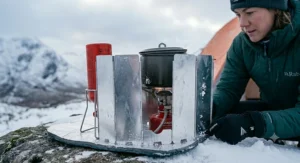
British winter weather is more about wind and horizontal rain than extreme cold. A modest windscreen — improvised from a piece of closed-cell foam mat, a dry stone wall, or your rucksack — can reduce fuel consumption by 30–50% and dramatically improve boil times for open-burner stoves like the PocketRocket 2. The enclosed-burner systems (WindBurner, Reactor) need no windbreak, which is precisely their point.
Insulate the Stove Base
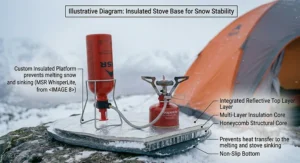
On snow or frozen ground, heat conducts rapidly downwards away from the stove. Place a small square of closed-cell foam mat beneath the stove to act as insulation. This simple trick — standard practice among Scottish winter climbers — meaningfully improves performance and prevents the stove from melting unevenly into snow, which creates stability problems.
Cook Quickly and Cover Your Pot
Always use a lid. A covered pot reaches boiling around 30% faster than an uncovered one, and in winter, where you’re burning through fuel faster anyway, that efficiency matters. After cooking, the insulated neoprene sleeves on Jetboil and Primus integrated systems keep food warm for 20–30 minutes — useful when you’re faffy about tent pitching.
Real-World Scenarios: Which Stove Suits Which UK Winter Camper?
The Scottish Winter Mountaineer
Profile: You’re bagging Munros between December and March, spending nights in bothies or under canvas in genuinely hostile conditions. Temperature regularly below -5°C, wind chill the main hazard, snow likely.
Best match: MSR Reactor 1.7L or MSR WhisperLite Universal. The Reactor’s closed radiant burner and pressure regulator make it essentially immune to wind and cold, while the WhisperLite Universal handles extreme cold through liquid-fuel feeding — if temperatures hit -15°C or below, liquid fuel wins outright. Budget-conscious mountaineers should strongly consider the MSR WindBurner Personal as a more affordable regulator-equipped alternative.
The English/Welsh Mid-Winter Wild Camper
Profile: You wild camp in the Lake District, Peak District, Snowdonia, or Dartmoor from October through February. Temperatures typically -2°C to +4°C overnight, wet and windy rather than deeply frozen.
Best match: Jetboil Flash or Primus Lite+. The Jetboil Flash’s speed and convenience serves you well in these conditions with the right fuel blend. The Primus Lite+ edges ahead if you want a pressure regulator for more consistent cold-weather performance, and its recessed wind-resistant igniter is a genuine advantage in the blustery conditions typical of British highland wild camping.
The Budget-Conscious Beginner
Profile: First or second winter camp, staying on established campsites or low-risk terrain, looking to spend sensibly while getting capable kit.
Best match: MSR PocketRocket 2 or Fire-Maple FMS-X2. Both offer genuine value with capable performance in mild British winters. The PocketRocket 2 wins on build quality and longevity; the FMS-X2 includes a pot and system for less money. Either paired with a Coleman C100 or Primus Power Gas canister will serve a novice winter camper well in lowland and mid-altitude conditions across England and Wales.
How to Choose a Camping Stove for Winter Camping in the UK: 6 Key Criteria
Navigating the world of cold weather camping stoves is genuinely confusing if you don’t know what the specs actually mean. Here’s what to look for, and why it matters in practice.
1. Pressure Regulator — The Most Important Feature Nobody Talks About
A pressure regulator maintains consistent fuel flow as canister pressure drops — whether from cold temperatures or depleting fuel levels. Without one, your flame gradually weakens over a camp session, often at precisely the moment you most need it. Stoves with regulators (WindBurner, Reactor, Primus Lite+) cost more, but for genuine winter camping in the UK they’re worth every penny. The spec sheet will typically say “pressure regulator” or “piezo ignition with regulated output” — look for it explicitly.
2. Fuel Type and Cold-Weather Rating
Standard butane: avoid it entirely for winter camping. Isobutane-propane blends: acceptable for UK mild winters (0°C to -5°C) when pre-warmed. White gas/liquid fuel: the gold standard for sustained sub-zero use. Check your canister packaging — it will state the operating temperature range. Primus Winter Gas, Jetboil JetPower, and Coleman C100 are all suitable UK-available options for canister stoves in winter conditions.
3. Wind Resistance
British weather, as every hillwalker learns rapidly, is as much about wind as temperature. An open-flame stove on a Cairngorm plateau in February is a study in frustration. Enclosed-burner systems (WindBurner, Reactor) solve this entirely. For open-burner stoves, a windscreen is not optional equipment in British winters — it is essential.
4. Boil Time vs. Fuel Efficiency
Headline boil times are marketing figures measured in windless, room-temperature labs. In real-world winter conditions, actual performance typically falls 30–50% below claimed figures for unregulated stoves, and only 10–20% for regulated or enclosed systems. The WindBurner’s apparently modest four-and-a-half minute boil time at -10°C is more impressive than the Jetboil Flash’s claimed 3.5 minutes under conditions where the Flash might actually take seven or eight minutes.
5. Weight and Packability
For backpacking and wild camping, every gram matters. The PocketRocket 2’s 73g burner is ludicrously light; the Reactor at around 595g is the heaviest system here. For UK hill-walking where you’re typically covering 15–25km per day with a full winter pack, the integrated pot systems (Jetboil, WindBurner, Primus) offer a practical compromise — you save weight by eliminating a separate pot, and the nesting design keeps your pack tidy.
6. Ease of Use in Cold, Gloved Hands
This one gets overlooked entirely by spec-sheet-focused reviews. Can you operate the fuel valve in thick winter gloves? Is the igniter accessible without removing insulation? Does the pot lock without fiddly alignment? The WindBurner and Reactor’s large, lever-lock connections; the Primus Lite+’s recessed igniter; and the Jetboil Flash’s one-handed locking mechanism all reflect genuine attention to cold-weather usability. The PocketRocket 2, by contrast, requires a steady hand for canister attachment when frozen — manageable, but worth practising at home before deploying at altitude.
Liquid Fuel vs. Canister Stoves for Winter Camping: What the Spec Sheets Won’t Tell You
The debate between liquid fuel stove winter advocates and canister devotees is genuinely interesting, and the answer depends almost entirely on where and when you camp in the UK.
The case for canister stoves: convenience, no priming, self-sealing canisters that won’t spill in your pack, lighter weight when both stove and fuel are considered for trips of three days or fewer. For the vast majority of UK winter campers — those spending one to four nights out, at altitudes below 900 metres, in temperatures between -5°C and 5°C — a regulated canister stove like the WindBurner or Primus Lite+ is simply a better practical choice. It’s also considerably easier to find isobutane-propane canisters in UK outdoor shops (Cotswold Outdoor, Go Outdoors, Blacks, Millets) than liquid fuel.
The case for liquid fuel: superior performance in sustained deep cold (below -10°C), no canister-emptying-progressively-weaker-flame issue, fuel available worldwide (white gas, petrol, kerosene), and repairability in the field. For multi-week winter expeditions, Scottish winter mountaineering at serious altitude, or anyone whose camping takes them to genuinely extreme conditions, the WhisperLite Universal’s multi-fuel flexibility is a compelling argument.
The pragmatic UK answer: if you’re camping below the Scottish Highlands snowline, a regulated canister stove is the sensible, practical choice. If you’re planning serious mountaineering on Cairn Toul in January, pack liquid fuel.
What to Expect: Real-World Performance in British Winter Conditions
Temperature Reality Check
Much of England and Wales rarely sees prolonged temperatures below -5°C at camping altitudes. Highland Scotland is different — the Cairngorm plateau regularly records -15°C to -20°C in January and February, with wind chill pushing effective temperature well below -30°C. According to the Met Office’s climate data for Scotland, mean January temperatures at 900 metres above sea level in the Cairngorms average around -7°C, with overnight lows regularly reaching -12°C. Choose your stove accordingly.
Wind: The True British Winter Challenge
The average wind speed on UK hilltops in winter comfortably exceeds 40 km/h, with gusts regularly above 80 km/h on exposed summits. This is, more than temperature, the primary stove performance challenge in Britain. In a 50 km/h wind, an unshielded open-burner stove operating on a half-depleted canister in 0°C conditions can reduce to perhaps 20% of its stated output. The same wind has minimal measurable effect on the WindBurner or Reactor. For most British hillwalkers, wind resistance is a more critical purchasing criterion than extreme-cold performance.
Damp vs. Dry
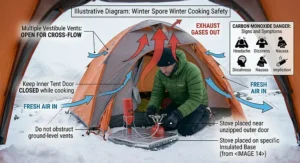
British winter camping involves a remarkable amount of moisture — condensation, rain, sleet, snow, and damp ground. Metal components including stove valves, canister connections, and pot bases collect moisture and can freeze between uses. Always dry your stove thoroughly before packing if temperatures are dropping overnight, and store it in a sealed dry bag inside your pack. Liquid from condensed cooking steam in a sealed tent can also ice up valve mechanisms on canister stoves left uncovered overnight.
Common Mistakes When Buying a Winter Camping Stove in the UK
Buying a Three-Season Stove and Expecting Four-Season Performance
The number one error. “Works fine on my summer camping trips” does not prepare you for a -5°C night on the Pennines. If a stove has no pressure regulator and no mention of low-temperature performance in its specifications, assume it is a three-season design and treat it accordingly.
Ignoring Fuel Canister Specifications
A top-tier stove paired with a cheap, pure-butane canister will perform like a budget stove in cold conditions. Conversely, a modestly priced stove like the PocketRocket 2 with a Primus Winter Gas cartridge will outperform an unregulated mid-range stove with a standard cartridge. The canister matters as much as the stove — perhaps more so.
Underestimating British Wind
British campers have a tendency to focus on temperature when evaluating stoves, when actually wind is a far more consistent challenge in our climate. A windscreen or enclosed-burner system should be a higher priority for a Dartmoor November camp than ultra-cold performance. Plan for horizontal rain and 50 km/h gusts, not merely -10°C.
Buying US Models That May Not Include UK-Compatible Canisters
Some stoves listed on Amazon.co.uk are fulfilled by international sellers and shipped from EU or US warehouses. While the stoves themselves work perfectly with UK EN417-standard canisters, accessories such as fuel canisters sent from overseas may not arrive promptly. Always verify that isobutane canisters compatible with EN417 Lindal valves are available locally — they are, from Cotswold Outdoor, Go Outdoors, and Amazon.co.uk itself.
Neglecting to Practise Setup at Home
The MSR WhisperLite Universal requires priming before use. The PocketRocket 2’s valve requires precise engagement with the canister in cold, gloved hands. Discovering these realities for the first time on a dark hillside in February is an unpleasant experience. Every new stove should be used at home — in the garden, in mild weather — before being trusted on a winter overnight.
✨ Don’t Miss These Exclusive Deals!
🔍 The right stove could genuinely make or break a winter trip. Click any highlighted product in this guide to check the latest price and availability on Amazon.co.uk — Prime members often benefit from next-day delivery, which is rather handy when a weather window opens unexpectedly.
Frequently Asked Questions
❓ What is the best camping stove for winter camping in the UK?
❓ Why does my camping stove struggle in cold weather?
❓ Can I use an inverted canister stove in winter in the UK?
❓ Are camping gas canisters available in UK outdoor shops for winter stoves?
❓ What fuel type is best for a camping stove for winter camping in very cold conditions?
Conclusion: The Right Stove Makes Winter Camping Genuinely Enjoyable
The gap between a good winter camping experience and a miserable one often comes down to the stove. Not the tent, not the sleeping bag — the stove. Because when your boots are soaked, your fingers are numb, and daylight has been gone for three hours, hot food and a warm drink are not luxuries. They are the difference between a trip you’ll repeat and one you’ll file under “lessons learned.”
The MSR WindBurner remains our top recommendation for the widest range of UK winter campers — it combines genuine all-weather performance with reasonable weight and ease of use. The Primus Lite+ is the best mid-range choice for solo adventurers who value fuel efficiency. The MSR WhisperLite Universal is the choice when temperatures are extreme and reliability is genuinely non-negotiable. The Jetboil Flash serves the mild British winter admirably with the right fuel. And the PocketRocket 2 proves that an informed budget buyer can still camp comfortably in winter with the right fuel selection.
Whatever stove you choose, remember: the best stove for winter camping in the UK is the one you’ve practised with, paired with appropriate fuel, and know how to operate in gloves at midnight in a gale. Buy it, use it at home first, and then head out. There are winter hills waiting.
✨ Don’t Miss These Exclusive Deals!
🔍 Click on any highlighted stove in this guide to check current pricing and availability on Amazon.co.uk. Prime members may enjoy free next-day delivery on eligible items — perfect for catching that upcoming weather window.
Recommended for You
- Best High Output Camping Stove UK 2026: 7 Powerful Picks Reviewed
- Best Mini Gas Stove for Travelling Light in 2026 (UK Guide)
- 7 Best Compact Camping Stoves UK 2026 – Lightweight Picks Tested
Disclaimer: This article contains affiliate links. As an Amazon Associate, I earn from qualifying purchases. If you purchase products through these links, we may earn a small commission at no additional cost to you.
✨ Found this helpful? Share it with your mates! 💬🤗
