
In This Article
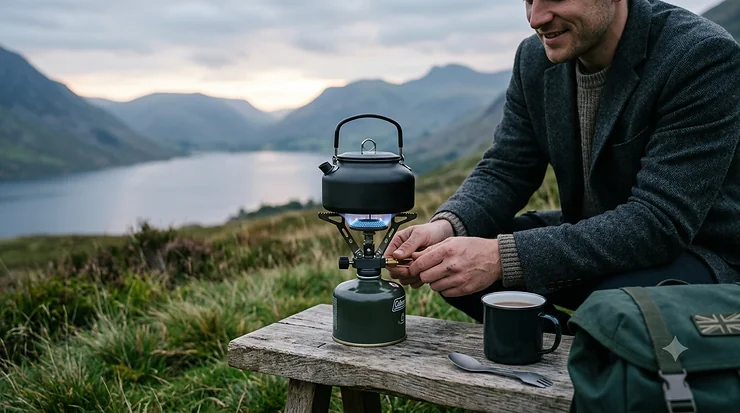
There’s a particular kind of joy in standing on a windswept ridge in the Lake District, watching a small flame coax water to a rolling boil while the rest of the world carries on below. The kettle’s on. Sort of. And it weighs roughly the same as a digestive biscuit.
That, in essence, is what a mini gas stove for travelling light is all about — not deprivation, but precision. Strip the experience of cooking outdoors back to its absolute essentials, and what you’re left with is something rather elegant: a tiny burner, a compatible canister, and the realisation that you genuinely do not need a full catering setup to eat well on the trail.
But here’s the thing. Not all lightweight stoves are created equal. The difference between a £15 bargain and a £70 piece of precision engineering can mean the difference between boiling water in 3 minutes and standing in a Force 5 gust watching your flame flicker and die. In British weather — which oscillates unpredictably between “surprisingly pleasant” and “biblical punishment” — that distinction matters enormously.
In this guide, we’ve done the legwork so you don’t have to. We’ve researched what’s actually available on Amazon.co.uk right now, dug into real customer feedback from UK buyers, and applied the kind of critical thinking that goes beyond copying out a spec sheet. Whether you’re packing for a solo Pennine Way thru-hike, a bikepacking weekend in the Scottish Borders, or a van life adventure down country lanes, there’s a mini gas stove here that suits your style, your budget, and — crucially — your pack weight.
A mini gas stove for travelling light typically refers to a compact, canister-mounted burner weighing under 150g that screws directly onto an isobutane-propane fuel canister, requires no priming, and packs small enough to nest inside your cooking pot.
Quick Comparison: Top 7 Mini Gas Stoves for Travelling Light (UK 2026)
| Stove | Weight | Output | Boil Time (1L) | Price Range | Best For |
|---|---|---|---|---|---|
| MSR PocketRocket 2 | 73g | 2,400W | ~3.5 min | £40–£55 | All-round performance |
| MSR PocketRocket Deluxe | 83g | 3,000W | ~3.5 min | £60–£75 | Cold & regulated cooking |
| BRS-3000T | 25g | 2,700W | ~3 min | £10–£20 | Absolute gram-counters |
| SOTO WindMaster 4-Flex | 67g | 3,260W | ~2.5 min | £65–£85 | Windy UK conditions |
| Fire-Maple Hornet II | 48.5g | 2,500W | ~3.3 min | £35–£50 | Ultralight titanium quality |
| Fire-Maple FMS-300T | 45g | 2,600W | ~3.8 min | £25–£40 | Budget ultralight |
| Fire-Maple Blade 2 | 135g | 2,800W | ~3.5 min | £50–£70 | Cold weather & winter trips |
Prices based on Amazon.co.uk research at time of writing. Check current pricing on Amazon.co.uk as prices change frequently.
The table tells part of the story — but only part. What it won’t tell you is that the lightest stove (the BRS-3000T) will have a rough time in the sort of gusty conditions you’ll regularly meet on exposed British hilltops, while the SOTO WindMaster costs three times as much but earns every penny when the weather turns nasty. Read on for the full picture.
💬 Just one click — help others make better buying decisions too! 😊
✨ Don’t Miss These Exclusive Deals!
🔍 Take your outdoor cooking to the next level with these carefully selected products. Click on any highlighted item to check current pricing and availability on Amazon.co.uk. These picks will help you find exactly the stove you need!
Top 7 Mini Gas Stoves for Travelling Light: Expert Analysis
1. MSR PocketRocket 2 — The Dependable All-Rounder
The PocketRocket 2 is the stove that converted a generation of backpackers to lightweight cooking, and it’s still earning its place in UK rucksacks in 2026. Weighing just 73g with a modest footprint, it screws onto any EN 417 threaded canister and gets out of your way. The 2,400W output boils a litre of water in around 3.5 minutes in calm conditions — that’s fast enough for a quick brew before you head off into the drizzle.
What separates the PocketRocket 2 from cheaper rivals is its simmer control. You can dial it down from a full roar to a gentle tick, which matters when you’re cooking actual food rather than just boiling water for freeze-dried meals. The WindClip windshield helps somewhat in breezy conditions, though it’s worth being honest: on an exposed Scottish Munro in October, you’ll still want to find a bit of shelter or carry a separate windscreen.
This is the stove for the sensible majority — people who want reliability, reasonable weight, and a brand with a solid UK customer service presence. UK reviewers consistently praise its durability; several mention using the same unit for three or four years of regular hillwalking without issues. Available on Amazon.co.uk and Prime-eligible for next-day delivery.
✅ Lightweight and compact — nests inside most 750ml pots
✅ Precise simmer control for actual cooking, not just boiling
✅ Trusted brand with long-term durability record
❌ No piezo igniter — you’ll need matches or a lighter
❌ Wind performance can disappoint on exposed ridgelines
Around £40–£55 — exceptional value for a stove that will likely outlast most of your other kit.
2. MSR PocketRocket Deluxe — Cold Weather’s Best Friend
Think of the PocketRocket Deluxe as the elder sibling who went to engineering school. It takes the beloved PocketRocket formula and adds a pressure regulator — and that single addition changes everything. An unregulated stove loses power as the canister empties and as temperatures drop; on a Scottish winter wild camp at -5°C, that can mean watching your flame splutter just when you need it most. The Deluxe doesn’t do that. It delivers consistent output from the first boil to the last dregs of fuel.
The built-in piezo igniter is genuinely useful — no fumbling for a lighter with cold, numb fingers. The wider burner head also distributes heat more evenly, which means you can actually simmer a curry rather than just scorching the bottom of it. At 83g it’s only 10g heavier than the standard PocketRocket 2, but for three-season use in British conditions, that 10g is arguably the best weight you’ll ever carry.
UK buyers in colder climates — Scotland, Northern England, Wales — will particularly benefit from the regulated output. One Lake District hiker noted in their Amazon.co.uk review that the Deluxe performed flawlessly down to near-freezing temperatures, while their previous unregulated stove struggled. It’s Prime-eligible with next-day delivery to most UK postcodes.
✅ Pressure regulator maintains consistent output in cold temps
✅ Built-in piezo igniter — works with cold fingers
✅ Wide burner head for better heat distribution and simmering
❌ Pricier than the standard PocketRocket 2
❌ Slightly larger packed size
Around £60–£75 — worth every penny for anyone doing three or four-season camping in Britain.
3. BRS-3000T — The Gram-Counter’s Dream (and a Few Caveats)
Twenty-five grams. Let that sink in. The BRS-3000T weighs less than a standard AA battery. It’s the kind of number that makes ultralight hikers actually emit a small noise of satisfaction. Made from titanium alloy, this tiny Chinese-engineered stove screws onto any EN 417 canister and outputs a respectable 2,700W — which, in calm conditions, boils a litre of water in around three minutes.
Here’s where we need to be honest with you, because the spec sheet won’t be. The BRS-3000T is excellent when the conditions cooperate. The moment British weather asserts itself — which, in our experience, is approximately always — its unprotected, minuscule burner becomes vulnerable. In any meaningful wind, performance degrades noticeably, and the flame can extinguish altogether. The pot supports are also on the small side; pair it with a titanium 750ml mug rather than a wide frying pan.
That said, for fair-weather trips, sheltered woodland campsites, bikepacking stopovers in valleys, or as a featherweight backup stove for longer expeditions, the BRS-3000T is virtually unbeatable at its price point. UK buyers on a tight budget routinely give it four and five stars on Amazon.co.uk — just buy a windscreen alongside it. Widely available and Prime-eligible.
✅ Astonishingly light — just 25g
✅ Strong output for its size (2,700W)
✅ Unbeatable value for money in the UK
❌ Struggles significantly in wind — carry a windscreen
❌ Tiny pot supports can feel unstable with larger cookware
Around £10–£20 — buy two and leave one at home as a spare. You’ve still spent less than a round of drinks.
4. SOTO WindMaster with 4Flex — Britain’s Weather Has Met Its Match
If the BRS-3000T is the stove for sunny days, the SOTO WindMaster is the stove for Britain. Japanese engineering at its finest, the WindMaster’s concave burner head is specifically designed to maintain a stable, flat flame disc even in gusty conditions — and it genuinely delivers on that promise in a way that most stoves simply don’t. UK hillwalkers who’ve switched from the MSR PocketRocket 2 consistently describe the WindMaster as a revelation in breezy conditions.
The micro-regulator ensures consistent output as the canister drains and as temperatures drop, which makes it a legitimate four-season option for serious British adventurers. The 4Flex pot support accommodates larger cookware beautifully; swapping to the TriFlex (sold separately) drops weight further for smaller mugs and pots. At 67g with the 4Flex attached, it’s impressively compact. The stealth piezo igniter is recessed to prevent damage and fires reliably every single time — a small detail that matters at 700 metres in the driving rain.
UK Amazon reviews are strikingly consistent: buyers who’ve used the MSR PocketRocket 2 and the SOTO WindMaster side-by-side in British conditions almost universally rate the WindMaster superior for wind resistance. One UK reviewer described testing both stoves on the same exposed ridge in Snowdonia: the PocketRocket 2 struggled, the WindMaster barely flinched. Prime-eligible on Amazon.co.uk.
✅ Outstanding wind resistance — the best in this category
✅ Micro-regulator for cold-weather consistency
✅ Compact despite the powerful output (3,260W)
❌ Premium price point — noticeably more expensive than most rivals
❌ The TriFlex for smaller pots is sold separately
Around £65–£85 — the most expensive stove on this list, and among the best justified.
5. Fire-Maple Hornet II — Titanium Excellence at a Sensible Price
Fire-Maple has quietly become one of the more impressive names in lightweight camping gear over the past decade, and the Hornet II is arguably their flagship statement stove. Weighing just 48.5g in titanium, with folded dimensions of 50 × 50 × 80mm, it’s compact enough to slip into a shirt pocket and outputs a solid 2,500W — boiling a litre of water in around 3 minutes 20 seconds.
What separates the Hornet II from the FMS-300T (Fire-Maple’s older original Hornet design, also on this list) is refinement. The pot supports are wider and more stable, the flame control is smoother, and the overall build quality has that satisfying density that suggests it’ll survive years of rattling around in a rucksack. UK reviewers particularly praise how well it pairs with Fire-Maple’s own heat-exchanger pots — though it works perfectly well with any standard cookware.
Wind protection is moderate. Better than the BRS-3000T, not in the same league as the SOTO WindMaster. For walking in sheltered valleys, woodland, or below the treeline in Wales and the Pennines, it’s an excellent choice. For exposed highland ridges, budget for a windscreen. Available on Amazon.co.uk, typically Prime-eligible.
✅ Genuine titanium construction — lightweight and durable
✅ Wider pot supports than many rivals at this weight
✅ Pairs exceptionally well with heat-exchanger cookware
❌ Wind performance could be better for exposed UK terrain
❌ Simmer control is adequate but not the finest in class
Around £35–£50 — a very strong proposition for anyone wanting titanium quality without MSR-level pricing.
6. Fire-Maple FMS-300T — ISPO Gold Award Winner, Budget-Friendly Gem
The Fire-Maple FMS-300T (sometimes sold as the original Hornet) is something of a dark horse on this list. It’s an ISPO Design Award Gold Winner — a fact the spec sheet happily shouts about, and for once, the bragging is justified. Weighing just 45g, made from titanium, and folding down to roughly the size of a lipstick, it is a genuinely impressive piece of compact engineering that costs less than a decent meal out.
The wide-spread flame distribution boils a litre in around 3 minutes 50 seconds — not the fastest on this list, but perfectly respectable. The broader flame pattern actually makes it better for real cooking than some of its more torch-like rivals; heat distributes more evenly across the base of the pot, which reduces hot spots and makes porridge on a damp November morning rather less fraught. As a budget gateway into ultralight cooking, it’s hard to fault.
The main caveat is wind. This stove has no wind protection whatsoever, and in typical British conditions you’ll need a windscreen. Several UK reviewers mention this explicitly, recommending the FMS-300T as a fair-weather companion or for sheltered camping scenarios — campsites, woodland, or valley camping in particular. Available on Amazon.co.uk.
✅ ISPO Design Award winner — quality that’s been independently recognised
✅ Budget-friendly entry into titanium ultralight stoves
✅ Wider flame distribution for more even cooking
❌ Wind performance is poor without a separate windscreen
❌ Slightly longer boil time than some competitors
Around £25–£40 — the best-value titanium stove on Amazon.co.uk, full stop.
7. Fire-Maple Blade 2 — The Cold-Weather Specialist
The Blade 2 occupies a different niche to the other stoves on this list — it’s heavier (135g) and designed specifically for winter and sub-zero conditions. The remote canister design means you run the fuel line to an inverted canister, which allows liquid fuel to feed the burner. Add the pre-heat tube that warms the fuel before combustion, and what you get is a stove that doesn’t sulk when the temperature plummets. In British terms: Cairngorms in January. Ben Nevis in February. The days when the summit is plastered in ice and a hot meal isn’t a luxury, it’s a necessity.
Output is 2,800W, which is strong, and stability is excellent thanks to the folding titanium legs that keep the whole assembly grounded even in moderate gusts. The 135g weight is higher than the other six stoves here, but for winter trips where an unregulated canister-top stove might simply refuse to work reliably, it’s weight that earns its passage.
This stove also works with an LPG adapter for Coleman-style bottles — useful if you’re based near a camping shop or high street outdoor retailer that stocks Coleman butane rather than threaded isobutane canisters, which can be harder to find in rural Britain. UK Amazon reviewers praise its cold-weather performance and compactness relative to its feature set. Prime-eligible.
✅ Remote canister + pre-heat tube for genuine cold-weather performance
✅ Excellent stability from folding titanium legs
✅ Works with LPG adapter for wider fuel compatibility in the UK
❌ Heavier than upright canister stoves on this list (135g)
❌ More setup involved — not a quick-boil solution
Around £50–£70 — the right tool for winter wild camping in Britain; unnecessary overkill for three-season use.
How to Use Your Mini Gas Stove Safely and Effectively in the UK
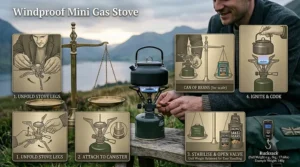
Setting up a mini gas stove for the first time is disarmingly simple — but there are a few things the product listing won’t tell you that’ll make a genuine difference in British conditions.
Attach the canister on firm, level ground. This sounds obvious until you’re balancing on a heathery slope in Dartmoor and the whole thing tips over. Always find the flattest patch available, even if it means moving a few feet. A pot full of boiling water and a top-heavy canister combination is not one you want to test on a slope.
Wind is your primary enemy. Even stoves with wind protection benefit from natural shelter — a rucksack, a rock, a drystone wall. Angle yourself so the wind comes from behind. The difference in fuel consumption and boil time between a sheltered and an exposed position is dramatic; one UK hillwalker estimated using twice as much fuel in an exposed camp versus a sheltered woodland site on the same trip.
In autumn and winter, warm your canister before use. Isobutane-propane mix performs better when the canister is at a reasonable temperature. Keeping it in a jacket pocket for 10 minutes before use — particularly on cold Highland mornings — makes a measurable difference to output on all but regulated stoves.
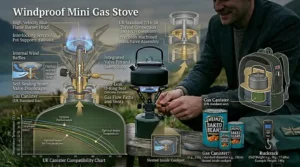
Screw-thread compatibility matters. All seven stoves on this list use the EN 417 screw-thread standard, compatible with Primus, MSR IsoPro, Coleman, and most own-brand camping gas canisters sold in UK outdoor shops. The one exception to note: the Fire-Maple Blade 2 can use an LPG adapter, but Coleman-style twist-and-click canisters (the older non-threaded type) are not compatible with any stove on this list without an adapter.
Store your canister safely. Never store a canister with a stove attached. UK summers can get warm in enclosed vehicles (yes, even our summers), and a pressurised canister left in a car boot in direct sun is a risk not worth taking. Separate the stove, pop the canister cap on, and store them away from heat sources. It’s basic, it matters.
Real-World Scenarios: Which Stove Suits Which UK Adventurer?
The Solo Pennine Way Thru-Hiker (Budget: £40–£60)
You’re walking 431km through the spine of England, probably over 16–20 days. Every gram is examined, every purchase justified. You’ll camp on moorland — sometimes sheltered in dips, sometimes horribly exposed on high ground. The MSR PocketRocket 2 is the obvious recommendation here: proven reliability, strong simmer control for proper evening meals, and a weight that barely registers. Buy a lightweight windscreen (under 50g, available on Amazon.co.uk) and carry it the whole way. Total cooking system weight under 130g.
The Bikepacking Weekend Warrior (Budget: £10–£25)
You’ve got panniers rather than a rucksack, so weight isn’t the absolute religion it is for backpackers — but space is. You want something that nests inside a 750ml titanium mug alongside a small canister. The BRS-3000T is genuinely ideal here: it’s laughably cheap, fits anywhere, and bikepacking routes through the Brecon Beacons or the Yorkshire Dales tend to offer valley camping with natural wind shelter. Save the money and spend it on a decent waterproof.
The Scottish Highlands Winter Camper (Budget: £65–£90)
You’re serious. You camp in months when sensible people don’t. You’ve been above 1,000 metres in conditions that would genuinely ruin most people’s week. The SOTO WindMaster with 4Flex is your stove — full stop. Pair it with a Heat Exchanger pot like the Fire-Maple Petrel or a SnowPeak 700ml mug and you have one of the most capable lightweight cooking systems available to UK buyers. The regulated output means it still performs when the canister is half-empty and the temperature is well below freezing.
The Van-Lifer Seeking a Compact Backup Stove (Budget: £25–£50)
You have a larger stove in the van, but you want something ultralight for day hikes and overnight walks away from the vehicle. The Fire-Maple FMS-300T hits the brief perfectly: cheap enough that you won’t worry about it, light enough to forget it’s there, and capable enough to boil water for coffee or tea at a viewpoint. Wind won’t be a concern if you’re stepping away from the van on a calm summer day — and if it isn’t, you can always retreat to the van stove.
Common Mistakes When Choosing a Mini Gas Stove in the UK
Buying purely on weight without considering wind performance. This is the most frequent error UK buyers make, and it’s understandable — the lightest stoves have the most impressive-sounding stats. But Britain is not Yosemite. We have sustained Atlantic winds, coastal gusts, and moorland exposed to weather from all directions. A stove that performs brilliantly in calm conditions and fails in wind is, in most British contexts, a flawed tool. Weight matters; so does whether it actually works when you need it.
Ignoring fuel canister availability. All the stoves on this list use EN 417 threaded isobutane-propane canisters. These are readily available at outdoor shops like Cotswold Outdoor, Tiso, and many independent camping retailers throughout the UK. However, in very rural areas — think remote parts of the Scottish Highlands or mid-Wales — availability can be patchy. For trips in genuinely remote areas, carry more fuel than you think you need, or choose a stove (like the Fire-Maple Blade 2) with LPG adapter compatibility for the more ubiquitous Coleman bottles.
Forgetting that gas performance drops in cold temperatures. Butane loses pressure rapidly below 0°C. An isobutane-propane mix (what most modern canisters use) performs better in the cold, but still degrades. If you’re camping in Britain between November and March, a pressure-regulated stove (the MSR PocketRocket Deluxe, the SOTO WindMaster, or the Fire-Maple Blade 2) is not a luxury but a sensible investment.
Assuming a canister will last as long as the manufacturer claims. Manufacturer burn times are measured in lab conditions: no wind, room temperature, constant output. In real British conditions, expect roughly 25–35% less. A 227g canister claimed to give 60 minutes of burn time might deliver 40 minutes on a blustery hill. Plan accordingly, and carry a spare canister on multi-day trips.
Overlooking the importance of simmer control for actual cooking. If you eat only freeze-dried meals that require nothing but boiling water, simmer control is irrelevant. If you cook real food — pasta sauces, scrambled eggs, porridge — a stove with poor simmer capability will make you miserable. The MSR PocketRocket 2, the MSR PocketRocket Deluxe, and the SOTO WindMaster all offer genuine simmer control. The BRS-3000T does not; it’s essentially on or off.
Mini Gas Stove vs Alcohol Stove vs Solid Fuel: What Actually Makes Sense in Britain?
The great stove debate never quite goes away in outdoor forums, and it deserves an honest answer in a British context.
Gas wins for convenience and speed. No priming, no spilled methylated spirits, no waiting for tablets to ignite. Screw on the canister and you’re cooking in 30 seconds. For the majority of UK walkers, bikepacking adventurers, and van-lifers, a mini gas stove for travelling light is the obvious practical choice.
Alcohol stoves win on fuel weight and international travel. Meths (methylated spirits) is available almost everywhere in the UK, including most hardware shops and many supermarkets. For very long trips where resupply is a concern, alcohol stoves offer flexibility. The trade-off: they’re slower, more affected by wind, and terrible in cold temperatures.
Solid fuel (Esbit, hexamine) wins in emergency backups. Lightweight, inert, indefinite shelf life. But slow, smelly, and not something you’d choose as a primary cooking solution.
For the vast majority of people reading this guide, a mini gas stove for travelling light remains the strongest all-round answer for UK conditions. Fuel canisters are widely available, the systems are reliable, and the weight penalty over alcohol stoves is minimal — often 50–100g for the canister overhead.
| Factor | Mini Gas Stove | Alcohol Stove | Solid Fuel |
|---|---|---|---|
| Speed | ✅ Fast (3–4 min/litre) | ❌ Slow (6–8 min/litre) | ❌ Very slow |
| Wind resistance | ⚠️ Variable | ❌ Poor | ❌ Poor |
| Cold performance | ⚠️ Variable (regulated = good) | ❌ Poor | ✅ Reliable |
| UK fuel availability | ✅ Widely available | ✅ Widely available | ✅ Widely available |
| Weight (system) | ✅ Very light (sub-100g) | ✅ Ultra-light | ✅ Ultra-light |
| Best For | 3–4 season UK use | Summer touring | Emergency backup |
Gas wins on points — particularly for British autumn and winter conditions where cold performance and boil speed matter most.
Long-Term Cost and Maintenance in the UK
These stoves require almost no maintenance, which is part of their charm. That said, there are a few things worth knowing if you want yours to last.
Keep the jet clean. The burner jet on any canister stove can accumulate residue over time. A gentle clean with a fine needle or a specialised jet-clearing tool (available cheaply on Amazon.co.uk) keeps flow consistent. Never use anything abrasive.
Inspect the O-ring before every trip. The rubber O-ring that seals the connection between stove and canister is the single most likely point of failure. Carry a spare — they’re tiny, cheap, and available from most outdoor retailers and on Amazon.co.uk. The BRS-3000T helpfully includes a spare in the box.
Canister cost over time. A 227g isobutane-propane canister costs around £5–£8 in UK outdoor shops. Used efficiently, one canister boils roughly 12–16 litres of water — enough for a long weekend of solo camping. Annual running costs are minimal: perhaps £20–£40 in fuel per active season, depending on how often you’re out.
Piezo igniter longevity. Built-in piezo igniters (found on the MSR PocketRocket Deluxe and SOTO WindMaster) can eventually fail, usually after several hundred uses or following moisture ingress. Always carry a small lighter or waterproof matches as backup — this is good practice regardless of whether your stove has an igniter. The Royal Warrant holder Primus recommends keeping your stove dry and away from grit, particularly around the igniter mechanism.
For further guidance on safe use of gas appliances outdoors, the Health and Safety Executive (HSE) publishes useful guidance on camping gas safety in the UK.
Features That Actually Matter (And Those That Don’t)
After sifting through dozens of product listings and hundreds of UK customer reviews, here’s our honest assessment of which features make a real difference and which are marketing filler.
Matters: Pressure regulation. On a cold morning in November, the difference between a regulated and unregulated stove is stark. The MSR PocketRocket Deluxe, SOTO WindMaster, and Fire-Maple Blade 2 all regulate output; the others don’t. If you camp in three or four seasons, regulation is worth paying for.
Matters: Weight under 100g. Above 100g for a stove alone starts to feel arbitrary unless you’re gaining meaningful features (like the Blade 2’s cold-weather design). Most of the stoves on this list are well below that threshold.
Matters: EN 417 compatibility. All seven stoves on this list are compatible with standard threaded isobutane canisters, which means you’re not locked into a proprietary fuel ecosystem. This is important for UK buyers given the varied availability of camping gas across British outdoor retailers.
Doesn’t really matter: Claimed BTU figures in isolation. 10,000 BTU sounds impressive until you realise that wind, canister temperature, and pot type all have a larger impact on actual boil times. Focus on real-world reviews rather than peak BTU output.
Doesn’t really matter: Exact packed dimensions. Beyond a certain size, any of these stoves fits inside a 750ml pot. A stove that’s 45mm × 50mm packed versus one that’s 50mm × 55mm packed makes essentially no practical difference to your pack organisation.
Matters: Pot support stability. The BRS-3000T’s tiny pot arms are functional with small titanium cups; with anything larger, they feel precarious. The SOTO WindMaster’s 4Flex and the MSR PocketRocket Deluxe’s wider arms are meaningfully more stable. If you cook with pots larger than 750ml, this is worth considering.
Frequently Asked Questions
❓ Can I take a mini gas stove in my hand luggage on a UK flight?
❓ What gas canisters are compatible with mini gas stoves in the UK?
❓ How long does a 100g gas canister last with a mini stove?
❓ Are mini gas stoves safe to use in a tent or bivvy bag?
❓ Do I need a windscreen with a mini gas stove for UK hillwalking?
Conclusion: The Right Stove for the Right Adventure
Choosing a mini gas stove for travelling light is, at its core, about matching the tool to the terrain. No single stove is definitively the best — but the right stove for your trips absolutely exists, and it’s on this list.
If you’re a year-round British hiker who values reliability above all else, the SOTO WindMaster with 4Flex is the premium choice that justifies its price in British weather. For the sensible majority who hike spring through autumn and want proven all-round performance, the MSR PocketRocket 2 remains one of the finest lightweight stoves money can buy. Budget-conscious gram-counters who camp in sheltered terrain will find the BRS-3000T frankly astonishing for the price. And for cold-weather specialists who venture into the Highlands between November and March, the Fire-Maple Blade 2 is a different kind of stove entirely — built for the days when everything else struggles.
The best part? Even the most expensive option on this list costs less than a night in a bunkhouse. Spend wisely, cook well, and enjoy the view.
✨ Don’t Miss These Exclusive Deals!
🔍 Check the latest prices and availability on all seven stoves above — click any highlighted product name to view current pricing on Amazon.co.uk. Stove prices fluctuate regularly, and Prime members can often get next-day delivery.
Recommended for You
- 7 Best Compact Camping Stoves UK 2026 – Lightweight Picks Tested
- Campingaz 206 Stove: 7 Best Models for UK Campers in 2026
- Push Fit Camping Stove UK 2026: 7 Best Picks & Buying Guide
Disclaimer: This article contains affiliate links. As an Amazon Associate, I earn from qualifying purchases. If you purchase products through these links, we may earn a small commission at no additional cost to you.
✨ Found this helpful? Share it with your mates! 💬🤗
