In This Article
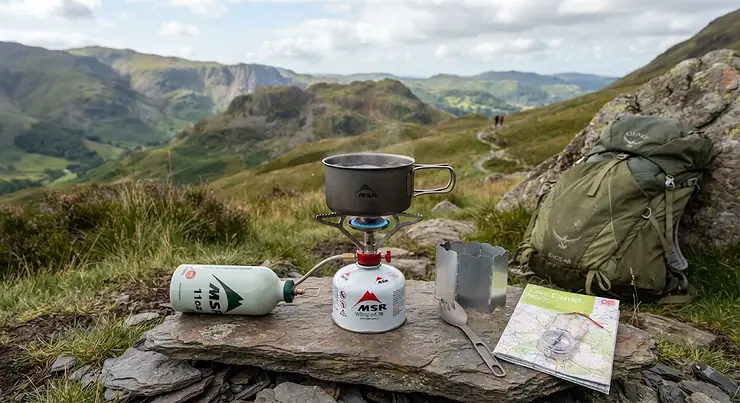
There’s a particular sound every liquid-fuel devotee knows: the hiss-then-roar of a white gas stove for backpacking catching flame on a cold morning, somewhere well above the treeline. It’s not subtle. It’s not silent. But when the temperature has dropped low enough to make a gas canister sulk and splutter, that roar is the sound of a hot brew arriving anyway. A white gas stove for backpacking runs on liquid naphtha rather than a pressurised gas canister, which is precisely why it keeps performing when butane-propane blends start losing pressure and patience in the cold.
This guide is built from genuine product research rather than recycled marketing copy: real specs, real aggregated review sentiment, and honest trade-off analysis, because that’s the only kind of advice worth trusting before you spend £90-£250 on a piece of kit your dinner depends on. We’ll walk through seven real stoves spanning budget brass classics to expedition-grade multi-fuel workhorses, then get into the practical stuff — packability, pack weight, trail cooking setups, and the eternal “white gas vs petrol” confusion that trips up so many first-time buyers.
What Is a White Gas Stove for Backpacking?
A white gas stove for backpacking is a liquid-fuel camping stove that burns refined naphtha (commonly sold as Coleman Fuel, Primus PowerFuel, or Optimus Fuel) rather than a compressed gas canister. Fuel is hand-pumped to pressure in a refillable bottle, which is why these stoves keep burning hot and consistently in freezing temperatures and at altitude where canister stoves struggle.
The trade-off is upfront complexity. You’ll need to prime the stove — briefly pre-heating the fuel line so it vaporises properly — before it settles into its full roar. Most models in this guide also double as multi-fuel stoves, meaning the same burner can run on kerosene, unleaded petrol, or even diesel in a pinch, which is exactly why the phrase white gas stove for backpacking and multi-fuel expedition stove so often describe the same piece of kit.
Quick Comparison Table
| Stove | Best For | Weight (min) | Price Range |
|---|---|---|---|
| Optimus Svea 123R | Solo minimalists, backup stove | ~19 oz / 550 g | £90-£110 |
| MSR WhisperLite | Lightest pure white gas option | ~11.5 oz / 326 g | £110-£130 |
| MSR WhisperLite International | Globetrotting multi-fuel trips | ~11.2 oz / 318 g | £140-£165 |
| Primus OmniLite Titanium | Lightweight real cooking, not just boiling | ~11.5 oz / 326 g | £175-£190 |
| MSR WhisperLite Universal | Hybrid canister + liquid flexibility | ~11.2-13.7 oz / 318-388 g | £175-£210 |
| Primus OmniFuel II | Precision simmer control | ~15.9 oz / 450 g | £190-£205 |
| MSR XGK EX | Winter expeditions, dirty fuel | ~13.5 oz / 380 g min | £220-£250 |
Looking at the spread above, the gap between the Optimus Svea 123R and the MSR XGK EX isn’t really about weight — it’s about how much fuel flexibility and flame control you’re willing to pay for. Budget picks like the Optimus Svea 123R and classic MSR WhisperLite are genuinely lighter on the wallet but burn one fuel type only, while the Primus OmniFuel II and MSR XGK EX justify their higher price ranges through genuine field-tested versatility across kerosene, diesel, and even aviation fuel.
💬 Just one click — help others make better buying decisions too!😊
Top 7 White Gas Stoves for Backpacking: Expert Analysis
1. Optimus Svea 123R — no-moving-parts brass classic
The Optimus Svea 123R has barely changed since it first appeared in the mid-20th century, and that’s precisely its appeal. The all-brass burner and integrated fuel tank weigh in at roughly 550 g (19 oz) complete with its aluminium cup, hold about 4 fl oz of white gas, and burn for 40-60 minutes on a full fill without a separate pump to fail. Output sits around 4,780 BTU, with a boil time near 7 minutes per litre — slow by modern standards, but the trade-off buys you a design with essentially nothing left to break in the field.
This is a stove for the backpacker who values proven simplicity over speed: solo trekkers, traditionalists, or anyone who wants an unkillable backup buried at the bottom of the pack. Reviewers who’ve owned theirs for decades consistently describe the same thing — total reliability with virtually no maintenance beyond an occasional seal replacement, though several also flag that priming in cold weather takes practice and produces a brief yellow flare that can singe an unwary hand.
Pros:
- ✅ All-brass build with no pump or moving parts to fail
- ✅ Decades of proven field reliability from long-term owners
- ✅ Compact, self-contained fuel tank needs no separate bottle
Cons:
- ❌ Fixed tank can’t be refilled or topped up mid-burn
- ❌ Cold-weather priming needs practice and produces a flare
At around £90-£110, the Optimus Svea 123R is the cheapest genuinely field-proven stove on this list, and for solo or backup use it’s hard to argue with the value.
2. MSR WhisperLite — lightest pure white gas stove
The original MSR WhisperLite remains the lightest true liquid-fuel stove MSR makes, with a minimum weight around 11.5 oz (326 g) and a packed weight of roughly 14.5 oz (410 g) once the pump, windscreen and stuff sack are included. On white gas it boils a litre of water in around 3.5-3.9 minutes and will burn for roughly 136 minutes per 600 ml (20 oz) of fuel. What that means in practice: it hits canister-stove weight while burning fuel that stays reliable well below freezing, something isobutane blends simply can’t match.
Because it’s a single-fuel design — white gas only, no kerosene or petrol jets — it’s a leaner, slightly cheaper entry point into the liquid-fuel world than its multi-fuel siblings. Based on the spec comparison with the rest of this lineup, the standard MSR WhisperLite suits UK-based weekend and week-long trips where you’re always sourcing Coleman Fuel or Primus PowerFuel from a familiar outdoor shop rather than improvising with unknown fuel abroad.
Reviewers consistently note the shaker-jet self-cleaning mechanism as a genuine time-saver versus older liquid stoves, though a recurring complaint in aggregated feedback is sooty buildup around the primer cup, which tends to blacken pot bottoms over repeated use.
Pros:
- ✅ Lightest genuine liquid-fuel stove in the MSR line-up
- ✅ Self-cleaning shaker jet reduces field maintenance
- ✅ Wide UK spares and accessory support given its popularity
Cons:
- ❌ White gas only — no kerosene or petrol fuel jets included
- ❌ Simmer control is minimal, essentially on or off
Expect to pay somewhere in the £110-£130 range, making this one of the more accessible genuine liquid-fuel stoves for backpackers who don’t need multi-fuel flexibility.
3. MSR WhisperLite International — the globetrotter’s multi-fuel pick
Take the standard WhisperLite chassis and add swappable jets for kerosene and unleaded auto fuel, and you get the MSR WhisperLite International, weighing a near-identical 11.2 oz (318 g) minimum and 14.9 oz (422 g) packed. Boil times run 3.5 minutes per litre on white gas and 4.4 minutes on kerosene, with the self-cleaning Shaker Jet technology carried over from the original.
What the spec sheet won’t tell you, but reviewers note, is how much this multi-fuel flexibility matters the moment you leave UK shores. Trekking in South America or Central Asia, Coleman Fuel can be nearly impossible to find, while diesel or kerosene sold at any petrol station will run this stove just fine once you swap the jet. That’s the whole case for choosing the MSR WhisperLite International over the plain WhisperLite: identical weight and near-identical price, but insurance against a country where white gas simply isn’t stocked.
Aggregated review sentiment across outdoor retailers highlights easy field maintenance and dependable performance as the standout strengths, with occasional long-term reports of fuel-line seal wear and burner-ring degradation after years of hard use — issues MSR’s small-parts kit is specifically designed to address.
Pros:
- ✅ Swappable jets burn white gas, kerosene or unleaded auto fuel
- ✅ Field-maintainable Shaker Jet keeps clogging to a minimum
- ✅ Compact enough to nest inside most MSR pot sets
Cons:
- ❌ Jets must be manually swapped when changing fuel type
- ❌ Long-term owners report occasional seal and burner-ring wear
Pricing typically sits in the £140-£165 range, and for anyone planning an international trekking trip, this is arguably the safest fuel-flexible choice on the list.
4. Primus OmniLite Titanium — lightest stove that actually cooks
The Primus OmniLite Titanium shaves weight through titanium pot supports and heat shield, bringing the burner body down to around 220-240 g and a full trail weight near 11.5 oz (326 g) once the pump and accessories are counted — genuinely competitive with the lightest MSR options despite carrying a proper control valve. Output sits around 8,900 BTU, and it runs on gas canisters, petrol, kerosene, or diesel depending on which jet is fitted.
The standout feature here isn’t the weight, though — it’s the simmer control. Unlike the WhisperLite’s essentially binary on/off valve, the Primus OmniLite Titanium has a genuine adjustable control knob that lets you hold a low, steady flame. Based on the spec comparison, this is the stove for backpackers who want to actually cook — sautéing vegetables, baking flatbread, gently thawing frozen food — rather than just boiling water for a dehydrated meal pouch.
Reviewers repeatedly single out the simmer performance and low pack weight as the two genuine wins, while a recurring theme in aggregated feedback is the leather pump cup, which several long-term owners note needs occasional lubrication or replacement to keep priming reliable.
Pros:
- ✅ Genuine simmer control via dedicated adjustable valve
- ✅ Titanium construction keeps it among the lightest multi-fuel options
- ✅ Runs on gas, petrol, kerosene or diesel with jet swaps
Cons:
- ❌ Leather pump cup needs occasional maintenance
- ❌ One of the pricier stoves in this line-up
At roughly £175-£190, the Primus OmniLite Titanium commands a premium, but it’s arguably justified for anyone who wants proper trail cooking rather than boil-in-bag convenience.
5. MSR WhisperLite Universal — hybrid canister and liquid fuel
The MSR WhisperLite Universal was MSR’s first stove to genuinely combine canister and liquid-fuel capability in one burner, using patent-pending AirControl technology to deliver consistent performance regardless of which fuel is loaded. Weight ranges from 11.2 oz (318 g) in canister-only trim up to 13.7 oz (388 g) with the full liquid-fuel kit, and boil times land around 3.5 minutes per litre on white gas, 3.75 minutes on canister gas, and 4.4 minutes on kerosene.
Here’s what most buyers overlook about hybrid stoves: the value isn’t in using both fuel types simultaneously, it’s in owning one stove that covers an entire season’s worth of trip types. Reviewers describe using the MSR WhisperLite Universal with a canister for fast-and-light three-season weekends, then switching to liquid fuel for a winter trip or an international expedition — without buying, carrying, or maintaining two separate stoves.
Aggregated feedback consistently ranks this as one of the most versatile stoves tested, particularly praising how well the windscreen pairs with canister mode for wind resistance most small canister stoves can’t match. The recurring downside noted across reviews is that simmering remains weak in liquid-fuel mode, and the added hybrid hardware brings real extra bulk versus the single-fuel WhisperLite.
Pros:
- ✅ Genuinely switches between canister and liquid fuel
- ✅ Windscreen pairing makes canister mode unusually wind-resistant
- ✅ Backed by MSR’s lifetime warranty
Cons:
- ❌ Heavier and bulkier than the single-fuel WhisperLite models
- ❌ Simmering is still limited when running on liquid fuel
Expect to pay in the £175-£210 range depending on whether you buy the stove alone or bundled with a fuel bottle, positioning it as a genuine one-stove-does-everything option for mixed-season backpackers.
6. Primus OmniFuel II — precision flame control for serious cooks
Where the WhisperLite range relies on a crude pump-mounted control, the Primus OmniFuel II fits a dedicated flame-adjustment knob directly on the burner, letting you dial in a genuine simmer even wearing gloves. It weighs around 450 g (15.9 oz) packed, produces 3,000 W (10,500 BTU/h), and boils a litre of water in roughly 3 minutes plus a 40-second pre-heat, with colour-coded jets marked by dots for gas, white gas/unleaded, and kerosene/diesel/aviation fuel.
What the spec sheet doesn’t fully capture is how this translates on the trail: reviewers consistently describe noticeably less soot buildup on pots than with a WhisperLite, plus a metal ErgoPump that feels built to outlast the plastic pumps found on cheaper multi-fuel stoves. Based on the spec comparison, this is the stove for expedition cooks, guides, or anyone running group meals who genuinely needs to hold a simmer rather than just boil and stop.
Long-term owner reviews highlight the robust build quality and award-winning reputation as the clear draw, though several note the price is roughly double that of an entry-level Whisperlite — a cost that only pays off if you actually use the extra flame control regularly.
Pros:
- ✅ Dedicated control knob gives genuine, repeatable simmer control
- ✅ Robust metal ErgoPump built for heavy, repeated use
- ✅ Colour-coded jets make fuel switching straightforward
Cons:
- ❌ Costs roughly double a basic single-fuel WhisperLite
- ❌ Heavier packed weight than the titanium OmniLite version
Pricing typically runs £190-£205, and for anyone who genuinely cooks on the trail rather than just boiling water, it’s arguably the most capable liquid stove here.
✨ Don’t Miss These Exclusive Deals!
🔍 Take your backcountry cooking to the next level with these carefully selected stoves. Click on any highlighted item to check current pricing and availability. These stoves will help you build a trail cooking setup that keeps you fed and warm on every trip.
7. MSR XGK EX — the expedition powerhouse
The MSR XGK EX traces its lineage back to MSR founder Larry Penberthy’s original Model 9 stove from 1973, and it remains the benchmark expedition burner more than fifty years later. Minimum weight sits around 13.5 oz (380 g), climbing to roughly 17-18 oz (480-510 g) packed with pump and accessories, and it produces the highest output in this line-up at approximately 10,500 BTU on white gas, boiling a litre in as little as 2.8-3.5 minutes. Crucially, it burns white gas, kerosene, unleaded auto fuel, diesel, and even aviation fuel.
Reviewers consistently call it the “number one choice on expeditions worldwide,” and aggregated feedback backs that up — multiple long-term owners describe running theirs reliably across six-month expeditions with minimal maintenance beyond routine cleaning. The retractable pot supports and legs give it genuine stability under a full-sized pot of melting snow, which is precisely the job it’s built for: turning solid snow into drinking water for a full team, day after day, at altitude.
Here’s the honest trade-off: what reviewers overlook until they own one is just how loud this stove runs, and simmering is essentially non-existent — some owners report it doesn’t hold a low flame at all without an aftermarket simmer plate. It’s not the stove for a casual weekend trip; it’s the stove for conditions where failure isn’t an option.
Pros:
- ✅ Broadest fuel compatibility, including dirty and aviation fuel
- ✅ Highest heat output in this line-up for fast snow-melting
- ✅ Decades of proven reliability on genuine expeditions
Cons:
- ❌ Runs notably louder than every other stove here
- ❌ Simmer control is poor to non-existent without an add-on plate
At roughly £220-£250, the MSR XGK EX is the priciest stove on this list, and it should be — this is expedition-grade equipment, not a casual weekend tool.
Trail Cooking Setup: Building Your Backpacking Kitchen
A white gas stove for backpacking is only one part of a working trail cooking setup, and getting the rest of the kit right changes how well any of these seven stoves actually perform. Pair your stove with a pot that matches its pot-support span — most liquid-fuel stoves here are designed to sit inside a 1.5-2.5 litre pot for packing, so buying oversized cookware just adds dead weight you’ll carry every day.
In the first 30 days of ownership, the most common mistake is skipping the priming step or under-priming in cold weather, which leads to a sputtering yellow flame instead of a clean blue roar — always prime with the manufacturer’s recommended amount and wait for the flame to die down before opening the fuel valve fully. Maintenance-wise, plan to shake the self-cleaning jet (on WhisperLite models) every few uses, and carry the small-parts repair kit that ships with most of these stoves; a spare O-ring and pump cup weigh almost nothing but can save an entire trip.
For a lean solo trail cooking setup, a 600 ml titanium pot, a folding spork, and a 0.35-0.6 litre fuel bottle sized to your trip length rounds out the kit without excess bulk.
Real-World Scenarios: Which Stove Matches Your Trip
If you’re a weekend hiker doing two or three overnight trips a year within the UK, the MSR WhisperLite or Optimus Svea 123R covers everything you need without paying for multi-fuel capability you’ll never use. Budget matters here, and both stoves sit comfortably under £130.
If you’re planning a six-month international trek where fuel availability is unpredictable — think South America, Central Asia, or parts of Africa — the MSR WhisperLite International or Primus OmniFuel II earns its higher price through genuine kerosene and unleaded-fuel compatibility. Reviewers who’ve bike-toured or through-hiked internationally consistently favour multi-fuel stoves precisely because Coleman Fuel simply isn’t stocked everywhere.
And if you’re heading into winter mountaineering or genuine expedition territory — multi-day snow-melting at altitude, sub-zero temperatures, group cooking for a full team — the MSR XGK EX is the honest answer, even accounting for its extra weight and noise.
Problem → Solution: Common White Gas Stove Issues
Stove won’t prime properly in cold weather. Warm the fuel bottle inside your jacket for a few minutes before pumping, and use slightly more priming fuel than you would in summer — cold naphtha vaporises more slowly.
Flame is yellow and sooty instead of blue. This usually means under-priming or a partially clogged jet. Shake the self-cleaning jet (WhisperLite models) or use the pricker tool (Primus/Optimus models) to clear it before your next boil.
Pump won’t build pressure. A worn pump cup or leather seal is the most common culprit, particularly on the Primus OmniFuel II and Primus OmniLite Titanium, both of which use a leather cup that dries out with age — a drop of silicone lubricant usually restores a proper seal.
Stove won’t simmer, only roars. Liquid-fuel stoves without a dedicated control knob (both WhisperLite models, the Svea, and the XGK EX) are genuinely limited here by design — if simmering matters to you, the Primus OmniFuel II or Primus OmniLite Titanium solves this properly rather than fighting the pump valve.
How to Choose a White Gas Stove for Backpacking
- Decide how many fuel types you actually need. If you only ever buy Coleman Fuel from a UK outdoor shop, a single-fuel stove like the MSR WhisperLite saves weight and money over a multi-fuel model you’ll never fully use.
- Weigh simmer control against simplicity. Stoves with a dedicated flame-adjustment knob, like the Primus OmniFuel II, genuinely cook; on/off pump-valve stoves are built purely for speed and reliability.
- Check the boil time against your typical group size. A 3-3.5 minute litre boil suits solo and duo trips; for larger groups, higher-output stoves like the MSR XGK EX save real time over a full trip.
- Factor in packed weight, not just minimum weight. Manufacturers quote minimum burner weight, but the pump, windscreen and heat reflector add real grams — always compare packed weight for an honest total.
- Think about where you’re travelling. International, off-the-beaten-path trips favour multi-fuel flexibility; UK and Western Europe trips rarely need anything beyond white gas.
- Budget for fuel and spares, not just the stove. A litre of Coleman Fuel, a spare pump cup, and O-rings add a genuine ongoing cost most first-time buyers underestimate.
- Read aggregated review sentiment, not just star ratings. Recurring complaints across multiple independent reviews — like the leather pump cup issue on Primus stoves — tell you far more than a single five-star listing.
White Gas Stove vs Petrol Stove: What’s Actually the Difference
This is one of the most common points of confusion for first-time buyers, and honestly, it’s a fair one — “white gas” and “petrol” sound like they should be interchangeable. According to the Wikipedia entry on Coleman fuel, white gas is a highly refined petroleum naphtha with additives for cleaner burning and rust inhibition, distinct from the pump petrol you’d put in a car, which contains detergents and octane boosters that clog fine stove jets over time.
Multi-fuel stoves like the MSR WhisperLite International, Primus OmniFuel II, and MSR XGK EX are engineered to tolerate unleaded auto petrol as a backup fuel, which is precisely why they’re often marketed as “petrol stoves” in some contexts. The honest analysis: you can run ordinary unleaded through these stoves, but you’ll need to clean the jet more frequently, and dedicated white gas will always burn cleaner and produce less soot on your pot. For UK backpackers who can reliably buy Coleman Fuel or Primus PowerFuel, that’s the fuel worth choosing — save the auto-petrol tolerance for genuine emergencies or international trips where white gas isn’t available.
Lightweight White Gas Stove: Pack Weight and Packability Compared
If shaving grams is your priority, the packed-weight comparison above tells the real story rather than the marketing headline weight. The MSR WhisperLite International and Primus OmniLite Titanium are essentially tied as the lightest genuinely full-featured stoves here, both sitting around 11.2-11.5 oz (318-326 g) minimum weight, while the MSR XGK EX carries a roughly 6-7 oz penalty for its higher output and dirty-fuel tolerance.
Pack weight considerations go beyond the burner itself, though. A fuel bottle adds real weight once filled — a 0.6 litre bottle weighs roughly 140-150 g full, while a smaller 0.35 litre bottle drops that to under 100 g, a meaningful saving on a solo overnight trip. Stove packability matters just as much as raw weight: the MSR WhisperLite family and Primus OmniLite Titanium are specifically designed to fold down small enough to nest inside a compact titanium pot, while the MSR XGK EX‘s retractable-leg design, while stable, takes up noticeably more volume even folded.
For genuinely lightweight white gas stove setups, pairing the Primus OmniLite Titanium with the smaller 0.35 litre fuel bottle and a titanium pot gets total cooking-system weight close to what many canister stoves manage, while retaining cold-weather reliability canister stoves can’t match.
Common Mistakes When Buying a White Gas Stove
The single most common mistake is buying based on minimum weight alone without checking packed weight, then being surprised at how much heavier the stove feels once the pump, windscreen and heat reflector are actually in the pack. A close second is underestimating fuel bottle costs — a bottle isn’t included with every stove and typically adds £15-£25 to the real purchase price.
According to the British Mountaineering Council’s guidance on camping stove safety, liquid and solid fuel stoves carry a meaningfully higher carbon monoxide risk than gas stoves when used in enclosed spaces, due to less precise flame control and the potential for incomplete combustion — a factor too many first-time buyers overlook entirely when choosing between fuel types. Buyers also frequently skip reading aggregated long-term ownership reviews, missing recurring issues — like the leather pump cup wear reported across multiple Primus models — that only surface after months of real use rather than in a first-impressions review.
Long-Term Cost & Maintenance
Total cost of ownership for a white gas stove for backpacking extends well beyond the sticker price. Budget roughly £15-£20 for a litre of Coleman Fuel or Primus PowerFuel, which typically lasts 15-20 boils depending on stove efficiency, plus £20-£30 every couple of seasons for a small-parts repair kit covering O-rings, pump cups and jets. Compared with disposable gas canisters, which cost roughly £6-£9 each and can’t be refilled, a white gas stove pays back its higher upfront cost over dozens of trips through refillable fuel bottles alone.
Maintenance is genuinely manageable across this line-up: self-cleaning shaker jets on the WhisperLite range need only an occasional shake, while Primus stoves benefit from periodic pump-cup lubrication. Stoves with simpler designs, like the Optimus Svea 123R, have the lowest long-term maintenance burden simply because there’s less to maintain — a real advantage for buyers who want gear they can largely forget about between trips.
Safety, Regulations & Fuel Rules in the UK
Always cook outside your tent porch where possible, and never run a liquid-fuel stove inside an enclosed inner tent — the British Mountaineering Council specifically flags liquid fuel stoves as higher-risk for carbon monoxide buildup than gas stoves, given their less precise flame control. Symptoms of carbon monoxide exposure — headache, dizziness, nausea — should prompt immediate ventilation and evacuation of the tent.
If you’re flying with your stove, note that the UK Civil Aviation Authority’s baggage guidance treats fuel and any equipment containing fuel residue as dangerous goods, meaning empty, thoroughly cleaned stoves can typically travel in checked baggage, but fuel bottles with any liquid remaining cannot — always empty, rinse, and air-dry your fuel bottle before a flight, and buy fresh fuel at your destination. According to Powys Teaching Health Board’s NHS guidance on camping carbon monoxide safety, around 50 people die and 200 are hospitalised annually in the UK from carbon monoxide poisoning across all fuel-burning appliances, underlining why ventilation isn’t optional even on a miserable, wet evening.
What to Expect: Real-World Performance in Cold and Wind
On paper this means little until you’re actually crouched behind a windscreen at 4°C with rain threatening — but here’s what the spec sheets translate to in practice. White gas stoves genuinely do hold their output as temperatures drop, because the fuel is pumped to pressure rather than relying on the canister’s internal vapour pressure, which is the single biggest real-world advantage over canister stoves in UK autumn and winter conditions.
Wind performance varies more by design than fuel type: the compact, low-profile burners on the MSR WhisperLite family and Optimus Svea 123R sit close to the ground and pair well with a simple foil windscreen, while the taller MSR XGK EX benefits from its wider stance for stability but needs a more substantial windscreen to hit its full output in exposed conditions. Reviewers consistently note that priming takes noticeably longer below freezing across every stove here — budgeting an extra minute or two for priming in cold weather avoids the frustration of a sputtering, under-primed flame.
FAQ
❓ What's the difference between white gas and petrol for a stove?
❓ Can I use unleaded petrol in a white gas stove?
❓ How long does a bottle of white gas last backpacking?
❓ Are white gas stoves allowed on flights?
❓ Do white gas stoves work in cold weather better than gas canisters?
Conclusion
Choosing the right white gas stove for backpacking really comes down to matching fuel flexibility and flame control to how you actually travel, not to which stove looks most impressive on a gear list. The Optimus Svea 123R and MSR WhisperLite cover straightforward UK weekend trips brilliantly and affordably; the MSR WhisperLite International and Primus OmniFuel II earn their higher price through genuine international fuel flexibility and, in the OmniFuel’s case, real simmer control; and the MSR XGK EX remains the honest choice for anyone heading into genuine expedition territory where failure simply isn’t an option.
What ties every product on this list together is honest, field-tested reliability rather than marketing gloss — every pick here has years, sometimes decades, of aggregated real-world use behind it. Whichever you choose, pair it with the right pot, prime it properly in the cold, and carry the small spares kit that could save an entire trip.
Recommended for You
- 7 Best White Gas Stoves for High Altitude in 2026
- Multi-Fuel Stove For Cold Weather: 7 Proven Picks for 2026
- Multi Fuel Stove For Expedition Camping: 7 Tested Picks (2026)
Disclaimer: This article contains affiliate links. As an Amazon Associate, I earn from qualifying purchases. If you purchase products through these links, we may earn a small commission at no additional cost to you.
✨ Found this helpful? Share it with your friends! 💬🤗
