
In This Article
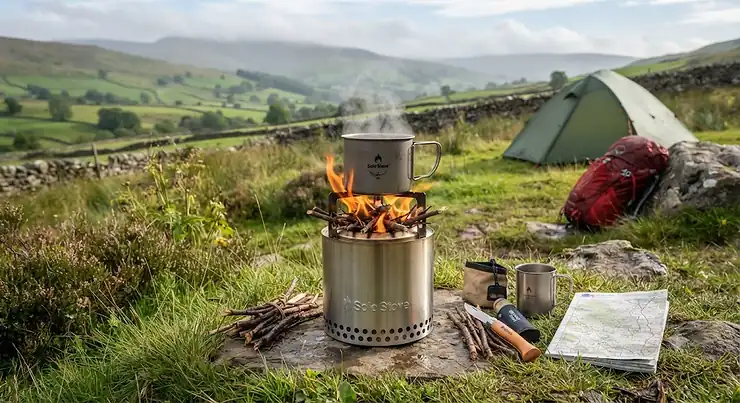
There’s a particular kind of quiet that settles over a campsite when the gas canister stove goes silent and all you can hear is the crackle of twigs. That’s the appeal behind this solo stove lite review, and honestly, it’s an appeal that’s easy to dismiss until you’ve actually crouched over one of these things at dusk, feeding it kindling like a small, obedient dragon. Wood-burning backpacking stoves occupy a strange corner of the outdoor gear world — beloved by bushcraft purists, viewed with suspicion by ounce-counting thru-hikers, and completely misunderstood by anyone who’s only ever used a Trangia. The Solo Stove Lite sits right at the centre of that debate, and for good reason: it popularised the double-wall burn design for a mainstream British and American audience raised on the brand’s smokeless fire pits.

What is a wood-burning camp stove? In short, it’s a compact metal firebox that burns twigs, pine cones, and other found fuel using a gasifier design that recirculates unburned smoke back through a second combustion stage, producing a hotter, cleaner flame than an open fire. That’s the mechanical bones of every product in this piece.
Below, you’ll find a genuinely researched comparison of seven real stoves — from the original Solo Stove Lite through to titanium alternatives from Toaks, Vargo, Emberlit, Firebox, Überleben and Bushbox — built on real specifications and aggregated review sentiment rather than marketing copy. This article contains affiliate links, which is disclosed in full below.
Quick Comparison Table
| Stove | Material | Weight | Price Range | Best For |
|---|---|---|---|---|
| Solo Stove Lite | Stainless steel | ~9 oz (255g) | £70–£90 | All-rounder smokeless burn |
| Toaks Titanium Wood Stove | Titanium | ~1.7–7.9 oz (varies by size) | £40–£60 | Lightweight double-wall burn |
| Vargo Hexagon | Titanium | ~4.1 oz (116g) | £45–£60 | Compact wood stove for solo trips |
| Emberlit FireAnt | Titanium | ~3 oz (85g) | £45–£55 | Titanium folding wood stove, ultralight |
| Firebox Nano G2 | Titanium | ~4 oz (113g) | £55–£75 | Best portable firebox, multi-fuel |
| Überleben Stöker | Titanium | ~7.7 oz (218g) | £70–£90 | Premium build, grill grate included |
| Bushbox XL Titanium | Titanium | ~8 oz (227g) | £55–£75 | Best folding camping stove for beginners |
Looking at this table, the pattern that jumps out immediately is the weight-to-price trade-off: Solo Stove Lite carries a weight penalty for its stainless-steel construction but wins on sheer bomb-proof durability, while the titanium stoves from Vargo Hexagon and Emberlit FireAnt shave off more than half the mass at a comparable or lower price. If you’re choosing based on pack weight alone, titanium wins every time; if you want something that will outlive your grandchildren’s camping trips, steel still has its place.
💬 Bookmark this page and share it with your camping mates before you head out — a good stove choice saves everyone’s dinner!
Top 7 Wood-Burning Camp Stoves: Expert Analysis
1. Solo Stove Lite — the smokeless benchmark everyone compares against
The Solo Stove Lite built its reputation on Solo Stove’s signature 360-degree airflow system, and that’s precisely what makes this solo stove lite review worth writing in the first place. Constructed from 304 stainless steel, it uses a double-wall burn chamber where preheated air is drawn up through the outer wall and injected through a ring of small holes near the top, reigniting smoke and unburned gases before they escape. In practice this means a noticeably hotter, less smoky fire than a simple twig-can stove, and a stove that copes reasonably well with damp or lower-quality fuel because it’s still combusting more completely.
Weighing around nine ounces and running roughly £70–£90 depending on whether you buy the stove alone or the fuller gear kit, it sits at the pricier end for a non-titanium product — reviewers consistently point out that a titanium equivalent would shave real weight for a similar spend. It suits car campers, family trips, and anyone doing shorter backcountry stints where the extra durability outweighs the ounces; it’s a poor match for gram-counting thru-hikers chasing a sub-two-pound base weight. Aggregated review sentiment across outdoor gear sites frames it as reliably easy to light and confidence-inspiring in the field, though several long-form reviewers note the stainless build is “no ultra-lightweight stove,” a fair critique given the titanium competition below.
Pros:
- ✅ Genuinely smokeless once established, even with damp wood
- ✅ Sturdy 304 stainless steel that shrugs off rough handling
- ✅ Nests neatly with the companion Solo Stove Pot 900
Cons:
- ❌ Nearly double the weight of titanium rivals like Vargo Hexagon
- ❌ Boil times lag behind canister stoves in cold or windy conditions
At around £70–£90, the value verdict is straightforward: pay the premium for build quality and brand backup, not for weight savings.
2. Toaks Titanium Wood Stove — the double-wall burn specialist for gram counters
If the phrase “double-wall burn” means anything to you, this is the stove that made it a selling point outside specialist bushcraft circles. The Toaks Titanium Wood Stove is a three-piece, can-style gasifier that slides together without tools, and its inverted double-wall design forces air downward between the walls before it’s pushed back up through the base, igniting the wood gas a second time. What that means practically is a taller, more concentrated flame than a single-walled hobo stove, and noticeably less smoke once it’s running hot.
The smaller version weighs as little as 1.7 ounces on its own (heavier configurations with the larger three-can system run closer to 7.9 ounces), and it packs down to about the size of a golf ball — small enough to disappear into a cook kit alongside a 750ml pot. It’s the natural pick for ultralight backpackers who still want the psychological comfort of a backup wood-burning option, or preppers building an emergency kit around minimal bulk. Reviewers repeatedly flag one genuine limitation: the side fuel port is small, so refuelling an established fire without lifting the pot is fiddly, and the stove is sooty enough that your cookware will need a wipe-down afterwards.
Pros:
- ✅ Among the lightest titanium wood stoves on the market
- ✅ Nests into a 750ml titanium pot for a sub-250g cook system
- ✅ Genuine double-wall burn improves fuel efficiency over single-wall cans
Cons:
- ❌ Small side fuel port makes mid-burn refuelling awkward
- ❌ Wide pots recommended — narrow mugs don’t heat evenly
Priced around £40–£60, this is arguably the best value titanium folding wood stove on this list if raw pack weight is your priority.
3. Vargo Hexagon — the compact wood stove that folds flatter than a phone case
The Vargo Hexagon takes a completely different construction approach: instead of nesting cans, it’s a single hinged sheet of titanium that unfolds into a hexagonal firebox and pot stand in one motion, then folds flat again to roughly five inches by half an inch. That hinged simplicity is the whole appeal — there’s nothing to lose, no cans to misplace, and assembly takes seconds even with cold hands.
At around 4.1 ounces and roughly £45–£60, it undercuts the Solo Stove Lite on both counts while adding genuine wind resistance, since the hexagonal walls double as a natural windscreen — several long-term reviewers report skipping a separate windscreen entirely, even in moderate alpine gusts. It’s best suited to solo or two-person trips using pots no larger than about 1.5 litres; the manufacturer is explicit that bigger cookware compromises stability. Aggregated reviews are largely positive on efficiency but split on start-up: some users found it needed active coaxing (blowing on the flame) to get established, while others reported it competing with canister stoves for early boil speed.
Pros:
- ✅ Folds completely flat — no loose parts to lose in the dark
- ✅ Hexagonal walls double as an effective built-in windscreen
- ✅ Cools quickly after use thanks to thin titanium construction
Cons:
- ❌ Limited to pots under roughly 1.5 litres
- ❌ Some users report needing to actively coax the initial flame
For solo hikers who want the smallest possible footprint without sacrificing wind performance, the Vargo Hexagon earns its £45–£60 price tag comfortably.
4. Emberlit FireAnt — the lightest titanium folding wood stove tested here
Few products on the market wear the “titanium folding wood stove” label as literally as the Emberlit FireAnt. It’s a four-panel titanium firebox — three walls, a door, and a floor — that slots together without a single crossbar or tent peg, and at roughly three ounces it’s the lightest fully rigid wood stove in this comparison, beaten only by the smallest Toaks configuration.
What most buyers overlook about this model is that the side door isn’t just for aesthetics: it’s a genuinely functional feed port for longer sticks, letting you push fuel in as it burns down rather than constantly lifting your pot to refuel from above, which is a meaningful quality-of-life improvement over some rivals. Reviewers who’ve carried it for multiple seasons describe it as durable despite the thin titanium plate, though a handful note the panels can develop a slight warp with heavy use — something that’s usually simple to bend back by hand. It’s a strong pick for ultralight backpackers layering a wood stove as backup to a primary canister or alcohol setup, since the weight cost of carrying it “just in case” is genuinely negligible.
Pros:
- ✅ One of the lightest rigid wood stoves available, around 3oz
- ✅ Side feed door allows refuelling without lifting the pot
- ✅ Compatible with Trangia and Esbit burners as a backup fuel option
Cons:
- ❌ Thin titanium panels can warp slightly with prolonged heavy use
- ❌ Small firebox limits burn duration between refuels
At around £45–£55, this is the stove to buy if “as light as possible, no compromises on rigidity” is your entire brief.
5. Firebox Nano G2 — the best portable firebox for multi-fuel flexibility
The Firebox Nano G2 is a genuinely different animal: a true hinged folding stove with no loose parts at all, engineered around a proprietary cross-feed fuel delivery system that lets you feed twigs in from multiple angles simultaneously. Unhinge it from its pouch and it locks into shape in seconds; fold it flat and it fits in a shirt pocket, which is not an exaggeration reviewers make lightly.
Where this stove pulls ahead of the more minimalist options above is fuel flexibility — beyond wood, it’s explicitly designed to accept a Trangia spirit burner or Trangia gas attachment at a “sweet spot” head height, effectively giving you three stoves in one shell. The titanium version weighs around four ounces and runs roughly £55–£75, sitting mid-pack on price but arguably top of the class on genuine versatility. Long-term owners on gear forums describe it as “an amazing piece of equipment” that’s shown no warping or jamming after years of use across wildly different climates, from Thai beaches to high-altitude Andean camps. The trade-off is a slightly more complex fold than the single-hinge Vargo, though most users report it becomes second nature within a couple of uses.
Pros:
- ✅ True hinged construction — nothing to lose or misassemble
- ✅ Accepts Trangia spirit and gas burner attachments for flexibility
- ✅ Small diameter, spring-tempered legs add real structural strength
Cons:
- ❌ Pricier than most titanium rivals of similar weight
- ❌ Narrow legs can sink into soft ground or snow without a base
If you want one portable firebox that adapts to wood, alcohol, or gas depending on the trip, the Firebox Nano G2 justifies its £55–£75 asking price.

6. Überleben Stöker Titanium — the premium pick with a built-in grill grate
The Überleben Stöker Titanium leans into a slightly different use case: fewer ultralight backpackers, more bushcraft-minded campers who want to cook actual meals rather than just boil water. Its five-panel titanium construction locks together tool-free into a stable combustion chamber, and it ships with a wire-formed titanium grill grate — the Köchen-X — that turns the stove into a legitimate mini barbecue as well as a pot stand.
At roughly 7.7 ounces and £70–£90, it’s neither the lightest nor the cheapest stove here, and that’s a deliberate trade Überleben has made in favour of cooking versatility. What the spec sheet won’t tell you, but reviewers note repeatedly, is how much the waxed canvas carry sleeve doubles as a genuinely useful tinder-foraging pouch on the trail — a small but thoughtful touch that keeps coming up in owner reviews. It’s best suited to weekend car campers, van-lifers, and bushcraft hobbyists who value the ritual of cooking over an open flame as much as the destination itself, rather than fast-and-light hikers racking up big daily mileage.
Pros:
- ✅ Included grill grate genuinely expands what you can cook
- ✅ Waxed canvas sleeve doubles as a tinder-foraging pouch
- ✅ Blast-finished titanium panels resist warping over repeated use
Cons:
- ❌ Among the heavier titanium options in this comparison
- ❌ Premium pricing compared with simpler flatpack rivals
For campers who see cooking as part of the adventure rather than a chore, the £70–£90 spend on the Überleben Stöker Titanium buys real functional upgrades, not just branding.
7. Bushbox XL Titanium — best folding camping stove for first-time buyers
Rounding out this list is the Bushbox XL Titanium, a German-engineered flatpack stove frequently mentioned in the same breath as the Emberlit as one of the two benchmark folding designs in the bushcraft community. Owners who’ve run both side by side describe the differences as genuinely marginal — slightly different air-hole spacing, a different preference for top-down versus bottom-up airflow — with most concluding that either is an excellent choice and some ending up buying both as a “second burner” for larger groups.
At roughly eight ounces and £55–£75, the Bushbox XL Titanium earns its “best folding camping stove” recommendation here specifically because of how approachable the assembly is for someone who has never lit a wood stove before: the panels are colour-coded implicitly by shape, they can only go together one sensible way, and the whole thing is stable enough for a first-timer’s shaky hands. It’s less specialised than the Firebox Nano’s multi-fuel system and less minimal than the Vargo Hexagon, sitting instead as a dependable, well-reviewed middle ground — which, for a first purchase, is often exactly what buyers actually want rather than the most extreme option on paper.
Pros:
- ✅ Beginner-friendly assembly with an intuitive, foolproof fold
- ✅ German build quality praised consistently by long-term owners
- ✅ Comparable performance to premium rivals at a mid-range price
Cons:
- ❌ Bulkier folded profile than the slimmest single-hinge designs
- ❌ Fewer official accessories than the Firebox or Solo Stove ecosystems
At £55–£75, it’s a genuinely sensible first titanium folding wood stove for someone stepping up from a disposable barbecue or an open campfire.
Benefits vs Traditional Alternatives
| Factor | Wood-Burning Stoves | Gas Canister Stoves |
|---|---|---|
| Fuel cost over a season | Free (foraged) | £5–£8 per canister |
| Weight carried | Stove only, no fuel | Stove + canister(s) |
| Reliability in wet conditions | Variable — needs dry fuel | Consistent regardless of weather |
| Simmer control | Poor to moderate | Excellent |
| Environmental impact | Minimal if LNT followed | Canister disposal is a known issue |
| Best For | Multi-day trips, bushcraft, budget-conscious campers | Alpine conditions, fast boil-and-go trips |
The core trade-off here is control versus cost. A gas stove from a brand like MSR or Jetboil will boil water reliably in under three minutes regardless of what the weather’s doing, but every canister is another £5–£8 and roughly 100–230g of dead weight in your pack once it’s empty. Wood-burning stoves like the Solo Stove Lite or Toaks Titanium Wood Stove flip that equation: near-zero fuel cost and effectively unlimited “resupply” as long as dry wood is available, at the price of a slower, more attention-hungry cooking process that can genuinely fail in prolonged wet weather.
💬 Ready to ditch fuel canisters for good? Compare current prices on the models above before your next trip!
Practical Usage Guide: Getting the Most From Your Wood Stove
Buying a wood-burning stove and using it well are two different skills, and the gap between them is where most first-time buyers get frustrated. Start by pre-sorting your fuel into three rough sizes before you even strike a match: pencil-thin kindling for the initial flame, finger-thick sticks for building heat, and slightly thicker pieces for sustaining a longer burn. Most gasifier-style stoves, including the Toaks Titanium Wood Stove and Solo Stove Lite, use a top-down or top-lit method where a small nest of tinder is lit at the top of a loosely packed fuel bed, letting the flame burn downward and drawing air through the double-wall system as it goes.
Common first-30-days mistakes are worth naming explicitly. New owners routinely overpack the firebox, choking off the airflow that makes these stoves smokeless in the first place — less fuel, added more frequently, almost always outperforms one big load. Another frequent error is ignoring wind direction; positioning the stove’s fuel door away from the prevailing breeze dramatically improves burn consistency. For maintenance, a wipe-down with dry leaves or a bit of sand once the stove has fully cooled removes most soot without needing water or soap, and titanium models in particular should be dried thoroughly before storage to prevent the faint rainbow patina from becoming a sticking point in the hinges.
Real-World Scenarios: Which Stove Fits Your Trip
The weekend car camper. Sarah drives to a Peak District campsite twice a month with her partner and a cool-box full of proper food. Weight is irrelevant; cooking enjoyment isn’t. The Überleben Stöker Titanium, with its grill grate, suits her far better than an ultralight can-stove because she’s actually grilling, not just boiling water for a dehydrated meal.
The budget-conscious Duke of Edinburgh leader. Tom is kitting out a group of teenagers for their first expedition and needs stoves that survive being dropped, mishandled, and occasionally rained on, without a huge unit cost. The Bushbox XL Titanium or the stainless Solo Stove Lite both fit, prioritising forgiving assembly and durability over shaving grams.
The thru-hiker doing 15 miles a day. Priya is racking up serious mileage on a long-distance UK trail and treats every gram as a decision. For her, the Emberlit FireAnt or the smallest Toaks Titanium Wood Stove configuration make more sense than anything above five ounces — she’s not looking to grill, she’s looking to boil water for a freeze-dried meal and move on.

How to Choose a Wood-Burning Camp Stove
- Decide your primary trip type first. Fast-and-light backpacking wants sub-4oz stoves; car camping and bushcraft trips can absorb a heavier, more versatile design.
- Check pot compatibility before you buy. Stoves like the Vargo Hexagon are explicit about maximum pot size — mismatch this and stability suffers.
- Weigh material trade-offs honestly. Titanium saves weight and resists corrosion; stainless steel like the Solo Stove Lite costs less per gram of durability and tolerates rougher handling.
- Consider fuel-port design. A side door for mid-burn refuelling, as on the Emberlit FireAnt and Firebox Nano G2, saves real hassle over top-only loading.
- Factor in wind performance. Stoves with taller or hexagonal walls need less auxiliary windscreen than open can-style designs.
- Look at multi-fuel flexibility. If you might want an alcohol or gas backup on the same stand, the Firebox Nano G2 covers all three fuel types.
- Match your budget to your usage frequency. A £45 titanium stove used every weekend earns its keep faster than a £90 stove that sits in a drawer.
Common Mistakes When Buying a Wood Stove
Buyers new to this category tend to make the same handful of errors. The first is chasing the lightest possible stove without checking pot compatibility — a three-ounce stove is no bargain if your existing 1.5-litre pot wobbles dangerously on it. The second is assuming all “titanium” stoves are equally durable; wall thickness varies considerably between brands, and thinner panels like those on some ultralight designs are more prone to warping under repeated heavy use, as reviewers of the Emberlit FireAnt have noted. The third mistake is overlooking regional fire regulations entirely — more on that below — and turning up somewhere that a UK national park or Site of Special Scientific Interest, where open flames including small wood stoves may be restricted during high fire-risk periods.
What to Expect: Real-World Performance
Specs on a page don’t tell you what boiling water over twigs actually feels like at 6am with cold hands. Expect a genuine learning curve for the first two or three uses — getting consistent airflow and fuel sizing right takes practice, and reviewers across every stove in this list mention an adjustment period. Once mastered, boil times for roughly 500ml of water typically land somewhere between six and twelve minutes depending on fuel quality and stove design, noticeably slower than a canister stove’s two-to-four-minute boil but broadly comparable to a well-tended alcohol stove. Expect soot. Every stove here will blacken your cookpot’s exterior, and a dedicated storage bag (most ship with one) keeps that mess away from the rest of your kit.
Safety, Regulations and Countryside Guidance
Wood-burning stoves are still open flames, and that matters under UK law and land-access rules. There’s no blanket ban on lighting a small stove in the countryside, but there’s equally no automatic right to do so — permission, local byelaws, and current fire-risk conditions all apply, and Natural England’s wildfire guidance is worth reading before any trip involving an open flame. During periods of high fire risk, which the Met Office and Forestry Commission flag increasingly often through the summer months, even a compact stove can be enough to ignite dry moorland vegetation if left unattended or used on the wrong surface.
Sensible baseline practice: use a fire-resistant mat or bare ground beneath the stove, never leave it unattended even briefly, and let ash cool completely before disposal — advice echoed directly in the government’s own wildfire preparedness guidance. It’s also worth understanding the basic mechanics of what you’re using: these stoves rely on a genuine wood gasification process where partially combusted wood gas is reignited in a second combustion stage, which is exactly why they burn hotter and cleaner than an open fire but still demand the same fire-safety discipline.
Long-Term Cost and Maintenance
Over a single season, the maths favours wood stoves clearly. A canister-stove user burning one 100g–230g canister every two to three days on a week-long trip can easily spend £15–£25 on fuel alone, repeated every trip. A wood stove owner spends that once, on the stove itself, and then nothing beyond the occasional replacement carry bag. Titanium models require essentially no maintenance beyond drying and light cleaning after use; stainless steel stoves like the Solo Stove Lite are marginally more prone to surface staining but no less structurally durable, and most reputable brands back their products with lifetime or multi-year warranties against manufacturing defects.
Features That Actually Matter (And Those That Don’t)
Genuinely worth paying for: fuel-port design that allows mid-burn refuelling, wall thickness that resists warping, and pot-stand stability with your actual cookware, not just the manufacturer’s recommended pot. Genuinely overrated: marginal weight differences below half an ounce, which matter enormously to competitive ultralight hikers but negligibly to everyone else, and elaborate accessory ecosystems you’ll likely never buy into. Reviewers consistently note that the fundamentals — airflow design and build quality — matter more to real-world satisfaction than any headline spec.
✨ Don’t Miss These Exclusive Deals!
🔍 Take your wood-burning cook kit to the next level with the stoves compared above. Click through on any highlighted model to check current pricing and availability before your next trip into the hills.

FAQ
❓ Is the Solo Stove Lite worth it for backpacking?
❓ Can you use a wood-burning stove in the UK countryside?
❓ What's the lightest titanium folding wood stove available?
❓ Do wood stoves work as well as gas stoves for boiling water?
❓ How do I clean soot off a titanium wood stove?
Conclusion
There’s no single “best” answer buried in this solo stove lite review, and that’s honestly the whole point of doing the comparison properly rather than crowning one winner and moving on. The Solo Stove Lite remains the sensible, durable all-rounder for anyone who wants a stove that just works without fussing over half-ounce weight differences. If you’re chasing the lightest possible titanium folding wood stove, the Emberlit FireAnt or smallest Toaks Titanium Wood Stove configuration will beat it on the scales every time. Bushcraft-minded cooks who want a genuinely versatile portable firebox should look hard at the Firebox Nano G2, while anyone who treats a campfire as part of the holiday, not just a means to hot food, will get more joy out of the Überleben Stöker Titanium‘s grill grate. Whichever you choose, the underlying appeal is the same: fuel you don’t have to carry, and a small, honest flame that makes camp feel like camp.
Recommended for You
- Folding Wood Burning Stove 2026: 7 Best Flat-Pack Picks Ranked
- Solo Stove vs Rocket Stove 2026: 7 Smokeless Picks Tested
- Rocket Stove for Camping: 7 Picks That Actually Work (2026)
Disclaimer: This article contains affiliate links. As an Amazon Associate, I earn from qualifying purchases. If you purchase products through these links, we may earn a small commission at no additional cost to you.
✨ Found this helpful? Share it with your friends! 💬🤗
