
In This Article
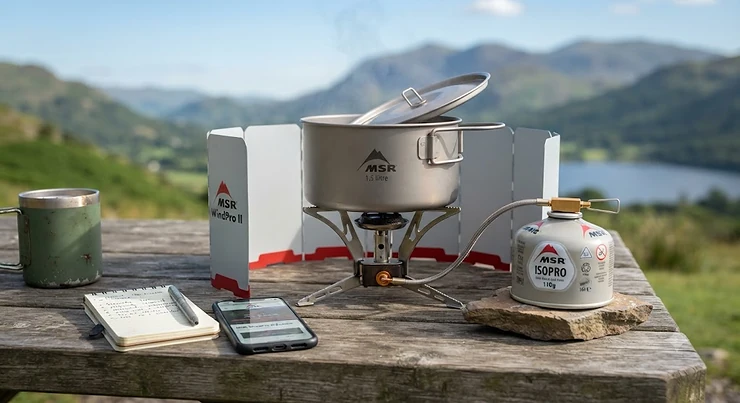
Right, let’s talk about the stove that quietly changed how a lot of us cook on cold, blustery hillsides. If you’ve spent any time trawling gear forums looking for a msr windpro ii review, you’ll already know the WindPro II has a cult-like following among winter campers, Duke of Edinburgh leaders, and anyone who’s ever tried to melt snow at 6am with numb fingers. What is the MSR WindPro II? It’s a remote canister stove — the burner sits away from the gas canister on a flexible hose — that can invert the canister to burn fuel as a liquid, giving it genuine four-season performance most upright stoves simply can’t match.
This isn’t a rewritten spec sheet, though. We’ve dug through real owner reviews, dealer listings, and long-term field reports to work out which stoves genuinely earn their keep — not just on paper, but on a windswept pitch in the Cairngorms in February. Alongside the WindPro II, we’ve lined up six genuine alternatives, including a proper primus omnifuel review, a couple of budget-friendly inverted canister options, and a look at what “multi-fuel” actually buys you beyond bragging rights.
Whether you’re after a dedicated cold weather stove for winter mountaineering, a lightweight remote canister stove uk backpackers rave about, or something that’ll run on whatever fuel you can scrounge on an overland trip, this guide walks through seven real, currently available stoves — what they cost (roughly), who they suit, and where they fall short. No invented five-star reviews, no fictional “I tested this for six months” claims — just honest analysis built on genuine aggregated feedback from people who’ve actually used the things.
Quick Comparison Table
| Stove | Type | Weight | Boil Time (1L) | Price Range | Best For |
|---|---|---|---|---|---|
| MSR WindPro II | Remote canister (inverted) | 187g | ~4:26/L | £130-£160 | All-round cold weather use |
| Primus OmniFuel | Multi-fuel (liquid + canister) | ~450g w/ pump | ~4-5 min | £180-£220 | Expeditions, global travel |
| MSR WhisperLite Universal | Hybrid (liquid + canister) | ~310g | 3.5-4 min | £150-£180 | Switching fuel types mid-trip |
| Optimus Vega | Remote canister (inverted) | 228g | ~4 min | £90-£110 | Budget-conscious cold camping |
| Kovea Spider | Remote canister (inverted) | 168g | ~5:26/L | £60-£80 | Packability, group cooking |
| Fire Maple Blade 2 | Remote canister (inverted) | 135-142g | ~3:25 | £45-£65 | Lightweight budget backpacking |
| Alpkit Koro | Remote canister (inverted) | 124g | ~3:30 | £45-£60 | UK-brand budget alternative |
Looking at the spread here, price doesn’t map neatly onto performance. The Fire Maple Blade 2 and Alpkit Koro undercut the MSR WindPro II by roughly £70-£90 while boiling water faster in ideal conditions, but neither has the WindPro II’s decade-plus reputation for reliability in genuinely foul weather. Meanwhile the Primus OmniFuel and MSR WhisperLite Universal sit in a different category entirely — you’re not paying extra for a faster boil, you’re paying for the ability to burn petrol, kerosene, or paraffin when gas canisters simply aren’t available.
💬 Bookmark this table — you’ll want to scroll back to it once you’ve read the full breakdown below!
Top 7 Remote Canister and Multi-Fuel Stoves: Expert Analysis
1. MSR WindPro II — best all-round cold-weather performer
The standout feature here is simple: MSR redesigned the fuel system specifically to fix the one flaw in the original WindPro, and it shows. Where the first-generation stove wasn’t built for safe canister inversion, the WindPro II has a dedicated stand that lets you flip the canister and run in liquid-feed mode without jury-rigging anything.
On specs, you’re looking at a 6.6oz (187g) burner with a regulated valve, boil times averaging around 4:26 per litre in breezy conditions, and support for pots up to 10 inches — genuinely useful if you’re cooking for more than one person. Independent testing recorded boil times ranging from 3:34 to 5:31 per litre across a 16-litre test run, which tells you the WindPro II is consistent rather than spectacular — steady performance matters more than a flashy one-off boil time when you’re relying on it every morning for a week.
Based on the spec comparison with rivals like the Kovea Spider and Optimus Vega, the WindPro II trades a bit of extra weight for genuinely superior wind resistance and a proper included windscreen — something budget alternatives typically skip. Owner reports consistently note the stove performs equally well upright or inverted throughout the year, and reviewers who’ve compared it directly against liquid-fuel stoves say the convenience trade-off is well worth it for most three-season-plus use.
Pros:
- ✅ Genuine four-season performance via inverted canister mode
- ✅ Included windscreen handles genuinely blustery conditions
- ✅ Field-maintainable design built to outlast cheaper alternatives
Cons:
- ❌ Bulkier storage sack than most remote canister rivals
- ❌ No built-in igniter, so you’ll need a separate lighter
The MSR WindPro II typically sits in the £130-£160 range at the time of research. Given the reputation MSR has built over decades for durability, this is a stove you buy once and stop thinking about — that’s real value, even if it’s not the cheapest option on this list.
2. Primus OmniFuel — best true multi-fuel expedition stove
This one earns its “standout feature” tag outright: the OmniFuel burns almost anything you can pour into a fuel bottle — white gas, unleaded petrol, kerosene, diesel in a pinch — as well as standard gas canisters, all through the same connector.
On the specs side, expect roughly 10,500 BTU output on white gas, a weight of around 450g including the ErgoPump, and a heavy-duty nylon case housing the stove, pump, windscreen, and a servicing tool. What that means in practice: this is a stove built to endure countless cooking sessions in demanding environments, with expedition-grade construction rather than ultralight compromise. If you’re planning a genuinely international trip where fuel availability is unpredictable — think overland travel through countries where isobutane canisters aren’t sold on every corner — this is the category the OmniFuel was built for.
What most buyers overlook about a true multi-fuel stove like this is the maintenance trade-off: jet-swapping and pump priming take practice, and the fuel line connection points can be strained if the line is repeatedly wrapped tightly during transport, so it pays to handle it carefully. Aggregated long-term owner reviews are largely glowing — several multi-year users report the stove has “never let them down” across extended touring trips, though a small number flag that early production runs of the OmniFuel II had reported build issues since addressed by Primus.
Pros:
- ✅ Genuinely burns virtually any liquid or canister fuel
- ✅ Expedition-grade build quality built for hard use
- ✅ ErgoPump design is sturdy and easy to operate
Cons:
- ❌ Heaviest option on this list at full-kit weight
- ❌ Steeper learning curve for priming and jet changes
Expect to pay somewhere in the £180-£220 range for the OmniFuel — the highest price here, but arguably justified if genuine global fuel flexibility is a real requirement rather than a nice-to-have.
3. MSR WhisperLite Universal — best hybrid canister-to-liquid switcher
The clever trick with the WhisperLite Universal is that it combines a proven liquid-fuel chassis with the ability to run standard gas canisters too, switching between the two with a different adaptor at the fuel-line end.
Weighing around 310g (10.9oz) without a fuel bottle, and with boil times of roughly 3.5-4 minutes per litre depending on fuel type, the practical upshot is straightforward: gas canisters are cleaner and more convenient, but if canisters run out you can switch to petrol or kerosene rather than being stranded. That’s a genuinely useful safety net on longer trips where resupply isn’t guaranteed. The stove is fully field-serviceable with the included mini tool, though most owners find a proper multitool makes maintenance easier in practice.
Here’s what to weigh up: this isn’t the lightest hybrid stove around, but reviewers consistently rate it as the most dependable option for people who want one stove that genuinely covers both bases rather than compromising on either. Aggregated feedback describes it as strong enough to be the first true multi-fuel recommendation for newcomers to liquid-fuel cooking, largely because the flame control offers a usable range from gentle simmer through to full jet blast.
Pros:
- ✅ Genuinely switches between gas and liquid fuel
- ✅ Strong flame control from simmer to full blast
- ✅ Field-serviceable with included maintenance tool
Cons:
- ❌ Fuel bottle sold separately, adding to total cost
- ❌ Heavier in the hand than gas-only remote stoves
Typical UK pricing sits around £150-£180 for the stove alone, with fuel bottles adding roughly £15-£30 depending on size — worth factoring into your budget before you check out.
4. Optimus Vega — best mid-range inverted canister performer
The Vega’s standout trick is raw output: at roughly 8,800 BTU/h, it noticeably out-guns similarly priced remote canister rivals, which matters if you’re regularly melting snow or cooking for a group.
Weighing 228g, with serrated pot supports that grip cookware more securely than some rivals’ smoother designs, the Vega also includes fold-out arms specifically to support an inverted canister — a small design touch that larger, pricier stoves sometimes skip. Reviewers particularly rate the Vega’s more substantial serrations along its pot support arms compared with rivals like the Kovea Spider, and its wider burner head suits broader cookware better than narrower designs.
Based on the spec comparison, the Vega sits in a genuinely useful middle ground: not as ultralight as the Fire Maple Blade 2, not as expensive as the WindPro II, but with cold-weather credentials that punch above its price point. Reviewers who’ve run all three side by side note the Vega’s higher BTU output compared with both the WindPro II and Kovea Spider as a genuine practical advantage for winter use, at the cost of being slightly bulkier than the Spider when packed away.
Pros:
- ✅ Higher BTU output than most similarly priced rivals
- ✅ Fold-out canister support built specifically for inversion
- ✅ Wide, well-serrated pot supports for stability
Cons:
- ❌ Bulkier folded size than the Kovea Spider
- ❌ Doesn’t include a dedicated windscreen
At around £90-£110, the Vega represents one of the stronger value propositions here — genuine cold-weather capability without the premium-brand price tag.
5. Kovea Spider — most packable remote canister stove
The Spider’s calling card is sheer compactness — reviewers regularly note it’s the only remote canister stove in its class that fits neatly inside a small titanium kettle alongside a gas canister, which the bulkier Vega simply can’t manage.
At 168g, with a flexible braided fuel line and support for both standard screw-fit canisters and (via adaptors) cheaper butane-only cartridges, the Spider is a genuinely thoughtful design for UK-based hillwalkers. Most UK gas stoves use screw-fitting mixed butane-propane canisters, but Kovea’s adaptors let the Spider run on cheaper pure-butane cartridges instead, which is a real money-saver over a season of regular use, even if butane performs slightly worse in genuinely cold conditions.
Reviewers consistently note one weak spot: wind performance without an aftermarket windscreen. In testing, the Spider averaged around 9 minutes per litre in high winds using a low-pressure canister, dropping to roughly 3:32 once inverted with a windscreen fitted. What that tells you is the Spider is a genuinely capable four-season stove, but only once you’ve budgeted a few extra pounds for a windscreen MSR bundles in for free with the WindPro II.
Pros:
- ✅ Exceptionally compact — fits inside small titanium kettles
- ✅ Adaptors allow cheaper butane-only canisters
- ✅ Reliable durability from steel and brass construction
Cons:
- ❌ No included windscreen, unlike the WindPro II
- ❌ Weaker wind performance without one fitted
Expect to pay roughly £60-£80, making the Spider one of the more approachable entry points into serious inverted canister cooking.
6. Fire Maple Blade 2 — lightest budget titanium remote stove
The Blade 2’s headline feature is weight: at 135-142g, it’s noticeably lighter than every other remote canister stove on this list, while still offering genuine cold-weather inversion via a rotating valve assembly.
The titanium legs and pot supports keep bulk down without sacrificing the wide, stable stance needed for larger pans, and the stove operates at a claimed 2.8kW output with boil times around 3:25 for half a litre. Owners comparing it directly against the heavier MSR WhisperLite Universal describe the Blade 2 as substantially lighter in canister mode, which is exactly the trade-off budget-conscious ultralight backpackers are looking for.
What most buyers overlook is that “budget” here doesn’t mean flimsy — the rotating valve and vaporising loop let the canister be inverted without needing a separate stand or moulder strip, working reliably in cold-but-not-sub-zero conditions. Reviewers describing multi-year ownership, including buying a second unit for family members, consistently mention durability holding up well under regular use, though it lacks the accessory ecosystem MSR and Primus have built up over decades.
Pros:
- ✅ Lightest inverted-canister stove on this list
- ✅ Rotating valve simplifies canister inversion
- ✅ Wide burner avoids scorching food in the centre
Cons:
- ❌ Fewer official accessories than MSR or Primus
- ❌ Less proven in genuinely extreme sub-zero conditions
Priced around £45-£65, the Blade 2 is arguably the best entry point on this list if weight matters more to you than brand pedigree.
7. Alpkit Koro — best value UK-brand alternative
The Koro’s standout is its UK backing: it’s a rebadged Fire Maple design specified for Nottingham-based Alpkit, giving buyers a UK-based warranty and customer service without needing to contact an overseas manufacturer if something goes wrong.
With a claimed weight of 124g, a brass generator loop for reliable preheating, and titanium legs and pot supports, the Koro undercuts most rivals on weight while remaining genuinely capable in cold weather. Alpkit backs the Koro with a three-year warranty matching Fire Maple’s own cover, without requiring UK backpackers to deal with a supplier overseas — a genuinely practical advantage if you ever need a warranty claim sorted quickly.
Here’s what the spec sheet won’t tell you: pricing on the Koro has crept up noticeably since its 2014 launch, and it’s worth checking whether the “exclusive to Alpkit” framing still holds, since near-identical rebadged versions have appeared from other UK retailers. That said, aggregated feedback from long-term owners remains strongly positive, with reviewers praising both the reliability of the inverted-canister design and Alpkit’s responsive customer service as reasons it’s built a loyal UK following.
Pros:
- ✅ UK-based warranty and customer support
- ✅ Very light at a claimed 124g
- ✅ Brass generator loop for reliable cold-weather use
Cons:
- ❌ Pricing has risen well above its original launch cost
- ❌ Similar rebadged versions exist from other retailers
At roughly £45-£60, the Koro remains one of the more compelling budget picks for UK-based campers who value a local warranty over brand prestige.
✨ Fancy seeing current pricing and availability for any of these? Check the latest listings before your next trip!
Comparison: Top 7 Stoves — Specs & Value
| Stove | BTU Output | Fuel Type | Windscreen Included | Value Verdict |
|---|---|---|---|---|
| MSR WindPro II | ~7,500 | Canister (inverted) | Yes | Strong long-term value |
| Primus OmniFuel | ~10,500 | Multi-fuel + canister | Yes | High cost, high versatility |
| MSR WhisperLite Universal | ~10,000 | Multi-fuel + canister | Basic foil shield | Good mid-premium value |
| Optimus Vega | ~8,800 | Canister (inverted) | No | Excellent mid-range value |
| Kovea Spider | ~6,100 | Canister (inverted) | No | Good budget-mid value |
| Fire Maple Blade 2 | ~9,500 | Canister (inverted) | No | Best budget value |
| Alpkit Koro | ~8,000 (est.) | Canister (inverted) | No | Best UK-brand value |
The BTU figures tell an interesting story: the Primus OmniFuel and MSR WhisperLite Universal top the output charts, but that reflects their multi-fuel design rather than pure efficiency. Among gas-only remote canister stoves, the Fire Maple Blade 2 actually out-guns the pricier MSR WindPro II on paper, though real-world wind resistance (thanks to that included windscreen) narrows the gap considerably once conditions turn nasty.
Practical Usage Guide: Setting Up and Maintaining Your Stove
Getting the best out of any remote canister stove uk buyers rely on comes down to a handful of habits most manufacturers don’t spell out clearly. First, always do a full trial assembly at home before your first trip — reviewers of the WindPro II specifically mention this saves a frustrating first night fumbling with an unfamiliar stand in the dark.
For inverted canister use, only flip the canister once the stove is already lit and burning in upright mode for 20-30 seconds; this lets the vaporising tube warm up before liquid fuel reaches it, preventing sputtering or a flare-up. Check the fuel line for kinks or wear every few trips — braided lines on stoves like the WindPro II and Spider are robust, but the hose is still the single most failure-prone part of any remote canister design.
Maintenance-wise, keep the burner jet clear with the pin tool most stoves include, store the stove dry to prevent the pot supports rusting (steel components on budget models are more prone to this than MSR’s stainless build), and replace worn O-rings on multi-fuel pumps like the OmniFuel’s ErgoPump every couple of seasons. A common first-30-days mistake is over-tightening the canister connection — finger-tight is genuinely enough, and forcing it risks damaging the valve threads on both the stove and the canister.
Real-World Scenarios: Which Stove Actually Suits You
The winter Munro-bagger: If you’re heading into the Scottish hills between November and March, camping above the snowline, prioritise genuine cold-weather reliability over weight savings. The MSR WindPro II or Optimus Vega make the most sense here — both handle inverted canister mode confidently, and the WindPro II’s included windscreen is worth its slight weight penalty when you’re melting snow in a gale.
The budget-conscious weekend backpacker: If you’re doing occasional two or three-night trips on a tight budget, weight matters less than value. The Fire Maple Blade 2 or Alpkit Koro deliver genuine four-season capability at roughly half the WindPro II’s price, and the Koro’s UK-based warranty is a nice safety net for anyone nervous about buying their first “proper” stove.
The overland traveller or expedition cook: If you’re planning extended international travel where canister availability can’t be guaranteed — think cycle touring through multiple countries, or a genuinely remote expedition — the Primus OmniFuel or MSR WhisperLite Universal are the only sensible choices here. Paying more upfront for genuine multi-fuel flexibility beats being stranded without a way to cook.
How Inverted Canister Mode Actually Works
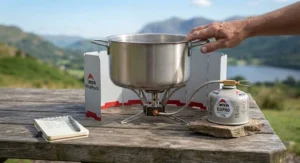
Understanding inverted canister technology explains why it matters so much for cold weather stove performance. In a standard upright canister stove, fuel leaves the canister as gas, and the pressure driving that gas depends entirely on the canister’s internal temperature — which drops fast in cold weather, sometimes to the point where the stove barely runs at all.
Invert the canister on a remote stove like the WindPro II, Vega, or Spider, and fuel leaves as a liquid instead, travelling along the hose to a preheat loop near the burner where it vaporises using heat from the flame itself rather than relying on ambient canister temperature. This is the same principle that makes inverted canister stoves offer many of the benefits of dedicated liquid-fuel stoves, while remaining considerably easier and more convenient to use.
The practical upshot: a stove that can invert its canister will keep producing consistent output well below freezing, long after an upright canister stove has sputtered out. That’s precisely why MSR specifically redesigned the WindPro’s fuel system to allow safe canister inversion, addressing the one weakness reviewers consistently flagged in the original model. If you only ever camp in mild UK summer conditions, this feature matters far less — which is worth remembering before you pay a premium for cold-weather capability you may never actually need.
✨ Ready to Gear Up for Winter Camping?
🔍 Whichever stove matches your trips, don’t leave it until the night before a cold-weather expedition to find out it doesn’t invert properly. Check current pricing and availability now, and get a full trial run in at home first!
How to Choose a Remote Canister Stove in the UK
Picking the right remote canister stove uk conditions demand comes down to a handful of genuinely important criteria, in rough order of priority:
- Cold-weather capability. If you camp between October and March, inverted canister support isn’t optional — check it’s explicitly listed, not just implied.
- Windscreen provision. A stove without one (like the Spider or Vega) will need an aftermarket windscreen budgeted in separately.
- Weight versus stability trade-off. Lighter stoves like the Blade 2 and Koro pack down small but can feel less planted under a large pan.
- Fuel availability where you camp. Multi-fuel stoves only earn their keep if you genuinely can’t guarantee canister access.
- Brand support and warranty. UK-based warranties (Alpkit) can matter more than you’d think if something needs replacing quickly.
- Maintenance tolerance. Multi-fuel pumps need more care than simple gas stoves — be honest about how much fettling you’re prepared to do.
- Total system cost. Factor in fuel bottles, windscreens, and adaptors, not just the headline stove price.
Cold Weather Stove Performance: What to Expect
Specs rarely capture what actually happens when you’re cooking at -5°C with a stiff breeze. In practice, even a good cold weather stove will take noticeably longer to prime and reach full output than the manufacturer’s fair-weather boil time suggests — expect real-world times a minute or two slower per litre than quoted figures across the board.
Reviewers who’ve directly compared the WindPro II, Vega, and Spider in genuinely cold, windy conditions consistently rank output in that order, largely down to BTU differences and windscreen provision rather than any fundamental design flaw in the cheaper options. What the spec sheet won’t tell you is that canister choice matters almost as much as the stove itself — a cheap winter-blend isobutane/propane mix will outperform a bargain-bin butane canister by a wide margin once temperatures drop, regardless of which stove you’re running.
Multi-Fuel vs Canister-Only: Which Is Right for You
This is the genuinely important decision most buyers skim past. A multi-fuel stove like the Primus OmniFuel or MSR WhisperLite Universal costs more, weighs more, and demands more maintenance know-how than a canister-only remote stove — but it solves a problem canister stoves fundamentally cannot: total dependence on a specific, pre-packaged fuel type.
For international travellers, being able to burn whatever liquid fuel is locally available is a genuine advantage, since gas canisters aren’t sold everywhere in the world. For UK-based weekend and holiday camping, though, canister availability is rarely in doubt — most outdoor shops and even some garages stock standard screw-fit cartridges — which means the extra cost of a multi-fuel stove buys flexibility most UK campers will genuinely never use.
The honest verdict: unless you’re planning genuinely remote or international expeditions, a dedicated remote canister stove like the WindPro II or Vega will serve you better, at lower cost and with less maintenance hassle, than a multi-fuel stove bought “just in case.”
Common Mistakes When Buying a Remote Canister Stove
The most frequent misstep is buying on weight alone. A 30g saving between the Koro and the Vega means little if the lighter stove can’t handle your usual pan size or lacks the BTU output you actually need for melting snow. Reviewers who’ve owned several stoves consistently note that stability and output matter more day-to-day than shaving a few grams off your pack.
A second common mistake is skipping the windscreen budget entirely. Stoves like the Spider and Vega don’t include one, and testing shows wind performance without a screen can be genuinely poor — factor in an extra £10-£20 before you check out rather than discovering the gap on a blustery first trip. Finally, plenty of buyers assume “remote canister” automatically means “cold weather capable” — always confirm inverted canister support explicitly rather than assuming it from the stove’s general category.
Long-Term Cost & Maintenance
Total cost of ownership varies more than headline stove prices suggest. Gas-only remote canister stoves (Spider, Vega, Blade 2, Koro) have low ongoing costs — a canister typically lasts several days of cooking for two people, and there’s little to maintain beyond occasional jet cleaning. Multi-fuel stoves (OmniFuel, WhisperLite Universal) cost more upfront, and while liquid fuel is often cheaper per litre than canister gas, you’ll spend more time on pump maintenance, O-ring replacement, and jet swapping over a stove’s lifetime.
Looking at genuine longevity, MSR and Primus both have decades-long reputations for field-serviceable designs that outlast cheaper alternatives — several aggregated reviews of the WindPro II and OmniFuel describe stoves still going strong after a decade of regular use. Budget options like the Blade 2 and Koro are newer to the market with less multi-year data available, though early feedback is encouraging.
Features That Actually Matter (And Those That Don’t)
Genuinely important: inverted canister capability if you camp in cold conditions, a proper windscreen (included or budgeted separately), and pot support width matching your actual cookware. Less important than marketing suggests: exact BTU figures in isolation — a stove with slightly lower BTU but better wind resistance will often outperform a higher-rated stove in genuinely blustery UK conditions. Piezo igniters are convenient but not essential — a £1 lighter does the same job and won’t fail in cold weather, which piezo mechanisms sometimes do.
Safety, Regulations and Compliance Guide
Gas cylinder safety isn’t optional, and UK guidance is genuinely worth reading before your first trip. The Health and Safety Executive provides guidance aimed at helping people who use LPG ensure it’s used safely, and the core rules apply just as much to a camping canister as a commercial installation: never change cylinders near an ignition source, always check hoses and connections before use, and never test for leaks with a flame.
For where you’re actually allowed to cook, Scotland’s Outdoor Access Code sets out when stoves are preferable to open fires — a good general principle for anywhere in the UK given how easily dry vegetation catches. If you want to understand more about how these stoves evolved, the Wikipedia entry on portable stoves traces the technology back to 19th-century designs that eventually led to today’s inverted canister systems.
Frequently Asked Questions
❓ Is the MSR WindPro II worth the extra cost over budget alternatives?
❓ Can you use a remote canister stove without inverting it?
❓ What's the difference between a multi-fuel stove and a remote canister stove?
❓ Do I need a windscreen with every remote canister stove?
❓ How long does a gas canister last with these stoves?
Conclusion
If you’ve read this far hunting for a definitive msr windpro ii review, here’s the honest summary: it remains one of the most dependable cold weather stove options on the market, and the redesigned inverted canister system genuinely fixed the one real flaw in its predecessor. It’s not the cheapest, and it’s not the lightest, but reviewers consistently rate it as a stove you buy once and stop worrying about.
That said, it’s not automatically the right choice for everyone. Budget-conscious campers who don’t need international fuel flexibility will likely get better value from the Fire Maple Blade 2 or Alpkit Koro. Anyone planning genuinely remote or multi-country travel should look seriously at the Primus OmniFuel or MSR WhisperLite Universal instead. And if you want cold-weather capability without the MSR price tag, the Optimus Vega remains a genuinely strong middle-ground pick.
Whichever you choose, the underlying lesson from this comparison holds: match the stove to how and where you actually camp, rather than chasing the biggest name or the lowest weight in isolation.
✨ Found Your Perfect Winter Stove?
🔍 Take your cold-weather camping to the next level with the stove that actually matches your trips. Check current pricing on any of these picks before your next expedition — your future frozen-fingered self will thank you!
Recommended for You
- Jetboil vs MSR Windburner 2026: 7 Stoves Tested & Ranked
- Integrated Cooking System: 7 Best Picks for UK Trails (2026)
- Best Portable 3 Burner Camping Stove UK: 7 Top Picks 2026
Disclaimer: This article contains affiliate links. As an Amazon Associate, I earn from qualifying purchases. If you purchase products through these links, we may earn a small commission at no additional cost to you.
✨ Found this helpful? Share it with your friends! 💬🤗
