
In This Article
An electric camping stove for van life is any cooking appliance that swaps a gas flame for mains or 12V electricity — a hot plate, an induction hob, or a 12V lunchbox-style stove wired into your leisure battery. No canister, no naked flame, no faint whiff of gas when you unclip the regulator with cold fingers. That’s the whole pitch in one sentence, and for a lot of van dwellers it’s a genuinely tempting one.
Here’s the twist nobody tells you at the campsite shop: electricity is a brilliant cook, but a stingy one. Where a gas ring shrugs off whatever you throw at it, an electric stove for van life lives and dies by amps, watts, and how patient you are willing to be with a pan of cold water. Get the maths wrong and you’ll be eating lukewarm pasta by torchlight with a leisure battery reading 40%. Get it right, and you’ve got a kitchen that never needs refilling, never smells of butane, and never keeps you up at 2am wondering if you left the gas on.
This guide walks through seven real, buyable options — from an £11 lunchbox stove that plugs into your cigarette lighter to a proper induction hob that rivals your kitchen at home — with the honest trade-offs behind each one. We’ll cover what to expect from real 12V camping stove reviews, the practicalities of where to buy an electric camping stove without regretting the postage, exactly how leisure battery power draw catches people out, how to build a sensible van kitchen setup around whichever stove you pick, and the flameless cooking safety case that quietly makes electric the sane choice for a lot of layouts. No fabricated five-star raves here — just spec sheets, aggregated review sentiment, and the sort of analysis you’d want from a mate who’s actually done the reading.
Quick Comparison Table
| Stove | Power Source | Wattage | Best For |
|---|---|---|---|
| RoadPro RPSC-197 | 12V leisure battery | ~150W | True off-grid 12V cooking |
| Duronic HP1BK | 230V mains hook-up | 1,500W | Budget single-ring cooking |
| Duronic HP2BK | 230V mains hook-up | 2,500W | Two-pan mains cooking |
| Russell Hobbs 15199 | 230V mains hook-up | 2,250W | Trusted-brand twin hotplate |
| Judge Portable Induction Hob | 230V mains hook-up | 2,000W | Budget induction speed |
| Daewoo 2200W Induction Hob | 230V mains hook-up | 2,200W | Preset-driven induction cooking |
| Tefal Everyday IH201840 | 230V mains hook-up | 2,100W | Premium build and control |
Look closely and a pattern jumps out: only one of these seven, the RoadPro RPSC-197, actually runs from a 12V leisure battery without an inverter — everything else needs 230V, which in a van generally means a campsite hook-up or a hefty inverter and battery bank. That single fact splits this whole category in two: true off-grid 12V cooking, and mains-dependent cooking that only works when you’re plugged in. Budget buyers gravitate toward the Duronic HP1BK for its low upfront cost, while anyone chasing speed and precise control should look straight past the basic hotplates to the Tefal Everyday IH201840 or the Daewoo 2200W Induction Hob.
💬 Found the right stove already? Compare current prices before you commit — availability shifts fast on the popular models!😊
Top 7 Electric Camping Stoves for Van Life: Expert Analysis
1. RoadPro RPSC-197 — the only true 12V option here
The RoadPro RPSC-197 is the odd one out on this list, and that’s precisely why it earns the top spot: it’s the sole stove here that plugs straight into a 12V accessory socket and draws from your leisure battery with no inverter required. It’s a lunchbox-style insulated oven, not a hob — you load pre-cooked or part-cooked food into a small aluminium tray, plug in, and wait.
Rated at roughly 150W and drawing around 12 amps at 12V, it heats to about 150°C (300°F) and takes 30 minutes to an hour to bring a portion of stew, curry, or leftover pasta up to eating temperature. It has no thermostat dial — heat control is simply plugging it in or pulling it out — which is refreshingly simple but means you can’t sear, fry, or boil anything from raw. Reviewers on Amazon and eBay, largely truckers and full-time van dwellers, consistently describe it as reliable for reheating rather than cooking, with several noting it happily melts cheese on a sandwich or warms a tin of soup during a driving break. A recurring theme in the aggregated feedback is that expectations matter enormously here: buyers hoping for a genuine cooker are often disappointed, while those buying it as a warming oven rate it highly.
Pros:
- ✅ Genuinely runs from a 12V leisure battery, no inverter needed
- ✅ Simple, almost foolproof operation with no controls to fail
- ✅ Well-proven design with a long trucking and van-life track record
Cons:
- ❌ Reheats and warms; it cannot fry, boil, or cook raw food
- ❌ Draws roughly 12A continuously, which adds up on a small battery bank
Priced in the £25-£40 range, the RoadPro RPSC-197 is best value as a second appliance for driving-day meals rather than your sole van kitchen.
2. Duronic HP1BK — best entry point for mains hook-up cooking
Step away from true 12V and into mains territory, and the Duronic HP1BK is where most budget-conscious van dwellers land first. It’s a single 187mm cast-iron hotplate rated at 1,500W, with a thermostatic dial offering roughly 500W, 1,000W, and 1,500W settings rather than infinite variable heat.
That three-step thermostat matters more than it sounds: it means you can properly simmer a curry on the low setting rather than switching a full-power ring on and off like a muppet, which is precisely the complaint that pushes many campervan owners toward it after living with a cheaper on/off hotplate. Cast iron heats slower than induction but holds that heat steadily once it arrives, which suits stews and slow-cooked dishes better than it suits a quick stir-fry. Aggregated Amazon reviews are strongly positive, with buyers repeatedly praising the build quality and simmer control relative to the low price, though a handful mention the thermo-insulated handles get warmer than expected during long cooking sessions.
Pros:
- ✅ Genuine three-stage simmer control, not just on/off
- ✅ Cast-iron plate holds heat evenly for stews and sauces
- ✅ Among the cheapest mains hotplates with a real thermostat
Cons:
- ❌ Requires 230V hook-up; unusable off-grid without a hefty inverter
- ❌ Single ring only, so a full meal means cooking in stages
At around £25-£35, the Duronic HP1BK is the sensible pick for van lifers who mostly stay on powered pitches and want dependable, unfussy cooking without spending big.
3. Duronic HP2BK — twin rings for cooking two things at once
If one ring on the Duronic HP1BK feels limiting, the Duronic HP2BK solves it with two independently controlled cast-iron plates: a 1,500W main ring and a 1,000W secondary ring, both on the same thermostatic dial system as its single-ring sibling.
The real-world benefit here is timing. Instead of boiling rice, taking it off, then starting the sauce, you can run both at once — genuinely useful in a compact van kitchen where every extra ten minutes of standing around is ten minutes you’d rather spend outside. The combined 2,500W draw is worth flagging, though: on a standard 10A UK campsite hook-up, running both rings flat out alongside a fridge and phone charger will edge uncomfortably close to tripping the site’s breaker, so most owners settle into running one ring hard and the other gently. Aggregated review sentiment describes the build as sturdy and the twin-ring layout as genuinely useful for van and caravan life, with occasional comments about the unit being heavier and bulkier to store than expected for a “portable” hob.
Pros:
- ✅ Two independently controlled rings for real multi-pan cooking
- ✅ Same trusted cast-iron thermostat design as the single-ring model
- ✅ Compact footprint given it packs in two cooking zones
Cons:
- ❌ 2,500W combined draw pushes close to a standard 10A hook-up limit
- ❌ Heavier and bulkier than the single-ring version to store
Expect to pay somewhere in the £40-£55 range, making the Duronic HP2BK a solid mid-range choice for anyone who genuinely cooks two-pan meals rather than one-pot dinners.
4. Russell Hobbs 15199 — the trusted-name alternative
The Russell Hobbs 15199 covers similar ground to the Duronic twin hotplate — two cast-iron rings, 1,500W and 750W, independently controlled — but wrapped in the reassurance of a household name with a stainless steel body rather than painted steel.
That stainless finish is more than cosmetic in a van kitchen: it shrugs off the inevitable splashes and doesn’t show scorch marks the way painted surfaces eventually do, and it wipes clean in seconds after a messy fry-up. The lower 750W secondary ring, versus the Duronic’s 1,000W, means slightly gentler simmering on the small plate but a marginally lower total draw of 2,250W, which gives a touch more headroom on a tight hook-up supply. Aggregated feedback across retailers puts it at a solid four-star average, with buyers frequently mentioning it as a reliable stopgap during kitchen renovations that then quietly becomes a permanent camping or caravan fixture — a pattern that speaks well of its durability even if it wasn’t originally bought with van life in mind.
Pros:
- ✅ Stainless steel body resists staining and cleans up fast
- ✅ Slightly lower 2,250W total draw than comparable twin hobs
- ✅ Backed by a well-established, easy-to-find UK brand
Cons:
- ❌ Secondary ring’s lower wattage means slower simmering on that side
- ❌ Still 230V-only, so no off-grid use without an inverter
Typically found in the £35-£50 range, the Russell Hobbs 15199 suits buyers who’d rather pay a small premium for brand reassurance and easier warranty support.
5. Judge Portable Electric Induction Hob — budget induction speed
Moving from cast-iron hotplates to induction changes the game entirely, and the Judge Portable Electric Induction Hob is the cheapest sensible entry point at 2,000W with 10 temperature settings running from 60°C to 240°C.
Induction heats the pan directly through a magnetic field rather than heating a plate that then heats the pan, which is why it can bring water to the boil noticeably faster than any cast-iron hotplate on this list — useful when you’re hungry and the light is fading. The catch, and it’s a real one, is that you need induction-compatible cookware with a magnetic base; your beloved aluminium camping pan almost certainly won’t work, so factor a new pan or two into the budget. Reviewers describe the black crystal glass surface as easy to wipe clean and the unit as genuinely light enough to stow in a cupboard, with the digital timer flagged as a handy feature for boiling pasta without hovering over it.
Pros:
- ✅ Fast, responsive heating thanks to genuine induction technology
- ✅ 10 temperature settings give far finer control than a hotplate
- ✅ Compact and light, easy to store in a van cupboard
Cons:
- ❌ Only works with magnetic, induction-compatible pans
- ❌ 2,000W draw still needs a proper mains hook-up to run
At roughly £30-£45, the Judge Portable Electric Induction Hob is the best-value way to try induction cooking before committing to a pricier branded model.
6. Daewoo 2200W Portable Single Induction Hob — presets for less thinking
The Daewoo 2200W Portable Single Induction Hob sits a notch above the Judge on power and adds six cooking presets with LED controls and an integrated timer, aimed squarely at people who’d rather select “stir fry” than fiddle with a wattage dial.
Presets sound like a gimmick until you’re stood in a dark van at the end of a long drive, in which case “press one button for a rolling boil” is a genuine quality-of-life upgrade over guessing your way through ten manual power levels. The trade-off for that convenience is less granular control than a fully manual hob when you want something very specific, like a gentle, exact simmer for a delicate sauce. Aggregated customer sentiment is broadly positive on ease of use and the clarity of the LED display, with a recurring theme in reviews being that the preset boil function reliably brings a pan to a rolling boil in well under the time a gas ring would take, though a minority of buyers note the touch controls can be fiddly with wet or cold fingers.
Pros:
- ✅ Six presets simplify common cooking tasks to a single button
- ✅ Clear LED display makes settings easy to read at night
- ✅ Slightly higher 2,200W output than budget induction rivals
Cons:
- ❌ Touch controls can be fiddly with wet or gloved hands
- ❌ Presets offer less fine control than fully manual power levels
Pricing generally sits in the £45-£65 range, positioning the Daewoo 2200W Portable Single Induction Hob as a comfortable mid-range step up for anyone who wants speed without a steep learning curve.
7. Tefal Everyday IH201840 — the premium, best-known pick
The Tefal Everyday IH201840 is the name most people already half-recognise from a friend’s kitchen, and it earns its premium position with nine power levels from 450W to 2,100W, six cooking functions, a two-hour timer, and a digital display that most testers rate as the clearest and most intuitive on this list.
What separates it in practice is the breadth of its power range: 450W at the bottom is genuinely gentle enough to hold melted chocolate or warm milk without scorching, while the top end brings a pan of water to a rolling boil in roughly ten minutes according to Tefal’s own published testing, a claim independent reviewers at outlets including Woman & Home have found broadly consistent with hands-on testing of similar Tefal models. It auto-switches off after five minutes of inactivity, a small but genuinely reassuring safety touch for anyone who’s ever driven off and only remembered the hob was on somewhere near the next services. Aggregated review sentiment across retailers sits around 4.3 out of 5, with buyers consistently praising build quality and the ceramic surface’s resistance to scratching, alongside occasional reports of milk-simmer mode tripping an RCD on faulty units — a fault pattern worth knowing about if you buy secondhand.
Pros:
- ✅ Widest power range on this list, from gentle 450W to 2,100W
- ✅ Auto-shutoff after five minutes adds genuine peace of mind
- ✅ Strong brand reputation with widely available spares and support
Cons:
- ❌ Priciest option here relative to the budget induction hobs
- ❌ A minority of units report faults on the milk-simmer setting
Expect to pay in the £65-£90 range for the Tefal Everyday IH201840, which is real money for a portable hob but buys you the most polished, best-supported cooking experience on this list.
Building Your Van Kitchen Setup Around an Electric Stove
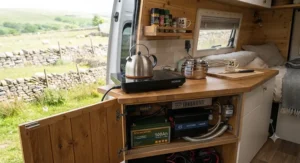
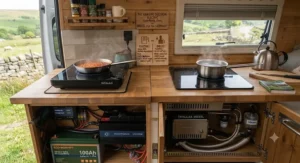
Choosing a stove is only half the job; a van kitchen setup has to be designed around whichever appliance you land on, because electric cooking behaves nothing like gas once you’re actually stood at the worktop. Start with worktop clearance: induction hobs and cast-iron hotplates both need genuine heatproof space either side, not the six inches of clearance a two-ring gas hob gets away with, because pan handles and steam behave differently when there’s no wind to carry them away.
Socket placement is the next decision, and it’s easy to get wrong on paper. A single 13A socket wired for a kettle is not automatically safe for a 2,500W hotplate running alongside a fridge compressor cycling on and off — get an installer or a competent DIY reference to check your ring’s total load rather than assuming one socket equals one safe appliance. Storage matters too: induction-compatible pans are heavier than the aluminium camping sets most van kitchens start with, so budget cupboard space and weight accordingly, particularly if payload is already tight. Finally, plan your worktop layout so the stove sits away from curtains, cushions, and anything flammable, exactly as you would with gas — flameless doesn’t mean risk-free, it just changes which risks you’re managing.
Real-World Scenarios: Matching Van Lifers to the Right Stove
The weekend warrior with occasional hook-up. If you tour campsites two or three weekends a month and always book pitches with electric hook-up, a mains hotplate like the Duronic HP1BK or Russell Hobbs 15199 makes sense: low cost, dead simple, and you’re rarely off-grid long enough for the lack of 12V compatibility to matter.
The full-time off-gridder with solar and lithium. Someone living in the van full-time, wild camping most nights with a decent solar array and a lithium battery bank, is the one buyer group where the RoadPro RPSC-197 genuinely earns its keep as a driving-day reheat option, paired with gas or a well-sized induction setup backed by a serious inverter for proper cooking.
The couple who cook properly, often. For two people who actually want to fry, boil, and simmer a real meal most evenings rather than reheat, the jump to induction pays off fastest — the Tefal Everyday IH201840 or Daewoo 2200W Portable Single Induction Hob cut cooking time meaningfully compared with cast iron, provided hook-up access is reliable.
Problem → Solution: Fixing Common Electric Cooking Headaches
Problem: the campsite breaker keeps tripping. This almost always means total wattage in use exceeds the pitch’s amp rating. Solution: check the wattage of every appliance running simultaneously — fridge, phone charger, and stove together — and stagger use of the Duronic HP2BK‘s two rings rather than running both at full power at once.
Problem: food never quite gets a proper sear. Cast-iron hotplates like the Duronic HP1BK heat more gently than gas and lose heat faster when a cold pan lands on them. Solution: preheat the plate for a couple of minutes longer than feels natural, and switch to an induction model if searing matters to you regularly.
Problem: the stove works at the campsite but not on the drive. Induction hobs and mains hotplates need 230V, which most vans only have via hook-up or a substantial inverter. Solution: treat the RoadPro RPSC-197 as your driving-day and off-grid backup, and your mains stove as the hook-up-only main event.
Problem: pans slide or clatter on a moving worktop. Solution: fit a simple lip or non-slip mat around the stove’s footprint; induction hobs in particular are light enough to shift under a firmly stirred pan.
How to Choose an Electric Camping Stove for Van Life
- Decide your power reality first. If you’re mostly off-grid, only a genuinely 12V appliance like the RoadPro RPSC-197 will work without a large inverter and battery bank; everything else on this list needs 230V.
- Match wattage to your hook-up. UK campsite hook-ups are commonly rated at 10A (2,300W) or 16A (3,680W); a 2,500W hob like the Duronic HP2BK leaves little headroom on a 10A site once a fridge is running.
- Check your cookware compatibility. Induction models such as the Tefal Everyday IH201840 need magnetic pans; cast-iron hotplates work with any pan you already own.
- Weigh speed against control. Induction wins on raw speed; cast-iron hotplates like the Russell Hobbs 15199 often win on gentle, even simmering.
- Think about storage weight and size. A twin-ring hotplate or induction hob adds several kilograms to your build; factor this into payload if your van is already close to its limit.
- Read the safety features, not just the price tag. Auto-shutoff, as found on the Tefal Everyday IH201840, is genuinely valuable in a moving, jostling vehicle.
- Confirm the plug and voltage suit UK use. Most listings are UK-spec, but always double-check before ordering from a marketplace seller based overseas.
Where to Buy an Electric Camping Stove in the UK
For anyone ready to buy an electric camping stove, amazon.co.uk remains the most convenient starting point thanks to clear returns policies and aggregated customer reviews you can actually read before committing. Specialist outdoor retailers and dedicated 12V suppliers are worth checking too, particularly for genuine 12V products like the RoadPro RPSC-197, where stock and pricing can vary noticeably between sellers. Whichever route you take, always check current price and stock at the time of purchase, since availability on popular models shifts quickly.
Leisure Battery Power Draw: The Maths Every Van Lifer Needs
This is the section that saves you from a dead battery on day two. Leisure battery power draw is simply current (amps) multiplied by time, and it’s the single biggest factor separating a stove that works from one that quietly drains your whole system.
| Appliance | Typical Draw | 1 Hour of Use Draws Roughly |
|---|---|---|
| RoadPro RPSC-197 (12V direct) | ~12A | 12Ah |
| Fridge compressor (typical) | 3-5A | 3-5Ah |
| 230V hotplate via 1,000W inverter | 80-90A at 12V | 80-90Ah |
| 230V induction hob via 2,000W inverter | 160-180A at 12V | 160-180Ah |
The jump between running the RoadPro RPSC-197 directly from 12V and running any mains hotplate or induction hob through an inverter is dramatic — an inverter doesn’t create power, it converts it, and that conversion multiplies the current your battery has to supply. A single 100Ah lithium battery simply cannot sustain a 2,000W inverter load for any meaningful length of time, which is precisely why induction hobs like the Tefal Everyday IH201840 are, in practice, a hook-up appliance rather than a true off-grid one unless your battery bank and inverter are seriously oversized.
✨ Don’t Miss These Exclusive Deals!
🔍 Take your van kitchen setup to the next level with these carefully selected stoves. Click on any highlighted product to check current pricing and availability, and cook proper, satisfying meals on the road without the guesswork.
Electric Camping Stove vs Gas Stove: Which Wins for Van Life?
Gas has been the default van life cooking method for decades, and for good reason: it’s powerful, fast, works in freezing temperatures, and needs no electrical planning whatsoever. A single gas ring boils a litre of water in three to four minutes flat, something even the fastest induction hob on this list, the Tefal Everyday IH201840, only roughly matches at full power on a good day. As explained on Wikipedia’s overview of induction cooking, induction heats cookware directly through electromagnetic fields rather than heating a surrounding element, which is what gives it its speed advantage over cast-iron hotplates specifically, even if it still trails a naked flame for raw power.
Where electric stoves for van life pull ahead is safety and cleanliness: no combustion means no carbon monoxide risk, no gas canister storage, and no faint hiss to check before bed. The trade-off is dependency — every option on this list except the RoadPro RPSC-197 needs 230V, which means hook-up access, planning, or a serious inverter setup that gas simply doesn’t require. For most van lifers, the honest answer isn’t “electric replaces gas” but “electric supplements gas,” covering hook-up nights and driving-day reheats while gas remains the off-grid workhorse.
Flameless Cooking Safety: Regulations & Practical Precautions
Flameless cooking safety is arguably the strongest, most underrated case for going electric in a van. According to NHS guidance on carbon monoxide poisoning, using barbecues or camping stoves in an enclosed space such as a vehicle can cause a dangerous build-up of carbon monoxide, a colourless, odourless gas that gives no warning before it becomes serious. Removing the flame entirely, as every stove on this list does, removes that specific risk outright — there’s simply no combustion happening inside the van.
That doesn’t mean electric cooking is risk-free, though, and this is where genuine flameless cooking safety practice matters. Mains appliances like the Duronic HP2BK and Tefal Everyday IH201840 still carry standard electrical risks: check hook-up cables are fully uncoiled before use to prevent overheating, never run a domestic-rated extension lead outdoors, and always test your consumer unit’s RCD trip button on arrival at a new pitch, a routine covered in detail by the Caravan and Motorhome Club’s hook-up guidance. For 12V appliances like the RoadPro RPSC-197, keep an eye on cable condition and never leave it running unattended for extended periods, since sustained high current draw generates real heat at the plug and socket.
Common Mistakes When Buying an Electric Camping Stove for Van Life
The single most common mistake is assuming “electric camping stove” automatically means “off-grid ready” — as this guide has repeatedly shown, only genuinely 12V products like the RoadPro RPSC-197 qualify, and buyers who skip this check often end up with an expensive hob they can only use at a handful of pitches. A close second is buying an induction hob, such as the Judge Portable Electric Induction Hob, without checking pan compatibility first, then discovering none of their existing cookware works.
Underestimating combined wattage is another recurring trap: pairing a 2,500W Duronic HP2BK with a fridge and a kettle on a modest 10A hook-up is a near-guaranteed way to trip a breaker mid-meal. Finally, plenty of buyers focus purely on price and overlook safety features entirely — an auto-shutoff function, present on the Tefal Everyday IH201840 but absent from cheaper rivals, is a small spec line that matters considerably more in a moving vehicle than in a static kitchen.
What to Expect: Real-World 12V Camping Stove Reviews
Genuine 12V camping stove reviews, gathered from Amazon, eBay, and dedicated trucker and van-life forums, paint a consistent picture once you filter out mismatched expectations. For the RoadPro RPSC-197, the recurring verdict is that it excels as a reheating device and disappoints anyone expecting it to cook raw ingredients — reviewers who understood this going in rate it very highly, while those who didn’t often leave harsher feedback that says more about mismatched expectations than product quality.
For the mains-powered options, aggregated sentiment tends to track build quality closely: the Duronic HP1BK and Duronic HP2BK both attract praise for their simmer control relative to price, while the induction models cluster around genuine speed and ease of cleaning as the standout themes. Across the board, negative reviews are disproportionately concentrated on units used outside their intended power setup — running an induction hob through an undersized inverter, for instance — rather than on core build defects, which reinforces just how much leisure battery power draw and hook-up planning shape real-world satisfaction with these products.
Long-Term Cost & Maintenance: Is an Electric Stove Worth It?
Run the numbers over a season and electric cooking looks more competitive than the upfront price tags suggest. A single gas canister typically costs several pounds and lasts a handful of cooking sessions, while UK campsite electric hook-up is usually included in, or added as a modest supplement to, your pitch fee — meaning the marginal cost of an extra hour on the Duronic HP1BK or Russell Hobbs 15199 is close to nothing once you’re already plugged in.
Maintenance costs also favour electric over the long run: there are no valves, seals, or regulators to replace, and cast-iron plates on hotplates like the Duronic HP2BK are essentially maintenance-free beyond keeping them clean and dry. Induction hobs need slightly more care around their ceramic surfaces, which can scratch under abrasive pan bases, but replacement units for models like the Tefal Everyday IH201840 remain widely stocked given the brand’s popularity. The genuine long-term cost to budget for isn’t the stove itself but the battery and inverter capacity needed to run it off-grid, which is where costs can escalate quickly if you’re not starting from the RoadPro RPSC-197‘s modest 12V footprint.
FAQ
❓ Can I run an induction hob off my leisure battery without hook-up?
❓ What's the fastest electric camping stove for van life?
❓ Is a 12V camping stove worth buying for van life?
❓ Do electric camping stoves need special pans?
❓ How much does it cost to run an electric camping stove at a campsite?
Conclusion
There’s no single best electric camping stove for van life, and honestly, anyone who tells you otherwise hasn’t looked closely enough at how differently these seven products actually behave. The RoadPro RPSC-197 stands alone as your genuine off-grid, battery-powered option, brilliant for reheats and useless for raw cooking. The Duronic HP1BK, Duronic HP2BK, and Russell Hobbs 15199 cover mains-powered hotplate cooking at three price points, each trading a little speed for dependable, simple simmer control. And the Judge Portable Electric Induction Hob, Daewoo 2200W Portable Single Induction Hob, and Tefal Everyday IH201840 deliver genuine speed and precision, provided you’ve got the pans and the hook-up to match.
The real decision isn’t really about the stove at all — it’s about your power setup. Work out honestly how often you’re on hook-up versus wild camping, check your leisure battery power draw against whatever you’re eyeing up, and build your van kitchen setup around that answer rather than around whichever hob looks nicest in the listing photos. Get that part right, and any of these seven stoves will earn its keep.
✨ Don’t Miss These Exclusive Deals!
🔍 Ready to upgrade your van kitchen setup? Check current prices on today’s featured stoves and start cooking proper meals on the road, wherever the next pitch happens to be.
Recommended for You
- 7 Best Petrol Stoves Under £120 (2026): Budget To Expedition Picks
- Petrol Camping Stove: 7 Best Picks Tested for UK Trips 2026
- Best White Gas Stove for Backpacking: 7 Top Picks for 2026
Disclaimer: This article contains affiliate links. As an Amazon Associate, I earn from qualifying purchases. If you purchase products through these links, we may earn a small commission at no additional cost to you.
✨ Found this helpful? Share it with your friends! 💬🤗
