In This Article
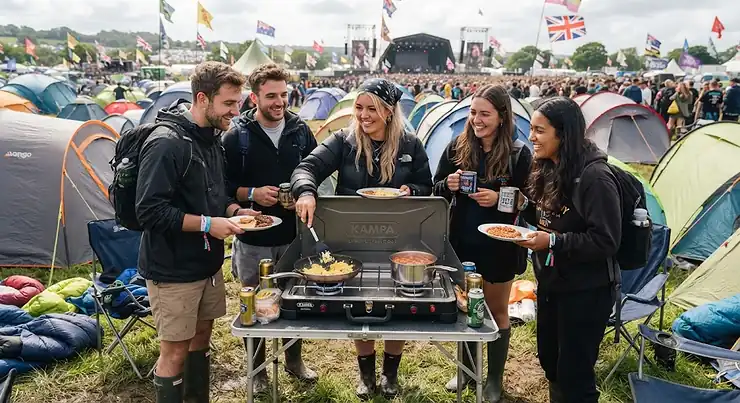
A camping stove for groups and festivals is any portable cooking appliance — usually gas, sometimes induction — built with a wide enough burner surface, high enough output, and sturdy enough frame to feed several hungry people at once rather than just one. If you’ve ever queued twenty-five minutes for a lukewarm burger while your tent is thirty metres away, you already understand the appeal.
Here’s the thing nobody tells you before your first proper group trip: cooking for six is a completely different job to cooking for one. It’s not just “buy a bigger stove.” It’s flame spread, wind exposure, fuel logistics, and the horrible discovery that your festival has banned gas altogether. We’ve dug through real specifications, aggregated review sentiment, and — crucially — the actual rulebooks of UK festivals, because the wrong stove can get confiscated at the gate before you’ve cooked a single sausage.
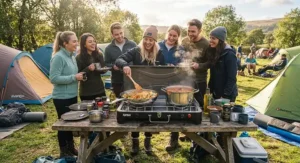
This guide covers seven genuine products spanning budget grill-stoves to full induction hobs, the fuel and safety rules that catch people out every summer, and practical scenarios for families, festival crews, and anyone organising an outdoor catering stove setup for a bigger event. Whether you’re after a straightforward family camping cooking stove gas setup or something built for communal camp cooking across a whole campsite pitch, there’s a sensible option below — and an honest verdict on where each one falls short.
Quick Comparison Table
| Product | Burners | Fuel | Best For |
|---|---|---|---|
| Campingaz Party Grill 400 CV | 1 grill + wok lid | Gas (CV Plus) | Big groups wanting grill + boil in one |
| Campingaz Camp Bistro 3 | 1 + griddle plate | Gas (cartridge) | Budget-conscious small groups |
| Outwell Jimbu Double Burner | 2 | Butane/Propane | Simultaneous cooking, mixed fuel |
| Cadac 2 Cook 2 Pro Deluxe QR | 2 + griddle | Gas (QR valve) | Serious weekend catering |
| Vango Sizzle Double Induction Hob | 2 | Mains electric | Awnings, no-naked-flame sites |
| Primus Onja Duo Stove | 2 | Gas (Duo valve) | Design-conscious family cooks |
| Trangia 25-4 UL Stove Kit | 1 (complete kit) | Methylated spirit | Gas-banned festivals |
Looking at the spread above, the honest takeaway is that there’s no single “best” — there’s a best-for-your-situation. If your festival has banned gas outright (and several major ones have), the Trangia 25-4 UL Stove Kit is arguably the only entry here that keeps you legally cooking. Anyone camping on a pitch with mains hookup should lean toward the Vango Sizzle Double Induction Hob, since it sidesteps the naked-flame question entirely. For everyone else feeding four to eight people from a car boot, the choice really comes down to grill versus twin-ring cooking, which we unpack product by product below.
💬 Bookmark this table now — you’ll want to compare it again once you’ve read the full breakdown below!
Top 7 Camping Stoves for Groups and Festivals: Expert Analysis
1. Campingaz Party Grill 400 CV — grill, wok and boil-ring in one unit
The Campingaz Party Grill 400 CV takes the format that made the smaller 200 model a festival favourite and scales it up, adding a wok-shaped lid so you get a grill plate, a curved surface for stir-fries, and enough space that you’re not constantly shuffling pans. Running on Campingaz’s CV Plus valve cartridges (propane/butane blend), it lights via a built-in Piezo igniter, so there’s no fumbling for a lighter with greasy fingers.
Based on the spec comparison with the smaller Party Grill 200 — which posts a boil time of around 4 minutes 18 seconds per litre and weighs 2.84kg — the 400 trades a little portability for genuinely useful grilling real estate. What most buyers overlook about this format is that it isn’t really “a stove with a lid,” it’s two cooking methods bolted together, which matters enormously when you’re trying to serve six people a fry-up before the headline act.
Reviewers consistently note that the components nest inside one another for storage, and that the non-stick grill plate wipes clean fast — a genuine advantage when you’re washing up with a squeezy bottle and baby wipes rather than a proper sink.
Pros:
- ✅ Grill, wok lid and boil ring cover most group meals
- ✅ Piezo ignition works even with cold, damp hands
- ✅ Components pack away inside each other neatly
Cons:
- ❌ Heavier and bulkier than a single-burner stove
- ❌ CV Plus cartridges cost more than standard screw-fit canisters
At around £70-£90 depending on retailer stock, this sits firmly in mid-range value — genuinely justified if grilling is central to your trip, less so if you only ever boil pasta.
2. Campingaz Camp Bistro 3 — budget single burner with integrated griddle
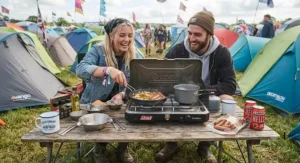
The Campingaz Camp Bistro 3 is the current generation of a stove that’s been a UK camping staple for years, and it earns that reputation through sheer unfussiness: one burner, one griddle plate, automatic ignition, and a built-in windshield that actually does something on a breezy pitch. It runs on widely available CP or CV cartridges, which means you’re never more than a petrol station or outdoor shop away from a refill.
Here’s what the spec sheet won’t tell you, but user reports suggest: a single-burner griddle stove like this genuinely can feed a small group if you cook in batches — bacon and eggs for four, then the same again for the next four, ten minutes later. It’s not simultaneous group cooking, but for a lightweight camping stove for large group trips where you’re travelling light, it’s a sensible compromise between capability and boot space.
Aggregated review sentiment consistently praises the safety certification and ease of connecting cartridges, with a smaller number of complaints about the griddle plate warping slightly under prolonged high heat — worth noting if you plan to sear rather than gently fry.
Pros:
- ✅ Genuinely compact for the cooking surface it offers
- ✅ Automatic ignition removes the need for matches
- ✅ Cartridges are cheap and sold almost everywhere
Cons:
- ❌ Single burner means batch-cooking, not simultaneous meals
- ❌ Griddle plate can warp slightly with sustained high heat
Around £50-£60 in the mid-£50s range, this is the entry point for anyone who wants a proper griddle without committing to double-burner bulk.
3. Outwell Jimbu Double Burner Stove — simultaneous two-ring cooking for families
The Outwell Jimbu Double Burner Stove solves the batch-cooking problem outright: two independently controlled burners let you boil water for coffee while frying eggs on the other ring, which is the whole point of a family camping cooking stove gas setup. It runs on either butane or propane canisters, giving you flexibility if one fuel type sells out at the campsite shop — not a rare occurrence in peak season.
Based on the spec comparison with single-burner rivals, the Jimbu’s built-in windshield and wider stance mean it copes noticeably better with an exposed pitch, where a narrow stove can tip or gutter in a stiff breeze. What most buyers overlook here is fuel flexibility: many double burners lock you into one canister type, and running out mid-holiday with the wrong spare in the car is a genuinely common festival horror story.
Reviewers consistently report that setup and pack-down take under two minutes once you’ve done it once, with detachable legs and a lid that doubles as a wind-break during cooking.
Pros:
- ✅ Two independent burners for simultaneous cooking
- ✅ Accepts butane or propane for fuel flexibility
- ✅ Stable footprint copes well with uneven pitches
Cons:
- ❌ Larger footprint takes up more table space
- ❌ Windshield helps but doesn’t fully solve exposed-site gusts
At around £90-£110, this is arguably the most balanced all-rounder on this list for straightforward family group cooking.
4. Cadac 2 Cook 2 Pro Deluxe QR — the closest thing to a proper camp kitchen
The Cadac 2 Cook 2 Pro Deluxe QR pairs two gas burners with an additional griddle attachment and a quick-release (QR) valve system, meaning you can swap cartridges without tools mid-cook — a small detail that matters enormously when dinner for eight is halfway done and the gas cuts out. On paper this means less downtime between courses, which is precisely what a group outdoor catering stove needs to earn its keep.
Here’s what the spec sheet doesn’t capture well: the quick-release fitting genuinely changes how confident newer campers feel swapping cylinders, because there’s no threading, no cross-thread risk, and no fumbling in low light. Reviewers consistently flag the fold-out griddle as the standout feature, since it converts the unit from “stove” to “outdoor kitchen” for a fraction of the cost of a dedicated event caterer’s rig.
The trade-off, honestly, is weight and bulk — this isn’t a stove you’ll want to carry more than a few metres from the car, and storage between uses takes up meaningful garage space.
Pros:
- ✅ Quick-release valve speeds up cartridge changes
- ✅ Griddle attachment adds genuine cooking versatility
- ✅ Sturdy build suited to repeat weekend use
Cons:
- ❌ Heavier and bulkier than most stoves on this list
- ❌ Premium pricing compared with simpler double burners
Sitting in the £120-£150 range, this is squarely a mid-premium buy for people who cook for groups often enough to justify the extra kit.
5. Vango Sizzle Double Induction Hob — the safest choice where naked flames aren’t welcome
The Vango Sizzle Double Induction Hob swaps gas for mains electric induction, which sounds like a compromise until you consider how many UK sites and festivals now restrict or ban gas cartridges outright. Plugged into a hookup, it delivers two independently controlled induction rings with none of the carbon monoxide risk or naked-flame hazard that comes with combustion stoves.
Based on the spec comparison with gas double burners, induction’s real advantage for groups isn’t raw power — it’s precision. Induction hobs heat the pan directly rather than the surrounding air, so simmering a sauce for a group meal is dramatically easier than balancing a flame in a breeze. What most buyers overlook about induction camping is that you need induction-compatible (magnetic-base) cookware; a favourite non-stick pan from home might simply refuse to heat up at all.
Aggregated review sentiment is strongly positive on cleanliness and safety, with the main honest caveat being total dependence on a mains hookup — this genuinely isn’t an option for a tent pitch with no electricity.
Pros:
- ✅ No naked flame, ideal for awnings and gas-restricted sites
- ✅ Precise temperature control suits sauces and simmering
- ✅ No cartridges to buy, carry or dispose of
Cons:
- ❌ Requires mains hookup — useless without electricity
- ❌ Needs induction-compatible pans, which not everyone owns
Priced around £90-£110, this is the standout choice specifically for caravan, motorhome and awning-based group cooking rather than tent-only festival trips.
6. Primus Onja Duo Stove — the design-led double burner with a clever chopping-board lid
The Primus Onja Duo Stove looks unlike anything else on this list, with a wooden lid that lifts off to double as a chopping board over the twin burners beneath. It connects via a Duo valve system compatible with most standard valve gas canisters, so fuel sourcing isn’t an issue, and independent testing has recorded a boil time of around 3 minutes 40 seconds per litre with a stove weight of roughly 3.2kg.
What the spec sheet won’t tell you, but reviewers note, is how much that wooden lid changes the actual cooking experience at a group meal — instead of a bare gas stove sitting awkwardly on a picnic table, you get something that looks intentional, doubles as usable prep space, and packs into a shoulder bag rather than a rigid case. For anyone hosting a proper outdoor cooking stove for events, whether that’s a milestone birthday camp or a small gathering, presentation genuinely matters.
The honest trade-off is that style costs money, and the burners themselves — while sturdy — reportedly need a few attempts to find the simmer sweet spot before you stop scorching things.
Pros:
- ✅ Wooden lid doubles as genuine prep-space chopping board
- ✅ Fits most standard valve gas canisters
- ✅ Packs down into a shoulder-carry bag, not just a case
Cons:
- ❌ Premium price for the level of raw cooking power on offer
- ❌ Simmer control takes practice to master
Expect to pay in the £130-£160 range — a genuine premium pick for campers who value the whole table experience, not just the flame.
7. Trangia 25-4 UL Stove Kit — the complete cooking system for gas-banned festivals
The Trangia 25-4 UL Stove Kit runs entirely on methylated spirits rather than gas cartridges, which is precisely why it belongs on this list: several major UK festivals, Download among them, now ban gas canisters and petrol-fuelled cookers outright from their campsites, permitting meths-based Trangia stoves as one of the few approved alternatives. The complete kit includes nested pots, a frying pan and a kettle, so it’s a full communal camp cooking setup rather than a bare burner.
Based on the spec comparison with gas alternatives, meths burns slower and can’t be turned off instantly like a gas valve, so it genuinely suits simmering stews and one-pot meals better than fast frying — a trade-off worth understanding before you rely on it for a full fried breakfast for six. What most buyers overlook is fuel limits at festivals: many events cap meths fuel at one litre per stove in its original sealed container, so plan your quantities accordingly rather than assuming you can bring as much as you like.
Reviewers consistently praise the near-indestructible construction — some owners report kits still going strong after a decade of seasonal use — with the main honest criticism being slower boil times than pressurised gas.
Pros:
- ✅ Compliant with gas-banned festival cooking policies
- ✅ Complete kit: pots, pan and kettle all included
- ✅ Exceptionally durable, sturdy build
Cons:
- ❌ Meths burns slower than gas, especially for frying
- ❌ Fuel amount is often capped by festival rules
At roughly £90-£120 for the complete kit, this earns its keep the moment your festival’s kit list rules out anything else on this page.
Practical Usage Guide: Getting Your Group Stove Set Up Right
Setting up a group stove for the first time is where most of the frustration happens, and most of it is avoidable. Start by pitching your cooking station on level, non-flammable ground — grass is fine, dry bracken or scrub next to a tent is not — and always cook at least a few metres from guy ropes and tent fabric. Connect gas cartridges outdoors, away from any ignition source, checking the seal is seated properly before you turn the valve; a hissing sound or the smell of gas means stop immediately and reconnect. For anyone unfamiliar with valve types, the Scouts’ own guidance on connecting gas cylinders safely is a genuinely useful reference, even for adult groups, because the connection principles don’t change with age.
In the first thirty days of ownership, the most common mistakes are overtightening regulator connections (finger-tight is usually enough — check your manual), storing part-used cartridges on their side rather than upright, and skipping a leak check after transport, when hoses can loosen from vibration. Maintenance is minimal but not optional: wipe burners free of grease after every group cook to prevent clogged jets, and replace gas hoses every couple of years regardless of appearance, since UV and heat degrade rubber from the inside out.
One optimisation trick that rarely makes the instruction leaflet: pre-boiling a large flask of water at breakfast for tea and coffee refills through the day cuts your total gas usage noticeably across a multi-day group trip, which matters when you’re relying on a fixed number of cartridges for a whole festival weekend.
Real-World Scenarios: Matching the Stove to Your Group
The family reunion cook-up (6-10 people, car camping): with a car boot and a fixed pitch, the Outwell Jimbu Double Burner Stove or the Vango Sizzle Double Induction Hob (if hookup is available) both make sense — simultaneous cooking matters more than portability here, and you’ve got the space to store a bulkier unit between meals.
The festival crew of four (tent-only, gate restrictions apply): check your event’s rules before anything else. If gas is banned, the Trangia 25-4 UL Stove Kit is realistically your best legal option for festival camping cooking; if gas is permitted in the campsite (as it is at many, though rarely in the arena), the Campingaz Camp Bistro 3 balances low weight against real cooking capability.
The weekend gathering with proper catering ambitions (8+ people, birthday or reunion): this is where a genuine group outdoor catering stove earns its cost. The Cadac 2 Cook 2 Pro Deluxe QR or the Campingaz Party Grill 400 CV both scale to feeding a crowd across a full weekend, provided you’ve budgeted enough cartridges and someone in the group is comfortable running the “kitchen” for an hour at a time.
Problem → Solution Guide for Group Camp Cooking
Problem: your gas runs out mid-meal. Solution: always carry one spare cartridge per person-day of planned cooking, and choose a stove like the Cadac 2 Cook 2 Pro Deluxe QR with a quick-release valve so swapping mid-cook takes seconds, not a fiddly five-minute wrestle.
Problem: wind keeps blowing your flame out. Solution: cook with the stove’s own windshield facing the prevailing wind, and if you’re using an open design like the Primus Onja Duo Stove, position a car boot, gazebo wall, or windbreak as a secondary barrier.
Problem: your festival has banned gas entirely. Solution: don’t discover this at the gate. Check the specific festival’s list of permitted cooking equipment before you pack, and default to a meths kit like the Trangia 25-4 UL Stove Kit if there’s any doubt.
Problem: cooking for a large group takes forever on one burner. Solution: batch-prep what you can cold (chopped veg, pre-marinated meat) so the burner time is purely cooking, not prep, and consider a double-ring stove such as the Outwell Jimbu Double Burner Stove if this is a recurring issue.
Problem: washing up for a group with no running water. Solution: a griddle-plate stove like the Campingaz Camp Bistro 3 or Campingaz Party Grill 400 CV cuts your pan count, since one flat surface can cook several items that would otherwise need separate pots.
How to Choose a Camping Stove for Groups and Festivals
- Confirm your event’s fuel rules first. There’s no point comparing burner outputs if your festival bans gas outright — check before you shop, not after you’ve bought.
- Count heads, not nights. A camping stove for large group use needs enough simultaneous burner capacity for your actual headcount, not just “bigger than a solo stove.”
- Match fuel type to your site. Gas suits most campsite pitches; induction suits hookup-only sites; meths suits gas-restricted festivals.
- Weigh portability against cooking power. The heaviest, most capable stoves are brilliant from a car boot and miserable if you’re carrying kit any real distance.
- Check wind resistance specifically. A stove that boils fast in a lab test can gutter badly on an exposed hillside pitch — built-in windshields matter more than headline BTU figures.
- Budget for fuel, not just the stove. Gas cartridges, meths bottles and induction electricity all have ongoing costs across a multi-day trip.
- Consider clean-up realistically. Griddle-plate designs reduce your pan count for group meals, which matters hugely without a proper sink nearby.
Common Mistakes When Buying a Group Camping Stove
The single most frequent mistake is buying based on burner count alone, without checking fuel type against where you’ll actually be camping — a beautiful double-burner gas stove is dead weight at a festival that’s banned gas. A close second is underestimating fuel needs; group cooking burns through cartridges and meths far faster than solo trips, and running short on day two of a four-day event is a genuinely common complaint in aggregated reviews. Buyers also frequently skip checking whether a stove needs a specific, harder-to-find cartridge size, only discovering the mismatch once they’re already at the campsite shop holding the wrong canister.
Camping Stove vs Portable BBQ for Groups
A dedicated camping stove and a portable BBQ solve overlapping but genuinely different problems. A stove like the Cadac 2 Cook 2 Pro Deluxe QR gives you precise, adjustable heat suited to sauces, fry-ups and anything that needs simmering — control a BBQ simply can’t match. A charcoal or disposable BBQ, by contrast, delivers that specific smoky char flavour and a wider, flatter cooking surface, but takes longer to reach cooking temperature and offers almost no fine heat control once lit. For a family camping cooking stove gas setup where you’re rotating through breakfast, lunch and dinner across several days, the stove’s speed and control usually wins; for a single evening’s group cookout where flavour and atmosphere matter more than efficiency, a BBQ (where permitted) has genuine appeal. Many experienced festival groups actually bring both — a stove for daily meals, a disposable BBQ for one big evening cook-up.
What to Expect: Real-World Performance at a Festival Campsite
Lab-quoted boil times rarely survive contact with an actual festival field. Wind exposure, uneven pitches, and cooking at 7am with cold hands all slow things down — expect real boil times to run 20-40% longer than manufacturer figures on a breezy site. Group cooking also means more simultaneous demand on a single gas supply than most people plan for; a stove rated to run for a set number of hours on one cartridge at solo-cooking intensity will burn through fuel noticeably faster when both rings are running flat out for a crowd. The practical upshot: bring more spare fuel than the spec sheet implies you’ll need, and treat published performance figures as a starting benchmark rather than a guarantee.
Camping Stoves for Family Camping vs Festival Crews
Families cooking together tend to prioritise different things than a festival crew. A family camping cooking stove gas setup usually benefits from stability, simultaneous burners for breakfast rushes with children, and enough surface area for pans of different sizes — the Outwell Jimbu Double Burner Stove and Vango Sizzle Double Induction Hob both suit this brief well. Festival crews, by contrast, are usually more weight- and rules-conscious, cooking simpler meals in a tighter space and needing to clear gate restrictions before anything else — which is exactly why festival camping cooking so often comes back to compact single-burner options or, where gas is banned, the Trangia 25-4 UL Stove Kit. Neither audience is “wrong” to want different things; the mistake is buying a festival-crew stove for a family trip (too small for a breakfast rush) or a family-camping stove for a festival with strict gate rules (too bulky, or the wrong fuel entirely).
Long-Term Cost & Maintenance
The stove’s purchase price is rarely the biggest cost over a season of group camping — fuel is. A family that camps six weekends a year, feeding six people each time, will likely spend more on gas cartridges or meths across those trips than the difference between a £60 stove and a £140 one. Factor this in before assuming the cheapest unit is automatically the best value; a stove with genuinely efficient burners can claw back its higher purchase price in fuel savings within a season or two of regular group use. Maintenance costs are modest across the board — occasional hose replacement, the odd regulator seal — but neglecting them isn’t just a false economy, it’s a safety issue, which is exactly why the next section matters.
Safety, Regulations & Compliance Guide
Gas safety around groups deserves genuine attention, not an afterthought. Never use any gas or liquid-fuel stove inside a tent, awning or any enclosed space — incomplete combustion produces carbon monoxide, an odourless gas that the NHS explicitly warns can build up dangerously from barbecues and camping stoves used in poor ventilation, with symptoms including headache, dizziness and nausea that are often mistaken for a hangover or flu. Always cook outdoors, raise your stove off bare grass where a site requests it, and change cartridges away from any naked flame or ignition source.
On the regulatory side, UK festivals increasingly restrict cooking equipment for fire-safety reasons: some allow small gas stoves in the campsite but ban them from the arena and car parks; others ban gas and liquid fuel entirely and only permit meths, gel, or solid-fuel stoves within strict fuel-quantity limits. Rules vary considerably between events and change year to year, so always check your specific festival’s current terms before you pack — don’t assume last year’s rules still apply. Even outside festivals, campers exercising wild camping rights in Scotland are specifically encouraged, under the Scottish Outdoor Access Code, to use a stove rather than light an open fire wherever possible, precisely to reduce wildfire risk on dry ground — a principle worth applying anywhere in the UK during a hot, dry summer.
Frequently Asked Questions
❓ Can I bring a camping stove for groups and festivals to any UK festival?
❓ What's the best camping stove for large group cooking?
❓ Is a gas or induction stove better for family camping?
❓ How much gas do I need for group outdoor catering over a weekend?
❓ Can I use a camping stove inside my tent if it's raining?
Conclusion
Picking the right camping stove for groups and festivals really comes down to three honest questions: how many people are you feeding, what fuel is actually allowed where you’re going, and how much are you willing to carry. A family with a car boot and a fixed pitch has completely different priorities to a festival crew navigating gate restrictions with everything on their backs, and no single stove on this list — however well-reviewed — suits both briefs equally well.
What ties every recommendation here together is that real-world group cooking is messier and slower than any spec sheet suggests, so building in spare fuel, a genuine windshield, and a stove that matches your actual event’s rules will save you far more hassle than chasing the fastest quoted boil time. Whether you land on a budget griddle, a design-led double burner, or a meths kit built for gas-banned festivals, cooking your own food properly rather than queuing for it is, by a wide margin, one of the best upgrades you can make to any group trip.
✨ Ready to sort your group’s cooking kit before your next trip? Check current prices and availability on the models above and get packing! 🔥
Recommended for You
- 7 Best Family Camping Stoves for 2026: Feed the Whole Crew
- 3 Burner Camping Stove: 7 Best Triple Ring Cookers for 2026
- 7 Best Freestanding Double Burner Camping Stoves UK 2026 (Tested Picks)
Disclaimer: This article contains affiliate links. As an Amazon Associate, I earn from qualifying purchases. If you purchase products through these links, we may earn a small commission at no additional cost to you.
✨ Found this helpful? Share it with your crew before your next trip away! 💬🏕️
