In This Article
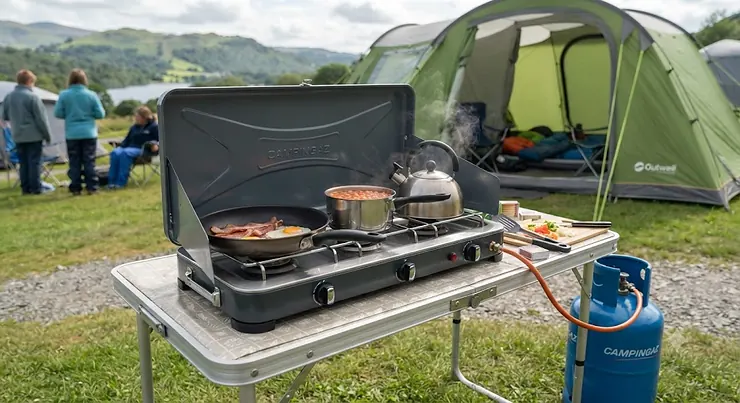
There’s a particular kind of chaos that happens around a two-burner stove when you’re cooking for more than three people. One pan finishes, gets shuffled off to a cool corner of the table, and something else goes on in its place while everyone hovers with plates, vaguely resentful. A 3 burner camping stove exists to end that dance. In short: a 3 burner camping stove is a portable, gas-powered cooking appliance with three independently controlled burners (or rings), designed to let you run a main, a side and a kettle simultaneously, typically fuelled by butane, propane or refillable LPG cylinders.
We’ve spent time digging into the real specs, the aggregated review sentiment and the practical trade-offs of the triple burner market so you don’t have to wade through marketing copy yourself. Whether you’re searching for a three burner gas camping stove for family holidays, a 3 ring camping stove gas setup for a scout group, or genuinely just a large capacity camping stove that can keep pace with a hungry crowd, this guide breaks down seven real products, how they stack up, and — critically — how to avoid buying more stove than you’ll ever actually use. Prices below are given as ranges only, since Amazon pricing shifts constantly; always check the current price on the listing before buying.
Quick Comparison Table
| Stove | Burners | Combined Output | Best For | Price Range |
|---|---|---|---|---|
| Coleman Classic 3-Burner | 3 | ~28,000 BTU | Family car camping | £90-£130 |
| Campingaz Camping Chef CV | 2 rings + grill | 4,500W | Budget-conscious families | £70-£90 |
| Campingaz Camping Kitchen 2 Multi-Cook Plus | 2 rings + griddle burner | ~4,500W | Versatile all-day cooking | £80-£110 |
| Campingaz Camping Kitchen 3 CV | 3 | Variable per burner | Serious weekend chefs | £100-£140 |
| Vango Combi IR Grill Cooker | 2 rings + IR grill | ~4.4kW | Budget family cooking | £60-£90 |
| Goplus 3 Burner Propane Cooker | 3 | 225,000 BTU | Catering & large groups | £120-£180 |
| Camp Chef Explorer 3X | 3 | 90,000 BTU | Serious outdoor cooks | £220-£280 |
A quick glance tells its own story here: BTU and wattage figures swing wildly depending on whether a stove is built for gentle simmering or genuinely industrial-scale cooking. The Goplus and Camp Chef models sit in a different weight class entirely, built more for catering trailers and tailgate parties than a weekend family pitch. Meanwhile, the Campingaz and Vango options prioritise portability and finesse over raw firepower, which suits anyone who actually wants to control a simmer rather than just blast heat at a pan.
💬 Just one click — help others make better buying decisions too! 😊
Top 7 3 Burner Camping Stoves: Expert Analysis
1. Coleman Classic 3-Burner Propane Stove — best all-rounder for family car camping
The standout here is how unfussy it is: point, click, cook, no drama. Coleman’s InstaStart push-button ignition lights each of the three burners without matches, and the stove pumps out roughly 28,000 BTU combined across those three adjustable rings, distributed by what Coleman calls its Even-Temp burner design. In practice, that means fewer scorched pancake edges than you’d get from a single-ring blast furnace trying to do three jobs at once.
Based on the spec comparison, this sits firmly in the mid-range bracket — powerful enough for a family of four or five, but not so industrial that you need a trailer to haul it. The chrome-plated grate lifts out for cleaning, and two WindBlock panels shield the flame from breezy pitches, which matters more than most first-time buyers expect. This is the stove for families who want dependable, matchless cooking without becoming amateur gas engineers.
Reviewers consistently report that the ignition system is the star feature, praising how reliably it fires up even after the stove has sat in a damp boot overnight. A recurring theme in feedback is that the stove runs through 16oz propane canisters faster than expected on the highest setting, so budget for spares on longer trips.
Pros:
- ✅ Matchless InstaStart ignition on all three burners
- ✅ WindBlock panels genuinely cut flame flicker in a breeze
- ✅ Removable chrome grate makes cleanup painless
Cons:
- ❌ Runs through 16oz canisters quickly on full heat
- ❌ Not the lightest three-burner on this list
Sitting in the £90-£130 range, this is solid value for what most families actually need — you’re paying for reliability and ignition convenience rather than raw power.
2. Campingaz Camping Chef CV — best budget three-in-one cooking zones
The standout feature is the reflective grill bolted onto a classic twin-ring stove, giving you three usable cooking zones for the price of a simpler two-burner unit. Campingaz rates the whole unit at 4,500W, but here’s what the spec sheet won’t tell you outright: that’s the sum of three separate 1,500W elements, not one giant burner, so don’t expect wok-level searing from any single ring.
What most buyers overlook about this model is that it doesn’t ship with a stand — you’ll need a table or flat surface to run it on, which actually keeps the packed size sensible for a car boot. As one detailed hands-on review notes, the Camping Chef CV handles simultaneous cooking well for car camping trips, managing beans, toast and a brew at once without much fuss, though wind protection is minimal in open pitches.
Aggregated review sentiment points to strong satisfaction with the fold-flat design and the CV470 cartridge system, which is genuinely painless to swap mid-cook. Some users note the lack of a carry bag as a mild annoyance, since the folded unit has sharp edges best kept away from bare hands in a packed boot.
Pros:
- ✅ Three cooking zones for a genuinely low price
- ✅ Folds flat and self-seals for compact storage
- ✅ CV470 cartridges are cheap and widely stocked
Cons:
- ❌ No carry bag included as standard
- ❌ Minimal built-in wind protection
At around £70-£90, this is the most affordable route into three-zone cooking on this whole list.
3. Campingaz Camping Kitchen 2 Multi-Cook Plus 3 Burner — best for versatile all-day cooking
This one’s standout trick is the dedicated non-stick griddle burner sitting alongside two proper 1,800W rings, so you get a genuine breakfast-to-dinner setup rather than three identical hobs. FLAMEGUARD technology shields each burner from wind, which the spec sheet frames as a minor detail but which reviewers repeatedly flag as the difference between a five-minute boil and a fifteen-minute one on a blustery pitch.
Here’s what matters in practice: the griddle uses a lightweight die-cast aluminium plate with a PTFE non-stick coating, and both it and the pan supports lift out for dishwasher cleaning — a genuinely useful trick that Amazon listings rarely mention because it’s not a headline spec. Based on the spec comparison against the standard Camping Kitchen 3 CV below, this Multi-Cook Plus trades one full burner for a griddle, which suits families who cook fried breakfasts more than families who need three simultaneous saucepans.
Reviewers note the dual piezo ignition as consistently reliable, and the slim folding design with a steel lid earns praise for surviving repeated packing without denting. A common complaint in user feedback is that this stove runs on Campingaz 904/907 refillable cylinders rather than the smaller disposable cartridges, meaning you’ll need a compatible hose and regulator, sold separately.
Pros:
- ✅ Dedicated griddle burner for fried breakfasts
- ✅ FLAMEGUARD wind protection on all elements
- ✅ Dishwasher-safe pan supports and griddle plate
Cons:
- ❌ Requires a separate hose and regulator purchase
- ❌ Griddle burner is weaker than the two main rings
Expect to pay in the £80-£110 range, with the regulator adding a little to the real-world total cost.
4. Campingaz Camping Kitchen 3 CV — best for serious weekend chefs
The headline advantage is genuine three-burner independence — no griddle compromise, no shared cooking zone, just three individually controlled rings with an integrated windshield and drip tray built in. That drip tray sounds like a footnote until you’ve scrubbed baked-on sausage fat off a stove without one; it’s a small design choice that saves real cleanup time.
What the spec sheet won’t tell you, but reviewers note, is that running CV470 canisters across three simultaneous burners drains fuel noticeably faster than a two-burner setup, so heavy users tend to carry two spare cartridges rather than one. This is the model to reach for if your campsite meals genuinely involve starters, mains and sauces rather than beans on toast — the kind of cook who resents sharing a ring.
According to industry coverage of the wider Camping Chef and Camping Kitchen range, availability of the full three-burner variant can vary seasonally in the UK, so it’s worth checking stock ahead of peak summer months rather than assuming it’ll always be on the shelf. Aggregated feedback highlights the built-in windshield as a genuine upgrade over cheaper Campingaz stoves, with noticeably steadier flames in moderate breeze.
Pros:
- ✅ Three fully independent burners, no shared zones
- ✅ Integrated windshield and drip tray as standard
- ✅ Compact folding design despite the extra burner
Cons:
- ❌ Burns through CV470 cartridges faster with all three lit
- ❌ Seasonal stock availability can be inconsistent
Sitting at roughly £100-£140, this is the pick for anyone who’s outgrown a twin burner and wants proper independent control.
5. Vango Combi IR Grill Cooker — best budget family cooker with grill
The standout advantage is sheer practicality on a budget: two 1.9kW stainless steel burners plus a 0.6kW infrared grill, giving three cooking zones for a genuinely accessible price. Each burner runs off its own brass flame control valve, so you can properly simmer a sauce on one ring while boiling pasta on the other — no compromise there.
Based on spec comparison with the Campingaz Camping Chef CV above, the Vango trades a slightly heavier overall build (under 4kg) for a marginally larger cooking footprint, useful if you’re regularly cooking for a family of four rather than a couple. What most buyers overlook is that this stove has minimal built-in wind resistance, so a windbreak isn’t optional extra kit here — it’s close to essential if you’re pitched anywhere exposed.
One hands-on family review found the cooker easy to assemble and reasonably stable once loaded with two full pans and the grill running simultaneously, describing it as well suited to “a keen outdoor chef travelling with their family.” A common thread in feedback is that buyers need to budget separately for a gas regulator and hose, adding roughly £20 to the real total cost.
Pros:
- ✅ Three cooking zones at a genuinely low entry price
- ✅ Independent brass valve control on each burner
- ✅ Anti-slip feet keep it stable when fully loaded
Cons:
- ❌ Regulator and hose sold separately, adding to cost
- ❌ Poor wind resistance without an external windbreak
At around £60-£90 before accessories, this is the value pick for families dipping a toe into triple-zone cooking.
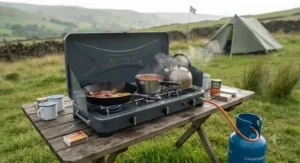
6. Goplus 3 Burner Propane Cooker — best for catering and large groups
There’s no subtlety to this one’s standout feature: 225,000 BTU across three cast iron burners, which is roughly eight times the output of the Coleman Classic above. This isn’t a stove for a quiet couple’s weekend — it’s built for feeding crowds, and the detachable legs mean it packs down small enough to fit in a car boot despite the industrial power on offer.
Here’s the practical interpretation: that much heat means water boils in a fraction of the time a domestic-style camping stove needs, which matters enormously if you’re catering for a scout troop, a wedding marquee, or a genuinely large family gathering. The cast iron construction with high-temperature powder coating resists rust better than the cheaper stamped-steel burners found on smaller stoves, though it does mean this unit is considerably heavier to lift and load.
Reviewer sentiment consistently praises the raw heat output, with feedback highlighting rapid boil times for large volumes of water — genuinely useful for anyone running a serious outdoor kitchen. A recurring concern in reviews is the need for a separately purchased high-pressure regulator and, of course, a propane tank, neither of which comes bundled with the stove itself.
Pros:
- ✅ Enormous 225,000 BTU output for fast, large-volume cooking
- ✅ Durable cast iron construction resists rust
- ✅ Detachable legs simplify transport and storage
Cons:
- ❌ Propane tank and regulator not included
- ❌ Overkill and inefficient for cooking small meals
Typically priced in the £120-£180 range, this only makes financial sense if you’re regularly cooking for groups of eight or more.
7. Camp Chef Explorer 3X — best premium option for serious outdoor cooks
The standout feature is balance: three 30,000 BTU burners combining for 90,000 BTU total, which gives you Goplus-level firepower with far more finesse and adjustability per burner. Each ring has its own control, so you can genuinely run a rolling boil, a gentle simmer and a searing pan side by side without one bullying the others.
What the spec sheet won’t tell you is how much the accessory ecosystem matters here — this stove is compatible with griddles, BBQ boxes and cast iron accessories designed for Camp Chef’s wider 16-inch cooking system, meaning your initial purchase can grow into a proper modular outdoor kitchen over time. On paper, that flexibility justifies the premium price tag far more than raw BTU figures alone would.
Reviewers consistently praise the even heat distribution and simmer control, with feedback specifically noting it handles crowd cooking without the hotspots that plague cheaper cast-iron burners. The trade-off, unsurprisingly, is price: this sits well above every other stove on this list, and casual campers are unlikely to recoup that investment through occasional weekend use.
Pros:
- ✅ Exceptional simmer control across all three burners
- ✅ Expandable with a genuine accessory ecosystem
- ✅ Even heat distribution reduces scorching
Cons:
- ❌ Significantly more expensive than rivals here
- ❌ Overkill for occasional or lightweight campers
Expect to pay in the £220-£280 range — a premium price for genuinely premium control.
Setting Up and Maintaining Your Three Burner Gas Camping Stove
Buying the stove is the easy part; keeping it running smoothly across a season of trips is where most people trip up. Before your first cook, always test-fire every burner at home with the manufacturer’s recommended cartridge, checking for even flame colour — a lazy yellow flame instead of crisp blue usually signals a dirty jet or poor ventilation, not a faulty burner. Store cartridges upright, away from direct sunlight, and never in the boot of a car on a hot day; heat build-up inside a sealed vehicle is a genuine risk with pressurised gas canisters.
A common first-30-days mistake is over-tightening the cartridge connection, which can damage the seal rather than improve it — hand-tight is almost always sufficient. After each trip, wipe down pan supports and burner heads before packing away; food residue left on a hot burner head bakes on fast and becomes genuinely difficult to remove after a couple of uses. Roughly every few months of regular use, check the rubber hose (on models that use one) for cracking or brittleness, since UV exposure degrades rubber faster outdoors than most people expect.
For optimisation, cooking with lids on wherever possible cuts boil times dramatically on all three of these burner types, and positioning the stove with its back to prevailing wind — rather than relying entirely on a built-in windshield — squeezes noticeably more efficiency out of every cartridge. The Camping and Caravanning Club’s cooking guidance is a genuinely useful resource here, particularly for anyone new to swapping between butane and propane fuel types depending on the season.
Real-World Scenarios: Who Actually Needs a Triple Burner Camp Cooker
The growing family (five-plus people, weekend trips): A double burner means constant rotation — one dish finishes while the next starts, and someone’s always eating cold food while others wait. A three burner camping stove like the Coleman Classic or Campingaz Camping Kitchen 3 CV lets you run a main, a side and the kettle at once, which genuinely changes the rhythm of mealtimes at the pitch.
The scout leader or organised group cook (eight to twelve people): At this scale, three burners start approaching the practical minimum, not a luxury. A large capacity camping stove with high BTU output, such as the Goplus or Camp Chef Explorer 3X, earns its keep here because boil times for big pans of water or pasta genuinely matter when you’re feeding a queue of hungry kids.
The weekend gourmet cook (two to four people, ambitious menus): If your campsite meals involve a proper sauce, a side and a starch cooked separately, you’ll use every burner regardless of headcount. The Campingaz Camping Kitchen 3 CV suits this profile particularly well, since independent burner control matters more here than raw output — simmering a sauce while boiling pasta needs finesse, not firepower.
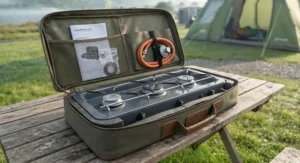
Common 3 Ring Camping Stove Gas Issues Solved
Problem: the flame keeps blowing out in wind. Most budget three-ring stoves, including the Vango Combi and Campingaz Chef CV on this list, have minimal built-in wind protection. Solution: pitch the stove downwind of a natural windbreak, or buy a dedicated foil windshield — a cheap accessory that noticeably outperforms most integrated shields.
Problem: uneven heat across pans. This usually comes down to burner design rather than user error. Solution: rotate pans periodically on stoves without Even-Temp or FLAMEGUARD-style burner technology, and avoid pans wider than the manufacturer’s stated maximum diameter, since overhang traps heat unevenly.
Problem: cartridge runs out mid-cook. Running three burners simultaneously drains fuel roughly 50% faster than a two-burner setup at the same settings. Solution: always carry at least one spare cartridge per day of heavy three-burner use, and consider a refillable cylinder system like the Camping Kitchen 2 Multi-Cook Plus for longer trips.
Problem: sticky, hard-to-turn control knobs after a season of use. Grease and grit accumulate in the valve mechanism over repeated outdoor use. Solution: a light application of food-safe silicone lubricant on the knob spindle, applied sparingly, restores smooth action without affecting the gas seal.
Problem: stove wobbles on uneven ground. Even stoves with wide, flat feet struggle on lumpy grass pitches. Solution: a dedicated stove table or a flat paving slab carried specifically for this purpose solves the issue permanently, and it’s cheaper than most people assume.
How to Choose the Best Triple Burner Camping Stove
- Match burner output to your group size. A family of four rarely needs more than 30,000 BTU combined, while groups of eight-plus genuinely benefit from the higher-output options like the Goplus or Camp Chef Explorer 3X.
- Check fuel type compatibility with your existing gear. Mixing cartridge-based Campingaz stoves with propane-only accessories creates ongoing frustration; standardise your fuel type across your camp kitchen where possible.
- Weigh portability against packed size honestly. A three burner camping stove is inherently bulkier than a double, so measure your actual boot space before assuming it’ll fit.
- Prioritise independent burner control over combined wattage figures. A stove with three genuinely separate controls beats one with a higher headline number but shared heat zones.
- Factor in accessory and regulator costs upfront. Several stoves on this list, including the Vango and Multi-Cook Plus, require a separately purchased hose and regulator — build that into your budget from the start.
- Consider wind protection as a core spec, not an extra. UK campsites are rarely sheltered; a built-in windshield genuinely earns its keep more often than most buyers expect.
- Read aggregated review sentiment on ignition reliability. Piezo and push-button ignition systems vary hugely in real-world durability, and this is one area where genuine user feedback tells you more than the spec sheet ever will.
Common Mistakes When Buying a Three Ring Outdoor Cooker
The single most common mistake is buying on BTU numbers alone without checking whether the stove offers independent burner control — a high combined output split across three burners that can’t be adjusted separately is far less useful in practice than a lower-output stove with genuine per-ring control. Buyers also frequently overlook fuel compatibility, purchasing a stove that requires a specific cartridge or cylinder system without checking local availability, which becomes a real problem mid-holiday in more remote areas.
Another recurring error is underestimating packed size and weight relative to available storage — a large capacity camping stove built for catering-scale cooking is genuinely awkward to transport for anyone without a roomy estate car or trailer. Finally, plenty of buyers skip checking whether a regulator and hose are included, only to discover at the campsite that the stove they’ve bought is, technically, incomplete without a further purchase.
3 Burner vs 2 Burner Camping Stoves: Is the Extra Ring Worth It?
The honest answer depends entirely on how you cook, not how many people you’re feeding. A double burner genuinely suffices for couples and small families who eat relatively simple, single-pot meals — boiling pasta, warming a sauce, done. Where the extra ring earns its keep is in menu complexity: the moment your camp cooking involves a main, a side and a hot drink running concurrently, a two-burner setup forces constant compromise, with one element always waiting its turn.
| Factor | 2 Burner Stove | 3 Burner Stove |
|---|---|---|
| Typical weight | 2-3kg | 3-5kg |
| Best group size | 1-4 people | 4-10+ people |
| Menu complexity handled | Simple, sequential | Multi-dish, simultaneous |
| Packed size | Compact | Noticeably bulkier |
| Typical price | £30-£80 | £70-£280 |
Looking at the comparison above, the extra burner clearly costs you in weight and packed size, and that trade-off only pays off if you’re actually cooking complex, simultaneous meals rather than sequential ones. Budget-conscious campers who mostly cook for two should think hard before upgrading, since a well-chosen double burner will genuinely serve them better than a three-ring stove that spends two of its three burners unused most trips.
👉 See today’s price and availability on Amazon before your next trip.
What to Expect: Real-World Performance From a Large Capacity Camping Stove
Spec sheets promise a lot, but real-world performance on a triple burner tends to hinge on wind, altitude and how full your pans actually are — not just the headline BTU figure. In mild conditions with a sheltered pitch, most mid-range stoves on this list will bring a litre of water to a rolling boil in five to seven minutes per ring, roughly comparable across the Coleman, Campingaz and Vango options despite their differing wattage claims. Where the higher-output models like the Goplus and Camp Chef genuinely separate themselves is in large-volume cooking — a big catering pan of water that would take fifteen-plus minutes on a domestic-style burner drops significantly faster under 200,000+ BTU.
What most buyers don’t anticipate is how much wind erodes theoretical performance. A stove rated for a five-minute boil in ideal conditions can easily take twice as long in a breezy, exposed pitch without a windbreak, regardless of the burner’s rated output. This is genuinely one of the biggest gaps between spec-sheet promises and lived experience, and it’s precisely why the built-in windshields on models like the Campingaz Camping Kitchen 3 CV consistently earn praise in aggregated reviews.
Long-Term Cost & Maintenance of a Three Burner Gas Camping Stove
The purchase price is only the opening chapter of total cost of ownership here. Fuel is the recurring expense that catches new buyers off guard: running three burners simultaneously through a season of regular weekend trips can easily mean ten or more cartridge purchases a year, at roughly £3-£6 each depending on size and brand. Over three to five years of regular use, that fuel spend can genuinely exceed the original purchase price of a budget stove, which is worth factoring into any value comparison between models.
Maintenance costs stay relatively low if you look after the burner heads and valve seals, but neglect compounds quickly — a rusted cast iron burner or a perished rubber hose typically means replacing that component rather than repairing it, and spare parts for budget models aren’t always readily stocked. Premium options like the Camp Chef Explorer 3X justify part of their higher upfront cost through a genuinely wider spares and accessory ecosystem, which extends usable lifespan considerably compared with stoves that have no aftermarket support at all.
Safety, Regulations & Gas Compliance Guide
Gas safety isn’t optional decoration on a spec sheet — it’s the single area where cutting corners genuinely risks injury. Every stove on this list should carry EN 17476 or equivalent European safety certification for flat-bed cartridge stoves, and any propane cylinder connection should meet the relevant UK gas fitting standards. Never operate a gas camping stove inside a tent, awning, caravan or enclosed vehicle; carbon monoxide from incomplete combustion is colourless, odourless and genuinely dangerous even from a well-functioning appliance, let alone a faulty one.
The Camping and Caravanning Club’s safety guidance recommends always cooking in a well-ventilated area away from your sleeping accommodation, and raising stoves off dry grass to avoid scorch damage or fire risk. Storage matters just as much as use: cartridges and cylinders should always be transported and stored upright, kept away from direct heat sources, and never left inside a hot car. For a more technical breakdown of pressurised gas handling, the HSE’s guidance on safe LPG use covers the underlying principles that apply just as much to a campsite cooker as to commercial installations, even though the scale is obviously very different.
Features That Actually Matter (And Those That Don’t)
Independent burner control, genuine wind protection and cartridge availability are the three features worth prioritising above almost everything else on a spec sheet — they directly affect whether your stove performs as promised on an actual UK campsite rather than in a controlled test kitchen. Removable, dishwasher-safe pan supports are a smaller but genuinely useful convenience feature that saves real time on multi-day trips.
Conversely, headline wattage or BTU figures, taken alone, mean surprisingly little without knowing how that output is distributed across the burners. Flashy extras like built-in mood lighting or overly elaborate carry cases tend to add cost without meaningfully improving the actual cooking experience — useful marketing hooks, but not features that change how well your dinner turns out.
Buyer’s Decision Framework
If you’re cooking for one or two people on simple, sequential meals, choose a double burner instead, because a three burner camping stove will mostly sit with a spare ring unused. If you’re feeding four to six people complex, simultaneous meals, choose a mid-range three burner like the Coleman Classic or Campingaz Camping Kitchen 3 CV, because independent control matters more than raw output at this scale. If you’re catering for eight-plus people or running a genuine outdoor kitchen, choose a high-output option like the Goplus or Camp Chef Explorer 3X, because boil times on large volumes genuinely change the practicality of the whole exercise. And if budget is the primary constraint regardless of group size, choose the Campingaz Camping Chef CV or Vango Combi, because both deliver three cooking zones without the premium price tag of the fully independent triple-burner models.
FAQ
❓ What is the best 3 burner camping stove for a family of five?
❓ Can I use a 3 burner camping stove indoors or in a tent?
❓ How much gas does a triple burner camp cooker use per trip?
❓ Is a large capacity camping stove worth it for occasional camping?
❓ Do three burner gas camping stoves need a separate regulator?
Conclusion
A 3 burner camping stove isn’t really about the extra ring on paper — it’s about ending the mealtime bottleneck that a double burner creates the moment your group grows or your menu gets ambitious. From the budget-friendly Campingaz Camping Chef CV to the genuinely industrial Camp Chef Explorer 3X, the right choice comes down to an honest read of your actual group size, cooking style and how much bulk you’re willing to carry for the privilege of three independent flames. Match the stove to how you genuinely cook, not to the biggest BTU number on the box, and you’ll get years of reliable use out of whichever model you settle on.
✨ Don’t Miss These Exclusive Deals!
🔍 Take your outdoor cooking to the next level with these carefully selected triple burner stoves. Click on any highlighted item to check current pricing and availability. These picks will help you create proper campsite feasts your whole family will love!
Recommended for You
- 7 Best Freestanding Double Burner Camping Stoves UK 2026 (Tested Picks)
- Best Tabletop Double Burner Camping Stove UK 2026: 7 Top Picks
- Best Folding Double Burner Camping Stove UK 2026: 7 Top Picks
Disclaimer: This article contains affiliate links. As an Amazon Associate, I earn from qualifying purchases. If you purchase products through these links, we may earn a small commission at no additional cost to you.
✨ Found this helpful? Share it with your friends! 💬🤗
