In This Article
There’s a very particular kind of smugness that comes from sitting round a fire on a still evening and not smelling like a kipper the next morning. That’s the promise both a solo stove and a rocket stove make, and it’s why the solo stove vs rocket stove question keeps popping up in camping forums and garden centre car parks across Britain. On paper, they look like cousins — both burn twigs and scraps of wood, both claim to be nearly smoke-free, both have devoted, slightly evangelical fan bases. In practice, they’re solving two different problems, and picking the wrong one means either lugging a garden fire pit up a Welsh hillside or trying to gather round a camping stove for a cosy Saturday night barbecue.
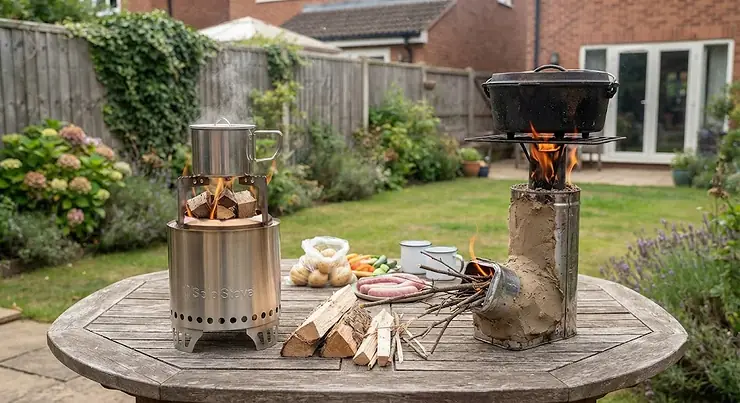
A rocket stove is, in the simplest terms, a small wood-burning stove built around an insulated vertical chimney that forces air and fuel gases to mix and burn almost completely before they reach your pan — the same basic principle behind the rocket stove design that engineers at the Aprovecho Research Center popularised. A solo stove, meanwhile, is a branded family of double-walled “gasifier” stoves and fire pits that use a similar secondary-combustion trick but is built more for ambience and cooking convenience than raw cooking efficiency. Over the next few thousand words we’ll dig into seven real, currently available models, work out which one actually suits your garden, campsite or bug-out bag, and clear up the rocket stove vs wood stove confusion that trips up half the people typing this into Google in the first place.
Quick Comparison Table: Solo Stove vs Rocket Stove at a Glance
Before the deep dive, here’s the shape of the market. All seven products below appear later with full write-ups, but this table is your five-second cheat sheet.
| Product | Type | Best For | Fuel | Price Range |
|---|---|---|---|---|
| Solo Stove Lite | Micro-gasifier camp stove | Solo backpackers | Twigs | £70–£90 |
| Kelly Kettle Trekker | Chimney kettle + hobo stove | Fast hot drinks | Twigs/dry grass | £60–£85 |
| Sierra Zip Stove | Fan-assisted rocket-style stove | Wet-weather reliability | Twigs, charcoal | £70–£100 |
| IronClad Supply Rocket Stove | True portable rocket stove | Backyard camping stove cooking | Wood, charcoal | £90–£120 |
| EcoZoom Versa | Heavy-duty rocket stove | Emergency + daily cooking | Wood, charcoal | £140–£170 |
| Solo Stove Ranger | Portable smokeless fire pit | Campsite gatherings | Wood | £180–£195 |
| Solo Stove Bonfire | Backyard smokeless fire pit | Garden entertaining | Wood | £245–£260 |
Looking at the spread, the pattern is fairly clean: the true rocket stoves — IronClad Supply Rocket Stove and EcoZoom Versa — sit in the middle of the pack and are built for cooking, while the Solo Stove Ranger and Solo Stove Bonfire cost more but buy you a bigger, prettier flame with less focus on the pot. If your priority is boiling water fast on a wet Tuesday, the fan-assisted Sierra Zip Stove punches well above its price. Prices above are typical UK ranges at the time of research and will move around, so always check current pricing before buying.
💬 Just one click — help others make better buying decisions too!😊
Top 7 Solo Stove and Rocket Stove Picks: Expert Analysis
We’ve picked genuine, currently sold products spanning budget backpacking kit through to premium garden fire pits, covering the full spread of what people actually mean when they type “solo stove vs rocket stove” into a search bar.
1. Solo Stove Lite — best budget pick for solo backpackers
The Solo Stove Lite is the smallest stove in the Solo Stove camping range, and it’s the one that started the company’s reputation before the garden fire pits took over. It’s a double-walled “micro-gasifier”: air enters at the base to feed the fire, then travels up through the gap between the two walls, gets pre-heated, and re-enters higher up to burn off the smoke that a normal wood fire would just let drift away.
In practice that means the standout feature — boiling roughly half a litre of water in under ten minutes on nothing but thumb-sized twigs — actually holds up, according to reviewers who’ve tested it on multi-day trips. At 9 ounces and roughly 5.7 inches tall, it nests inside its own companion pot, so it barely registers in a pack. What most buyers overlook is that this efficiency comes with a learning curve: it’s a genuine wood fire, not a knob-controlled burner, so damp fuel or a lazy re-stock mid-cook will stall it. Reviewers consistently note that it needs proper attention during the first few cooks before the rhythm clicks, and more than one has admitted to slightly sooty pans as the trade-off for not carrying gas.
This is the stove for the person who enjoys the process as much as the destination — students, thru-hikers on a budget, or anyone who likes not worrying about running out of canister fuel.
Pros:
- ✅ No fuel to carry or run out of on longer trips
- ✅ Nests inside its own pot for near-zero pack bulk
- ✅ Genuinely fast boil times once the fire is established
Cons:
- ❌ Needs bone-dry twigs, which UK weather rarely guarantees
- ❌ Blackens cookware more than a gas stove would
At around £70–£90, it’s the cheapest genuine entry point into this category, and for occasional car camping or fair-weather backpacking it’s hard to beat on value.
2. Kelly Kettle Trekker — best for a fast brew with minimal fuss
The Kelly Kettle Trekker isn’t strictly a rocket stove, but it uses the same chimney-effect trick — a double-walled water chamber wrapped around a central fire tube — and it’s the model people most often cross-shop against a solo stove when they just want tea, not a three-course meal. Irish in origin and largely unchanged in design for over a century, the standout feature is speed: reviewers report boiling roughly 600ml of water in a few minutes flat, even in driving rain, because the fire is almost entirely enclosed.
The whole kit, including the detachable “hobo stove” base, pot, grill and cup, weighs about 1.17kg — not ultralight, but genuinely compact for what it does. On paper, the appeal is obvious for anyone who wants hot water on tap without decanting fuel canisters; what the spec sheet won’t tell you is that the kettle shape makes it a poor general cooking platform, since the hobo stove base underneath is really the only bit you can put a pan on. Reviewers consistently praise its reliability in filthy weather and its bombproof stainless-steel build, while a recurring complaint is that it eats more rucksack space than a simple stove would.
It suits kayakers, Duke of Edinburgh groups, and anyone whose priority is a reliable hot drink over cooked meals.
Pros:
- ✅ Boils water fast even in wind and rain
- ✅ Detachable hobo stove doubles as a basic cooker
- ✅ No batteries or fuel canisters required
Cons:
- ❌ Bulkier in a pack than a simple twig stove
- ❌ Limited as a proper cooking platform beyond boiling
Expect to pay in the £60–£85 range for the Trekker kit, making it a strong value pick if boiling water fast is genuinely your main use case.
3. Sierra Zip Stove — best for reliable burns in damp UK weather
Where most stoves in this list rely purely on natural draft, the Sierra Zip Stove cheats a little, and it works brilliantly for it. A small fan, powered by a single AA battery, forces air into the twin-wall burn chamber, giving you an adjustable, near-instant flame that behaves more like a blowtorch than a campfire. The standout feature here is control: flick the fan to high for a rolling boil, or low for a gentle simmer, something few passive wood stoves can match.
Reviewers on long-distance trails report a single AA battery lasting anywhere from several hours to multiple weeks of intermittent use, and the forced draught means damp or marginal fuel that would smother a passive stove still burns. Based on the spec comparison with gasifier stoves like the Solo Stove Lite, the trade-off is weight and a reliance on a consumable battery — if you forget spares, you’re back to relying on wind alone. Aggregated review sentiment is unusually consistent for a niche product: users repeatedly flag its stability as the main weak point, since the narrow base makes it prone to tipping with larger pans, and its tendency to blacken cookware more than gas.
For anyone who’s ever cursed a wood stove that just won’t catch in the rain, this is the one worth seeking out — though it’s more commonly imported from the US than stocked on UK high streets.
Pros:
- ✅ Fan-forced draught burns damp or marginal fuel
- ✅ Adjustable heat unlike most passive wood stoves
- ✅ Single AA battery lasts many hours of use
Cons:
- ❌ Narrow base is prone to tipping with bigger pans
- ❌ Relies on a battery you must remember to pack
Typical landed UK cost sits around £70–£100 once shipping is factored in, positioning it as a mid-range specialist buy rather than an impulse purchase.
4. IronClad Supply Rocket Stove — best true rocket stove for backyard cooking
This is where the “rocket stove” side of our comparison properly begins. The IronClad Supply Rocket Stove is a genuine J-shaped combustion design: a fully insulated vertical chamber forces the gases from burning twigs, branches or charcoal to mix and combust a second time before reaching the cast-iron cooktop, producing what the maker rates at up to 23,000 BTU/hr.
What that number means in practice is serious cooking heat from a handful of sticks — enough to sear, boil or simmer a full family meal, according to reviewers who’ve used it as a genuine backyard camping stove replacement for a gas hob. Here’s what to weigh: it’s built more like furniture than backpacking gear, with a stainless carry handle system and a canvas storage bag rather than a nesting design, so it’s a “leave it in the shed and take it to the allotment” tool rather than a pack-it-in-your-rucksack one. Reviewers consistently highlight the reduced smoke output compared with an open fire pit, along with its ability to handle heavier cast-iron cookware without wobbling — a genuine weak point on lighter fan-stoves like the Sierra.
It’s the natural pick for anyone who wants proper rocket-stove cooking efficiency for weekend camping, allotment cook-ups, or emergency preparedness, without paying premium-brand prices.
Pros:
- ✅ True rocket-stove combustion for serious cooking heat
- ✅ Handles heavy cast-iron pots and Dutch ovens
- ✅ Canvas bag and fuel support system included
Cons:
- ❌ Heavier and bulkier than backpacking-focused stoves
- ❌ Limited independent long-term UK reviews so far
Expect a price range of roughly £90–£120, making it one of the more accessible entry points into genuine rocket-stove cooking.
5. EcoZoom Versa — best heavy-duty rocket stove for daily and emergency use
If the IronClad is the accessible rocket stove, the EcoZoom Versa is the one built to survive genuinely heavy use. Its ceramic-lined combustion chamber, protected by a sheet-metal body and cast-iron top, was independently tested for emissions at the Aprovecho Research Center and has been piloted by aid organisations cooking daily meals in East Africa — a genuinely unusual pedigree for a stove also sold to UK campers and preppers.
Standing around 12 inches tall and roughly 25 lbs, the standout feature is durability rated at over 10,000 hours of cooking life with proper care — this is not a stove you’ll wear out in a single camping season. Reviewers who’ve used it for years report it still cooking “like new” despite living outdoors permanently, and note it’s genuinely close to windproof since the fire sits fully enclosed within the body. On paper this means real longevity; what most buyers overlook is the weight, which firmly rules it out for backpacking — reviewers are unanimous that this is a car-camping, allotment or emergency-preparedness stove, not something for a rucksack. A minor but recurring niggle is stray ash drifting into open pots while refuelling, easily solved with a lid.
For households wanting a genuine backup cooking method for power cuts, or for slow, deliberate outdoor cooking at a fixed pitch, this is one of the most field-proven rocket stoves available.
Pros:
- ✅ Rated for 10,000+ hours of cooking life
- ✅ Near-windproof enclosed combustion design
- ✅ Field-tested for emissions by an independent research body
Cons:
- ❌ At roughly 25 lbs, too heavy for backpacking
- ❌ Ash can drift into open pans while feeding fuel
Prices typically sit in the £140–£170 range, positioning it as a premium rocket stove that justifies its cost through sheer longevity.
5.5 A Quick Word on Fuel and Feed Style
Before moving to the fire-pit end of the line-up, it’s worth flagging one practical difference between the rocket stoves above and the Solo Stove entries below: rocket stoves are fed continuously through a side door while cooking, whereas Solo Stove products are loaded from the top and largely left to burn down. Neither is “better” — they simply suit different rhythms of use, which we’ll unpack properly in the Buyer’s Decision Framework further down.
6. Solo Stove Ranger — best portable smokeless fire pit for campsites
Stepping away from cooking-focused stoves, the Solo Stove Ranger is the smallest of Solo Stove’s fire pit range and the one most directly aimed at campers who want an evening fire rather than a cooking platform. At about 15 lbs and roughly a foot tall, the standout feature is genuine one-handed portability combined with the brand’s signature double-wall airflow system.
The design draws air in at the base, channels it up between the inner and outer walls, and releases it through a ring of holes near the rim, igniting unburned gases and cutting visible smoke dramatically compared with an open fire. UK reviewers who’ve tested it in real garden conditions found it “far less smokey” than a standard fire pit rather than perfectly smokeless — after half an hour standing nearby, a faint smoke smell on clothing was still detectable, which is a fair and honest expectation to set. Based on the spec comparison with the larger Bonfire below, the Ranger trades some flame size and standing time for genuine grab-and-go portability, complete with a carry case.
It’s the natural choice for campsite groups of three or four who want a proper fire without a smoke-filled sleeping bag the next morning, or for anyone who wants one fire pit that works equally well in the garden and in the boot of the car.
Pros:
- ✅ Genuinely one-handed portable at around 15 lbs
- ✅ Noticeably less smoke than an open fire pit
- ✅ Comes with a dedicated carry case
Cons:
- ❌ “Less smoke” rather than fully smokeless in real-world tests
- ❌ Smaller flame and shorter burn time than larger models
UK pricing typically runs £180–£195, occasionally dropping during seasonal sales, making it a considered but not outrageous investment for a portable fire pit of this build quality.
7. Solo Stove Bonfire — best premium backyard fire pit for entertaining
The Solo Stove Bonfire is the model most people picture when they hear the brand name — the mid-size, most popular fire pit in the range, built for groups of up to five gathered on a patio rather than hauled between campsites. At roughly 20 lbs and 14 inches tall, it uses the same double-wall secondary-combustion principle as the Ranger, scaled up for a bigger, steadier flame.
What most buyers overlook is that the “smokeless” claim is really about a self-sustaining secondary burn rather than zero smoke at every stage — light it with damp logs and you’ll still get smoke during the first few minutes, but once established, the flame visibly draws through the upper vent holes and the smoke drops off sharply. Reviewers who’ve owned one for over a year consistently rate it highly for durability and its lifetime warranty, and several directly compare its portability favourably against premium propane pits at a similar price point. On the value side, at a typical UK price in the mid-£200s, it sits above budget fire pit alternatives but below the brand’s largest Yukon model, and buyers considering the step up should weigh whether they genuinely need the extra flame size the Yukon offers.
This is the one for anyone treating a fire pit as a serious garden feature rather than a camping accessory — a fixture for barbecues, birthdays and long summer evenings.
Pros:
- ✅ Big enough flame for groups of up to five
- ✅ Backed by a genuine lifetime warranty
- ✅ Doubles as a portable pit thanks to its carry case
Cons:
- ❌ Noticeably more smoke during the first few minutes of lighting
- ❌ Costs considerably more than budget fire pit alternatives
Typical UK pricing sits around £245–£260, which is broadly in line with quality gas fire pits, and most reviewers consider it worth the premium for the durability and warranty alone.
Practical Usage Guide: Getting a Smokeless Fire Right From Day One
Whichever of these seven you land on, the first fortnight of ownership is where most disappointment happens, and it’s almost always fixable. Start with fuel: both rocket stoves and Solo Stove products need genuinely dry material, and UK weather rarely hands that to you for free. Keep a stash of kindling indoors or in a dry shed for at least a week before you plan to use the stove, since even slightly damp wood produces the visible smoke these designs are meant to avoid.
Lighting technique matters more than most buyers expect. A small firelighter cube or a scrunched strip of newspaper under a loose pyramid of thin kindling gets the secondary combustion effect going far faster than trying to nurse a flame from thick logs. Once the fire is established — usually signalled by flames licking from the upper vent holes on a Solo Stove product, or a steady roar from a rocket stove’s chimney — you can start feeding larger pieces.
Maintenance is refreshingly simple across the category: empty ash once it’s fully cold (never immediately after use), wipe down the outer shell to prevent ash caking, and store the stove somewhere dry between uses to avoid rust bloom on the steel. The single most common first-month mistake is over-filling the fuel chamber early on, which starves the fire of the airflow these designs depend on — resist the urge to pile it high, and let the double-wall or chimney draw do the work it’s engineered for.
Real-World Scenarios: Matching the Stove to How You Camp
Consider three different people shopping this exact keyword. First, a university student planning solo microadventures on a tight budget: the Solo Stove Lite paired with a cheap titanium pot covers boiling and basic cooking for well under £100, and the lack of fuel canisters suits irregular, spontaneous trips.
Second, a family of four who car-camp three or four times a summer and want evenings around a proper fire without smelling of bonfire smoke on the drive home: the Solo Stove Ranger hits the size and portability sweet spot, while the IronClad Supply Rocket Stove earns its place alongside it for actually cooking the group’s dinner rather than just providing ambience.
Third, a household in a rural area who wants a genuine backup cooking method in case of a power cut, plus the odd weekend of slow, deliberate outdoor cooking: the EcoZoom Versa‘s field-tested durability and high heat output make it the sensible pick over anything designed primarily for portability. Whichever scenario fits, always check locally whether open fires are permitted where you’re heading — many managed sites and access land restrict them entirely, and the National Trust’s Countryside Code is a useful starting point before you pack the car.
What Is a Rocket Stove? (And How a Solo Stove Differs)
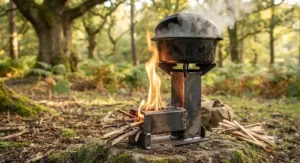
A rocket stove is a small, highly efficient wood-burning stove that forces fuel gases through an insulated vertical chimney, achieving near-complete combustion before the flame reaches your cookware. A solo stove uses a related but distinct double-wall gasifier design, prioritising a clean-burning ambient flame over raw cooking heat.
The practical difference shows up the moment you try to cook a full meal. Rocket stoves like the EcoZoom Versa and IronClad Supply Rocket Stove are fed continuously through a side door and built around a flat cooktop, so you can genuinely fry, simmer and boil in sequence. Solo Stove products are loaded once from the top and largely left to burn down, which suits a pot balanced on top for boiling water but is clumsier for active, multi-stage cooking. Neither approach is objectively superior — it depends entirely on whether you want a cooker or a campfire substitute.
How to Choose Between a Solo Stove and a Rocket Stove
- Decide your primary use first. If cooking full meals matters more than atmosphere, lean rocket stove; if evening ambience matters more, lean Solo Stove fire pit.
- Weigh portability honestly. Backpackers should rule out anything over about 2 lbs; car campers and garden owners have far more latitude.
- Check your fuel source. Twig-fed stoves suit woodland campsites; if you’re mostly in a suburban garden, factor in buying kiln-dried logs.
- Consider group size. A single person rarely needs more than the Solo Stove Lite or Kelly Kettle Trekker; groups of four-plus need the Ranger or Bonfire.
- Think about wind and rain tolerance. The fan-assisted Sierra Zip Stove and enclosed rocket stoves cope with damp UK conditions better than passive gasifiers.
- Factor in local burning rules. Some campsites and access land ban open fires outright, so a stove that’s technically permitted where a bonfire isn’t can be the deciding factor.
- Set a realistic budget band. Genuine differences in build quality and warranty appear clearly once you compare the roughly £70 entry point against the £250 premium end of this list.
Solo Stove vs Rocket Stove: The Core Design Difference
At the heart of both categories sits the same physics: burning wood gases a second time rather than letting them escape as smoke. Where they diverge is airflow architecture. A true rocket stove channels air past the fuel and up a dedicated internal chimney shaped like a “J” or an “L”, creating a strong, self-sustaining draught that burns hot enough to double as a small forge. A solo stove instead uses a double-walled cylinder, drawing air up the gap between the walls to pre-heat it before it re-enters near the top of the fire.
The result, based on the spec comparison across our seven picks, is that rocket stoves generally produce more usable, directed cooking heat per stick of fuel, while Solo Stove products produce a larger, more visually appealing flame that’s gentler to cook over but genuinely excels as an evening fire. Reviewers consistently note that Solo Stove products blacken pans less over time because cooking is more occasional, whereas rocket stove owners who cook daily report needing to clean cast-iron cooktops more regularly.
✨ Don’t Miss These Exclusive Deals!
🔍 Take your outdoor cooking setup to the next level with these carefully selected stoves and fire pits. Click on any highlighted item to check current pricing and availability. These picks will help you create authentic smokeless evenings your family will love!
Rocket Stove vs Wood Stove: What’s Actually Different
This is where a lot of buyers get genuinely confused, because “wood stove” gets used loosely to mean almost any solid-fuel appliance. A conventional wood stove — the kind fitted indoors with a flue through the roof — burns fuel in an open chamber with relatively simple air control, and while modern stoves built to the UK’s Ecodesign requirements for solid fuel space heaters are far cleaner than older units, they don’t force the same aggressive secondary combustion that a rocket stove achieves through its insulated chimney geometry.
A rocket stove, by contrast, is specifically engineered so that unburned gases are forced to mix with fresh air at high temperature before they can escape, which is why a rocket stove of modest size can outcook a traditional wood stove several times its weight on a fraction of the fuel. The trade-off is scale: a wood stove heats a room continuously for hours; a rocket stove is built for short, intense cooking sessions rather than sustained space heating, though rocket mass heater variants do exist for exactly that purpose. If your goal is heating a static structure, a proper wood stove remains the right tool; if your goal is portable, efficient outdoor cooking, the rocket stove design wins comfortably.
Portable Rocket Stove Review: What Reviewers Consistently Say
Pulling together aggregated sentiment across the portable rocket stove reviews we researched for the IronClad Supply Rocket Stove, EcoZoom Versa and Sierra Zip Stove, a few themes repeat almost word for word across independent sources. Reviewers consistently praise the dramatic reduction in visible smoke compared with an open fire, often specifically noting how little residual smell clings to clothing afterwards — a genuine point of differentiation from a standard campfire.
Weight and bulk is the most common complaint, particularly for the heavier ceramic and cast-iron models, which reviewers repeatedly flag as unsuitable for backpacking despite marketing that sometimes suggests otherwise. A second recurring theme is that ash management needs a bit of practice: several reviewers mention ash drifting into open pots during refuelling, a minor but consistently reported niggle across multiple independent write-ups. Finally, longevity comes up again and again as a genuine strength — owners reporting years of near-daily outdoor use without meaningful degradation, which is unusually strong sentiment for a product category that often sees complaints about rust or warping within a single season.
Secondary Combustion Explained: Why These Stoves Run (Almost) Smokeless
Smoke is, in simple terms, unburned fuel — tiny particles and gases that escape the fire before they’ve combusted. Secondary combustion is the deliberate engineering trick of capturing those escaping gases and reintroducing them to flame and oxygen a second time, at a high enough temperature that they burn rather than drift away as visible smoke.
In a rocket stove, this happens because the insulated chimney keeps combustion gases hot enough, for long enough, that a fresh injection of air near the top ignites what would otherwise have escaped. In a Solo Stove product, the same principle is achieved through the double-wall design: air pre-heated between the walls re-enters through a ring of holes near the rim, igniting gases at exactly the point they’d normally become visible smoke. Neither design eliminates smoke entirely, particularly during the first few minutes of lighting from cold with damp fuel — but once the fire reaches operating temperature, the difference compared with an open fire pit is genuinely dramatic rather than marketing spin.
Common Mistakes When Buying a Backyard Camping Stove
The single biggest mistake is buying based on flame size in a marketing photo rather than actual use case — a stunning garden fire pit photograph tells you nothing about whether the stove can cook your dinner. A close second is underestimating weight: several products on this list are marketed loosely as “portable” while weighing 20lbs or more, which is fine for the boot of a car but genuinely impractical for anyone planning to walk any distance with it.
Buyers also frequently overlook fuel availability. A twig-fed gasifier stove is fantastic in a woodland campsite but frustrating in a suburban garden where you’ll need to buy kiln-dried logs regularly, quietly eroding the “free fuel” appeal that first attracted them. Finally, many people skip checking local burning rules entirely, only to discover after buying that their preferred campsite or local access land prohibits open fires outright — a five-minute check beforehand avoids an expensive and disappointing surprise.
Long-Term Cost & Maintenance
Judged purely on upfront price, the Solo Stove Lite and Kelly Kettle Trekker look like the value leaders, and for occasional use they genuinely are. But total cost of ownership tells a slightly different story once fuel and replacement cycles enter the picture. Twig-fed stoves cost effectively nothing to run if you forage fuel, while anyone using a fire pit regularly in a UK garden will likely end up buying bagged kiln-dried logs, adding a recurring cost that a one-off price comparison misses entirely.
Durability separates the pack further. The EcoZoom Versa‘s rated 10,000-hour lifespan and the Solo Stove Bonfire‘s lifetime warranty both push their effective cost-per-use down dramatically over a five-year ownership period compared with a budget rocket stove of uncertain longevity. Maintenance costs are low across the board — occasional ash removal and a wipe-down are the extent of it — but stainless steel and ceramic-lined models resist corrosion and cracking far better than painted sheet-metal alternatives, which is worth weighing against a lower sticker price if you plan to leave the stove outdoors year-round.
Safety, Regulations and Garden Fire Rules in the UK
There’s no blanket law against a garden fire or fire pit in the UK, but there are real constraints worth understanding before you light one. If you live in a designated smoke control area, rules apply specifically to chimneys fixed to a building rather than portable garden appliances, and the definitive current position is set out in the government’s smoke control area guidance, which confirms that portable fire pits, barbecues and chimineas are generally permitted while unauthorised solid fuel burned via a fixed chimney is not.
Separately, if smoke from any fire — portable or otherwise — becomes a persistent nuisance to neighbours, it can be treated as a statutory nuisance under environmental law regardless of smoke control zone status, so positioning and courtesy matter as much as the appliance itself. For camping specifically, always check whether your destination permits open fires at all: many National Trust sites, national parks and areas of access land ban them outright due to wildfire risk, particularly during dry spells, and a stove that’s technically self-contained doesn’t automatically exempt you from a site-wide ban. Keep a source of water nearby, never leave any of these stoves unattended while lit, and allow full cooling before transporting or emptying ash, since embers can smoulder in ash for hours after the visible flame has gone out.
FAQ
❓ Is a rocket stove better than a solo stove for camping?
❓ Do rocket stoves really produce no smoke?
❓ Can you cook a full meal on a Solo Stove?
❓ What's the difference between a rocket stove and a wood stove?
❓ Are portable rocket stoves legal to use in UK gardens?
Conclusion
If there’s one honest takeaway from comparing seven of these stoves side by side, it’s that solo stove vs rocket stove isn’t really a rivalry — it’s a mismatch of use cases wearing similar clothing. Reach for a rocket stove like the EcoZoom Versa or IronClad Supply Rocket Stove when cooking is the actual goal, whether that’s a proper camp dinner or a genuine emergency backup. Reach for a Solo Stove Lite when you’re travelling light and want simplicity over cooking power, or step up to the Ranger or Bonfire when the fire itself — the gathering, the glow, the s’mores — is the point rather than the meal.
Budget shapes the decision too: the sub-£100 end of this list, covering the Solo Stove Lite, Kelly Kettle Trekker and imported Sierra Zip Stove, covers genuine needs for solo and lightweight campers, while the £150–£260 band covering the EcoZoom Versa, Solo Stove Ranger and Solo Stove Bonfire suits households wanting a long-term fixture for the garden or serious backup cooking capability. Whichever you land on, the underlying secondary-combustion engineering is genuinely clever, decades-proven technology — not a gimmick — and picking the right one for how you actually camp or entertain will make that cleverness worth every penny.
✨ Ready to stop coughing on campfire smoke for good? Compare current prices on today’s pick before your next trip! 💬🤗
Recommended for You
- Rocket Stove for Camping: 7 Picks That Actually Work (2026)
- Kelly Kettle vs Ghillie Kettle 2026: 7 Best Picks Compared
- Military Hexamine Stove UK: 7 Best Solid Fuel Stoves 2026
Disclaimer: This article contains affiliate links. As an Amazon Associate, I earn from qualifying purchases. If you purchase products through these links, we may earn a small commission at no additional cost to you.
✨ Found this helpful? Share it with your friends! 💬🤗
