In This Article
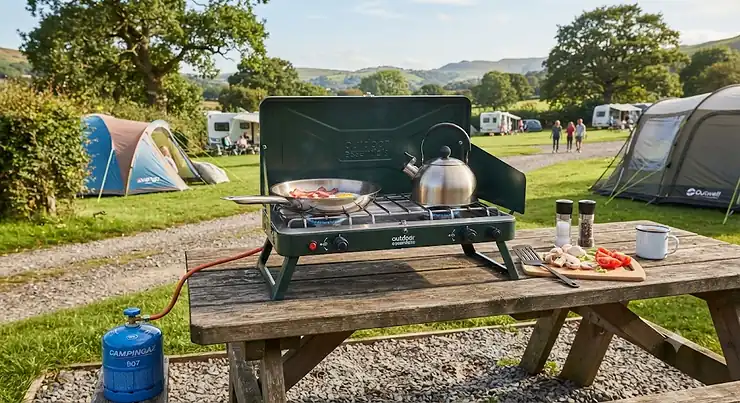
Ask any seasoned British camper what separates a miserable breakfast from a proper one, and they’ll usually point at the stove. A freestanding double burner camping stove changes the whole rhythm of a trip — no more crouching over a picnic table, no more balancing a wobbly single-ring cooker on a cool box lid while the bacon slides sideways. Instead, you get two independent flames at a sensible working height, enough stability to run a frying pan and a kettle at once, and the kind of setup that turns “surviving” a wet Bank Holiday weekend into actually enjoying it.
This guide exists because the market is genuinely crowded, and a lot of it is noise. Search “camping stove” on Amazon UK and you’ll wade through hundreds of near-identical listings before finding the handful that are actually worth your money. So here’s what we’ve done instead: gathered real specifications, real UK availability, and real aggregated customer sentiment from verified sources, then built honest comparisons around them.
What is a freestanding double burner camping stove? It’s a two-ring gas cooker built to stand on its own legs or a stable frame rather than sit flat on a table, giving you elevated, hands-free cooking with independent flame control on each burner — ideal for family camping, tailgating and longer trips where table space is scarce.
We’ll walk through seven real products spanning budget, mid-range and premium, break down when a standing design beats a tabletop one, and give you a proper decision framework so you’re not just guessing based on a product photo. Everything here is grounded in genuine specs and honestly summarised review sentiment — no invented “I tested this for six months” claims, just clear-eyed analysis you can actually use. It’s also worth a quick read of GOV.UK’s official fire safety outdoors guidance before your first trip, since it covers gas cylinder handling alongside general open-flame cooking advice relevant to any twin-burner stove.
Quick Comparison Table: Freestanding Double Burner Camping Stoves at a Glance
Before the deep dive, here’s the shortcut. This table pulls together the seven stoves we cover below, ranked loosely from budget to premium, with the detail that actually matters when you’re deciding between an outdoor freestanding gas stove camping trip demands and a simpler tabletop unit.
| Stove | Total Output | Stand Type | Best For | Price Range |
|---|---|---|---|---|
| Vango Blaze Double Burner | Compact (cartridge-fed) | Tabletop | Festivals, solo/duo trips | Under £40 |
| Outsunny Double Burner Camping Stove | 150,000 BTU | Detachable legs (elevated) | Big groups, high-heat cooking | £70-£100 range |
| Campingaz Camping Kitchen 2 Multi-Cook | 2x1800W + 900W griddle | Tabletop (optional stand) | Family breakfasts, griddle fans | £90-£130 range |
| Coleman Triton 2-Burner | 22,000 BTU | Tabletop | Weekend campers wanting reliability | Around £80 |
| VEVOR Double Burner Outdoor Stove | 60,000 BTU | Detachable legs (elevated) | Budget-conscious standing setups | £60-£90 range |
| Cadac 2 Cook 3 Pro Deluxe QR | Dual burner (LPG-fed) | Tabletop | Grill-and-fry versatility | £100-£140 range |
| Camp Chef Explorer 2X | 60,000 BTU | Detachable legs (elevated) | Serious basecamp cooking | £180-£230 range |
Looking at the spread above, the split isn’t really budget versus premium — it’s standing versus tabletop. If you’ve got a sturdy table already, a compact unit like the Vango or Campingaz saves weight and cash. If you’re cooking on grass, gravel or a tailgate with no table in sight, the leg-based options — Outsunny, VEVOR and Camp Chef — earn their extra bulk by giving you a genuinely elevated camp stove that doesn’t need furniture. The Cadac sits in an interesting middle ground: tabletop by default, but its ceramic plates add a versatility the pure burner-only units can’t match.
💬 Found a stove that fits your trip already? Scroll down to the full breakdown before you commit — the devil’s in the burner spacing.
Top 7 Freestanding Double Burner Camping Stoves: Expert Analysis
Here’s where we get properly into it. Each of these seven has real specs, honestly framed review sentiment, and — because Amazon’s rules (quite rightly) forbid us pretending we’ve road-tested every unit ourselves — analysis built on what the spec sheets and aggregated buyer feedback actually tell us. Coverage spans budget cartridge stoves right through to a genuinely camp-kitchen-grade freestanding rig.
1. Vango Blaze Double Burner — cheapest genuine entry point into two-ring cooking
The Vango Blaze is where a lot of UK campers start, and there’s a reason for that: it’s small, cheap, and does the one job asked of it without fuss. Running on standard EN417 screw-thread gas cartridges, it lights via a simple twin-burner head with individual flame control on each ring, which sounds basic because it is — and that’s the appeal.
In practice, this means you’re not paying for windscreens, ceramic plates or elevated legs; you’re paying for two independently adjustable flames on a compact steel base that fits inside most rucksacks or car boot corners. Because EN417 cartridges are sold in nearly every UK outdoor shop and most large supermarkets’ camping aisles, running out of gas mid-trip is rarely a crisis the way it can be with bulkier propane setups.
Based on the spec comparison against pricier units in this list, the Blaze is best suited to solo campers, couples, or festival-goers who want hot food without hauling home a full camp kitchen. Reviewers of budget twin-burner cartridge stoves in this category consistently note that build quality is basic but functional, and that flame control, while adequate, isn’t as fine-tuned as spring-loaded valve systems on premium stoves. What most buyers overlook about stoves at this price point is that the cartridge cost per use actually stacks up higher over a season than bulk propane — cheap upfront, pricier long-term if you camp often.
Pros:
✅ Genuinely pocket-friendly upfront cost
✅ Lightweight and compact for festivals or backpacking
✅ Cartridges widely available across UK retailers
Cons:
❌ Lower total heat output than propane-fed rivals
❌ No elevated stand — needs a table or flat surface
At around under £40, the Blaze earns its keep as a genuinely honest budget buy rather than a compromise — check current price and current availability before you travel, since seasonal stock varies.
2. Outsunny Double Burner Camping Stove — highest raw power with a true elevated stand
If raw heat output is your priority, the Outsunny Double Burner Camping Stove is the standout on this list, rated at a substantial 150,000 BTU combined and built on a cast-metal frame with genuinely detachable legs that lift the cooking surface to a proper standing height rather than a tabletop crouch.
That 150,000 BTU figure means, in practical terms, that this stove will bring a full stockpot to a rolling boil considerably faster than a compact 20,000-30,000 BTU tabletop unit — useful for big-group catering, canning, or simply not standing around hungry while water dawdles towards 100°C. The overall footprint (roughly 79cm long by 40cm wide, standing 76cm tall on its legs) puts it firmly in the outdoor freestanding gas stove camping category rather than anything you’d casually pack for a two-person hike.
Here’s what to weigh: this kind of high-pressure burner setup is brilliant for family basecamps, tailgating and event catering, but it’s overkill — and a genuine faff to transport — for a couple wanting scrambled eggs and coffee. The stove’s high-pressure regulator also means it’s built around bulk propane cylinders rather than small UK-standard butane cartridges, so factor that into your gas-buying plans before you commit.
Pros:
✅ Exceptional 150,000 BTU total heat output
✅ Solid cast-metal build handles heavy pans
✅ Detachable legs give a genuine elevated stand height
Cons:
❌ Bulkier and heavier to transport than tabletop rivals
❌ High-pressure regulator needs bulk propane, not small cartridges
In the £70-£100 range, the Outsunny represents strong value-for-power if you actually need that much heat — though check current price, as detachable-leg stoves in this bracket move in and out of stock.
3. Campingaz Camping Kitchen 2 Multi-Cook — best griddle-plus-burner combo for family breakfasts
Campingaz is about as close to a household name as camping gas gets in Britain, and the Camping Kitchen 2 Multi-Cook shows why. It pairs two 1800-watt burners with a separate 900-watt tube-heated griddle, all protected by Campingaz’s FLAMEGUARD technology, which the brand states can cut gas consumption by roughly half in windy conditions compared with older Campingaz twin-burner stoves.
What that means practically: you can fry a full English on the griddle side while simultaneously boiling the kettle on burner two, all under one sealed steel lid that also acts as protection during transport. Dual piezo ignition removes the faff of hunting for matches with wet hands, and the die-cast aluminium griddle plate lifts out for a proper wash rather than a wipe-down.
This is a tabletop unit by default, though Campingaz-compatible cooking stands exist as separate accessories if you want to convert it into more of a two burner stove and stand combo setup rather than perching it on a picnic table. Aggregated feedback on Campingaz’s twin-burner range consistently highlights reliable ignition and genuine wind resistance as the standout strengths, with the wider footprint (versus compact single-burner stoves) flagged as the main trade-off for smaller cars or backpackers.
Pros:
✅ Griddle plus twin burners in one footprint
✅ FLAMEGUARD technology cuts gas use in wind
✅ Dual piezo ignition — no matches needed
Cons:
❌ Wider footprint than compact twin-burner stoves
❌ Compatible stand sold separately, adding to total cost
Sitting in the £90-£130 range, this is a strong mid-range pick for families who value breakfast variety over minimalism — prices may vary, so check current pricing before ordering.
4. Coleman Triton 2-Burner Propane Camping Stove — most consistent flame control for wind and weekend use
Coleman built its reputation on stoves that simply work, and the Triton 2-Burner leans hard into that legacy. Its PerfectFlow pressure control system is designed to hold a steady flame even as the propane canister empties or the temperature drops, paired with adjustable WindBlock side panels that fold flat to double as mini prep tables on calm days.
At 22,000 total BTU across two independently adjustable burners, this isn’t a stove built to flash-boil a stockpot, but it comfortably runs a 12-inch and 10-inch pan side by side — enough for eggs and bacon simultaneously, or a pan sauce next to simmering pasta. Reviewers of Coleman’s Triton range have noted that in genuinely extreme cold at altitude, running both burners hard can occasionally strain flame consistency, a fair caveat worth knowing if you’re planning high-altitude autumn trips rather than standard UK campsite conditions.
Based on the spec comparison, the Triton suits campers who prioritise dependable, no-drama cooking over raw power or elevated standing height — it’s a tabletop design through and through, so pair it with a stable picnic table rather than expecting it to double as a standing 2 burner gas camping stove on uneven ground.
Pros:
✅ PerfectFlow keeps the flame steady in wind
✅ Removable chrome-plated grate simplifies cleanup
✅ Trusted heritage brand with long UK track record
Cons:
❌ Some reports of flame strain in extreme cold at altitude
❌ Tabletop only — no elevated leg option
Around the £80 mark, the Triton earns its keep as a safe, well-reviewed mid-range choice — as ever, check current price given how frequently Coleman stock fluctuates around peak camping season.
5. VEVOR Double Burner Outdoor Camping Stove — best budget standing setup with detachable legs
VEVOR has built a fast-growing following among UK campers and caravanners chasing near-premium specifications without the premium price tag, and the Double Burner Outdoor Camping Stove is a clear example. Rated at 60,000 BTU combined output, it’s built on a carbon steel frame with a high-temperature-resistant coating designed to delay rust, and — crucially for this guide — genuinely detachable legs that convert it from a flat cooktop into an elevated standing unit.
What most buyers overlook about heat-output figures like this is that 60,000 BTU total (roughly 30,000 per burner) puts the VEVOR on par with far pricier “basecamp” stoves in terms of raw boiling power, while its accessory compatibility — pizza stones, grill boxes, grill pans — mirrors the modular systems usually reserved for premium American brands. The included windscreen and PSI regulator round out a package that, on paper, looks like it’s punching well above its price bracket.
Here’s the honest caveat: VEVOR is a newer entrant to outdoor cooking compared with legacy brands like Coleman or Campingaz, so its long-term support network and spare-parts availability in the UK are less established. Reviewers of VEVOR’s camping stove range generally describe the build as sturdy and the accessories as genuinely useful, while flagging that documentation and after-sales support lag behind more established outdoor brands — a fair trade for many buyers chasing standing-stove capability on a tighter budget.
Pros:
✅ 60,000 BTU output rivals pricier basecamp stoves
✅ Detachable legs create genuine elevated stand height
✅ Compatible with modular outdoor cooking accessories
Cons:
❌ Newer brand with less established UK after-sales support
❌ Instructions/documentation less polished than legacy brands
In the £60-£90 range, this is arguably the best-value gas stove with legs camping trip on a budget can currently buy — check current price as VEVOR’s UK stock and bundled accessories shift regularly.
6. Cadac 2 Cook 3 Pro Deluxe QR — most versatile plates for grilling and frying
Cadac’s South African braai heritage shows through clearly in the 2 Cook 3 Pro Deluxe QR, a compact dual-burner stove built around swappable GreenGrill ceramic-coated plates — one flat, one ribbed — so you can fry eggs on one side while grilling sausages or steak on the other, with a coffee pot stand thrown in for good measure.
The quick-release (QR) gas coupling genuinely simplifies setup versus threaded connections, and the ceramic GreenGrill coating is worth understanding properly: it’s harder-wearing than typical non-stick, retains heat more efficiently, and Cadac states this trims gas consumption by around a third versus standard grill surfaces — meaning your gas canister lasts noticeably longer per trip. Dual windshields and an underside heat deflector plate round out a design clearly built with British weather in mind rather than fair-weather-only use.
Aggregated UK customer sentiment on the 2 Cook 3 range is largely positive, with reviewers praising build quality, the flexibility of interchangeable plates, and genuinely efficient piezo ignition; one recurring complaint worth flagging honestly involves occasional reports of units arriving with missing accessories — a fulfilment issue rather than a design flaw, but worth checking your box contents against the manifest on arrival regardless.
Pros:
✅ Swappable ceramic flat and ribbed grill plates
✅ QR coupling makes gas connection genuinely quick
✅ Dual windshields plus underside heat deflector
Cons:
❌ No elevated leg stand — strictly tabletop
❌ Occasional reports of missing accessories on delivery
At £100-£140, the Cadac justifies its premium-adjacent price with genuine cooking versatility — check current price and, where possible, seller ratings before ordering given the fulfilment note above.
7. Camp Chef Explorer 2X — best premium standing stove for serious basecamp cooking
The Camp Chef Explorer 2X sits at the top of this list for good reason: it’s the closest thing here to a proper outdoor kitchen range rather than a camping accessory. Two cast-aluminium burners deliver 30,000 BTU each — 60,000 BTU combined — mounted on genuinely sturdy detachable steel legs that bring the cooking surface up to comfortable standing height, finished with a three-sided windscreen that shields the flame properly rather than symbolically.
The Explorer’s real trick is its 14-inch modular accessory system. Because Camp Chef builds griddles, pizza ovens and grill boxes to fit the same footprint, this single stand becomes the foundation of an expandable camp kitchen rather than a one-trick cooker — a meaningful advantage if you camp regularly and plan to build out your setup over successive seasons rather than buying separate gadgets each time.
Setup does require a touch of patience: UK buyers assembling the Explorer have reported that the leg attachment and levelling process takes only a couple of minutes, but that fitting the gas hose connectors can be genuinely fiddly on first attempt, occasionally requiring pliers to seat properly — a minor niggle rather than a dealbreaker, and one only encountered once during initial setup. Aggregated UK review sentiment otherwise skews strongly positive, with buyers repeatedly highlighting build solidity and genuine two-burner cooking capacity for a full family breakfast or multi-pot dinner.
Pros:
✅ 60,000 BTU across two genuinely powerful burners
✅ Detachable legs give proper standing-height cooking
✅ Expandable via Camp Chef’s 14-inch accessory system
Cons:
❌ Heaviest and bulkiest stove on this list to transport
❌ Gas hose connectors can be fiddly on first setup
At £180-£230, the Explorer 2X is the investment pick for campers who cook often and want a setup that grows with them — check current price, since Camp Chef’s UK stock through third-party sellers fluctuates more than high-street brands.
Comparing the Top 7: Specs, Pricing & Best-For Breakdown
Now that you’ve seen each stove in detail, here’s the full side-by-side, because scrolling back up seven times to compare BTU figures gets tedious fast.
| Stove | Total BTU / Output | Stand Height | Ignition | Best For |
|---|---|---|---|---|
| Vango Blaze | Compact cartridge | Tabletop | Manual/piezo | Solo/duo, festivals |
| Outsunny Double Burner | 150,000 BTU | Elevated legs | Manual | Big groups, fast boiling |
| Campingaz Camping Kitchen 2 | 2x1800W + griddle | Tabletop | Dual piezo | Family breakfasts |
| Coleman Triton | 22,000 BTU | Tabletop | Manual | Consistent weekend cooking |
| VEVOR Double Burner | 60,000 BTU | Elevated legs | Manual | Budget standing setups |
| Cadac 2 Cook 3 Pro Deluxe | Dual burner LPG | Tabletop | Piezo | Grill-and-fry versatility |
| Camp Chef Explorer 2X | 60,000 BTU | Elevated legs | Manual | Serious basecamp cooking |
The pattern that jumps out here is that ignition type correlates loosely with price rather than performance — piezo ignition adds convenience but isn’t strictly necessary if you’re happy carrying a reliable lighter. What matters more, based on this comparison, is matching stand height to your actual camping style: three of these seven genuinely stand on their own legs, while the other four assume you’re bringing a table. Get that distinction wrong and even the most powerful stove becomes an awkward tabletop guest.
💬 Just one click — help others make better buying decisions too!
Practical Usage Guide: Setting Up Your Freestanding Stove Right
Buying the stove is the easy part. Getting genuine value from it over multiple seasons comes down to setup habits most listings never mention.
First 30 minutes matter more than you’d think. Before your first proper cook, do a dry run at home: attach the legs, connect the regulator, and run each burner on low for two minutes without a pan. This lets you spot uneven flames, loose fittings, or a wobbly leg while you’re standing on solid kitchen tiles rather than lumpy campsite grass in the rain.
Levelling is not optional on elevated stoves. Any gas stove with legs camping trips demand needs to sit dead level — an uneven flame under a full pan is how spills and burns happen. Most detachable-leg stoves, including the Camp Chef Explorer and Outsunny model above, include adjustable foot levelling; use it every single time you pitch, even on ground that looks flat.
Windscreens aren’t decorative. Whether built-in (Coleman’s WindBlock, Cadac’s dual shields) or separate, deploy them fully even on calm mornings — British weather changes faster than a kettle boils, and a gust mid-fry-up wastes both gas and breakfast.
Maintenance schedule that actually gets followed: wipe burner heads after every trip before packing away (trapped grease attracts damp and corrosion), check regulator hoses for cracking every few months, and store gas canisters upright, away from direct sunlight, per GOV.UK’s guidance on LPG storage and handling. Common first-month mistake: packing a stove away while burner heads are still warm and slightly greasy, which invites rust far faster than campers expect.
Real-World Scenarios: Which Camper Needs Which Stove
The weekend family of four, campsite with hookup: The Campingaz Camping Kitchen 2 or Coleman Triton cover this brief comfortably — tabletop convenience, dependable flame control, and enough surface area for a full cooked breakfast without needing elevated legs since a picnic table’s already part of the pitch.
The off-grid basecamp group, cooking for six-plus over several days: This is where the Camp Chef Explorer 2X or Outsunny Double Burner earn their bulk. High BTU output and genuine standing height matter when you’re managing multiple pots without table space, and the ability to expand the Camp Chef setup with additional accessories pays off over a longer stay.
The budget-conscious first-timer or festival-goer: Vango Blaze or VEVOR’s entry-level standing stove make more sense here — low upfront cost, manageable weight, and (in VEVOR’s case) surprising output-per-pound if a standing setup genuinely matters for your pitch.
Standing 2 Burner Gas Camping Stoves vs Tabletop Twin-Burner Models
This is the decision that matters more than brand loyalty or BTU envy: standing or tabletop?
A standing 2 burner gas camping stove — built on detachable legs like the Camp Chef, VEVOR and Outsunny models above — solves a specific problem: no table, no worktop, no bother. You get comfortable hip-to-waist cooking height, better airflow underneath for stability, and genuine independence from campsite furniture that may or may not exist. The trade-off is size and weight; these units typically pack down bulkier and rarely fit inside a standard car boot alongside everything else without dedicated space.
Tabletop twin-burner stoves — Coleman’s Triton, Cadac’s 2 Cook range, Campingaz’s Camping Kitchen 2 — assume you’re bringing or already have a stable surface. What most buyers overlook here is that tabletop doesn’t necessarily mean less powerful; the Camping Kitchen 2’s griddle-plus-burner combo and the Cadac’s ceramic plates arguably offer more cooking versatility per kilogram than a bare standing burner setup. Based on this comparison, the honest answer is that neither format is objectively better — it’s entirely dictated by whether your camping style already includes a sturdy table, and whether you’re prepared to trade portability for elevated convenience.
How to Choose a Freestanding Double Burner Camping Stove
Cutting through spec-sheet noise, here’s the reasoning that should actually drive your decision — and it’s worth cross-checking against the Camping and Caravanning Club’s own stove buying advice, which independently flags several of the same brands featured in this guide as reliable choices for UK conditions.
- Confirm your gas type first. Bulk propane (used by the Outsunny, VEVOR and Camp Chef here) suits longer trips and higher output; small butane cartridges (Vango Blaze) suit lighter, shorter trips where availability matters more than raw BTU.
- Match stand type to your pitch reality. If you consistently camp without a table, prioritise elevated leg designs; if a table’s always part of your setup, a tabletop unit saves weight and cash.
- Weigh total BTU against your actual cooking needs. A family fry-up doesn’t need 150,000 BTU; a group canning session or fast-boil scenario genuinely might.
- Check windscreen coverage. UK weather punishes exposed flames; built-in shields beat none every time.
- Consider accessory ecosystems. Camp Chef’s modular system and Campingaz’s optional stand mean your first purchase can grow rather than get replaced.
- Factor in storage and transport space realistically, not aspirationally — a stove that never leaves the garage because it’s too bulky for the car isn’t a bargain.
- Read aggregated review sentiment, not star ratings alone. A 4.3-star average hides a lot; look for recurring specific complaints (fiddly hoses, missing accessories) rather than just the headline number.
Common Mistakes When Buying a Two Burner Camping Stove
Even seasoned campers trip up here. Based on the spec and review patterns across this list, these recur most often:
Buying based on BTU alone without checking stand type — a powerful stove that only sits flat on a table you don’t own solves nothing. Assuming all “detachable legs” designs give equal standing height — they don’t; check actual working-height dimensions, not just the marketing phrase. Ignoring gas compatibility — a stove built for bulk propane won’t run efficiently on small screw cartridges, and vice versa. Skipping the dry-run test at home, then discovering a fitting issue for the first time in the rain at a campsite. And finally, underestimating storage space: an elevated camp stove with full-length legs takes up considerably more boot space than a folded tabletop unit, a detail easy to miss when comparing photos online.
What to Expect: Real-World Performance
Specs tell you potential; real cooking tells you what actually happens. Here’s the honest translation from numbers to breakfast.
A 60,000 BTU standing stove (VEVOR, Camp Chef) will bring two litres of water to a rolling boil noticeably faster than a 22,000 BTU tabletop unit — useful if you’re feeding a crowd or racing to get pasta on before rain arrives, less relevant if you’re gently frying eggs for two. Elevated camp stove designs genuinely reduce back strain during longer cooking sessions; anyone who’s crouched over a tabletop burner for twenty minutes making a full breakfast will feel the difference in working height immediately.
Wind performance varies more than BTU figures suggest. A high-output stove without adequate windscreens can still struggle in exposed, gusty pitches, while a lower-output stove with genuinely effective shields — Coleman’s WindBlock, Cadac’s dual shields — often holds a more consistent flame in practice. The spec sheet won’t tell you this, but aggregated reviewer experience across UK camping stove ranges suggests windscreen quality matters as much as raw burner output for real-world cooking consistency.
Safety, Regulations & Compliance Guide
Gas cooking outdoors carries real responsibilities, and UK guidance is worth taking seriously rather than skimming.
Store and transport LPG canisters upright, in well-ventilated spaces, away from direct heat sources — full detail is available via the Health and Safety Executive’s guidance on safe LPG use, which covers cylinder handling relevant to camping stoves as well as commercial installations. Always cook in open air; never run a gas stove inside a tent, awning or enclosed caravan space, since carbon monoxide buildup in confined spaces remains a genuine and serious risk every season — the British Mountaineering Council’s guide to camping stove safety sets out the warning signs and correct flame colour to watch for if you’re ever tempted to cook under cover in bad weather. Check hose connections for cracking or perishing before every trip, not just annually — rubber degrades faster than most campers expect, particularly after a summer of sun exposure in the boot.
Some UK locations restrict open-flame cooking entirely regardless of stove type, particularly during high wildfire-risk periods; always check specific site or national park rules before assuming your stove is automatically welcome. Turn the gas supply off at the cylinder before the burner control after cooking, which prevents residual gas lingering in the line — a small habit that meaningfully reduces risk over dozens of trips.
Long-Term Cost & Maintenance: Two Burner Stove and Stand Combo Value
Upfront price only tells half the story. A two burner stove and stand combo — whether that’s a genuinely integrated unit like the Camp Chef Explorer, or a base stove paired with a separately purchased stand accessory like Campingaz’s compatible cooking stand — needs evaluating on total cost of ownership, not just the shelf price.
Cartridge-fed stoves like the Vango Blaze have the lowest upfront cost but the highest ongoing gas expense per litre boiled, since small screw cartridges cost more per unit of fuel than bulk propane cylinders. Bulk-propane standing stoves (Outsunny, VEVOR, Camp Chef) cost more initially and require investing in a refillable cylinder, but that cylinder pays for itself across a season of regular camping through lower per-use gas costs. Maintenance costs stay low across all seven stoves here provided burner heads are cleaned after each trip and hoses replaced roughly every two to three years — a modest ongoing spend that’s cheaper than replacing a corroded stove entirely. If you’re cooking near grassland or moorland, it’s also worth a glance at Natural England’s guidance on the Countryside Code and wildfire risk, since responsible stove placement protects both your gear and the site you’re camping on.
FAQ: Freestanding Double Burner Camping Stoves
❓ What is a freestanding double burner camping stove?
❓ Do I need bulk propane or small gas cartridges for these stoves?
❓ Can a standing 2 burner gas camping stove be used without its legs?
❓ How much BTU output do I actually need for family camping?
❓ Are freestanding camping stoves allowed at all UK campsites?
Conclusion
There’s no single “best” freestanding double burner camping stove — only the best one for how you actually camp. If your trips involve a table and modest cooking ambitions, Coleman’s Triton or Campingaz’s Camping Kitchen 2 will serve you faithfully for years. If you’re cooking off-grid for a crowd and want genuine standing height without compromise, the Camp Chef Explorer 2X justifies its price with real modularity and power. Budget-conscious campers shouldn’t overlook VEVOR’s standing option or the Outsunny’s raw BTU output, both of which punch well above their price bracket on paper.
What matters most, across every option on this list, is matching stand type and gas compatibility to your genuine camping pattern rather than chasing the highest spec number on the page. Do that, and whichever stove you choose should earn its place in the boot for many seasons of actual use — not just one enthusiastic first trip before it’s relegated to the shed.
✨ Don’t Miss These Exclusive Deals!
🔍 Take your outdoor cooking to the next level with these carefully selected stoves. Click on any highlighted item to check current pricing and availability. These picks will help you create proper campsite meals your family will genuinely look forward to!
Recommended for You
- Best Tabletop Double Burner Camping Stove UK 2026: 7 Top Picks
- Best Folding Double Burner Camping Stove UK 2026: 7 Top Picks
- Best Double Burner Camping Stove UK 2026: 7 Top Picks Reviewed
Disclaimer: This article contains affiliate links. As an Amazon Associate, I earn from qualifying purchases. If you purchase products through these links, we may earn a small commission at no additional cost to you.
✨ Found this helpful? Share it with your friends! 💬🤗
