
In This Article
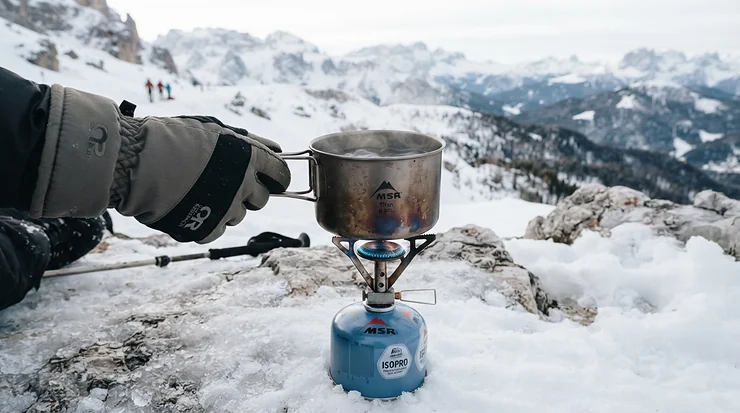
Propane butane mix for cold weather camping is a pressurised blend of liquefied petroleum gases in a screw-on or valve cartridge. Propane (boiling at −42°C) props up the pressure that butane or isobutane (−1°C and −11.7°C respectively) loses as temperatures fall. More propane means a stove that still lights when the tent is crunchy with frost.
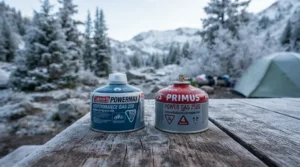
Here’s the awkward truth most UK campers discover around the second week of October. The canister that purred all summer now coughs, flickers and gives up while your porridge is still lukewarm. Nothing’s broken. It’s physics, and physics is unmoved by the fact that you pitched in the dark.
This guide cuts through the marketing gloss. I’ve pulled together published specs, manufacturer blend claims and aggregated buyer feedback on seven real canisters sold in the UK. Then I’ve translated the numbers into what they’ll do on a frosty Tuesday morning. One honest note up front: this is research and analysis, not lab testing or a personal field trial. Where sources disagree, I’ll say so rather than smooth it over.
Along the way we’ll settle propane butane mix vs pure butane, decode cold-weather gas blend ratios and unpick vapour pressure at low temperatures. We’ll also hunt for value propane butane gas canisters that don’t punish your wallet, and nail your autumn camping fuel choice before the first frost. If you only remember one thing, make it this: more propane buys you cold-weather grunt, but only if you also keep the canister warm. Prices are ranges only, so check current pricing before you buy.
Quick Comparison: Propane Butane Mix for Cold Weather Camping at a Glance
Blend percentages and low-temperature figures below are as listed by manufacturers or retailers. Treat them as claims, not lab results, and always read the label on the can in your hand.
| Product | Blend (as listed) | Size | Listed low-temp claim | Best For |
|---|---|---|---|---|
| MSR IsoPro | 80% isobutane / 20% propane | 227g | Not quoted | All-round autumn backpacking |
| Primus Power Gas | 80% isobutane / 20% propane | 230g | Positioned spring to autumn | Changeable three-season weather |
| Jetboil Jetpower | Propane/isobutane “four-season” blend | 100g, 230g, 450g | Not quoted | Fast-boil Jetboil systems |
| Coleman C300 Xtreme | Butane/propane (range listed at 60/40) | 230g | −27°C (claimed) | Budget cold-weather attempt |
| Coleman C500 | 70% butane / 30% propane | ~440g | Not quoted | Cheap car-camping bulk |
| Campingaz CV470 Plus | 80% butane / 20% propane | 450g | About −5°C (seller) | Campingaz Easy Clic Plus kit |
| GoSystem Premium Blend | Butane, propane and iso-butane | 170g, 350g | −20°C (retailer claim) | Value pick with a bold claim |
Two patterns jump out. The isobutane-propane cans (MSR IsoPro, Primus Power Gas, Jetboil Jetpower) are the safe bet for anyone who wants predictable behaviour near freezing. The butane-propane cartridges trade some cold-weather headroom for lower prices and bigger sizes. Coleman C300 Xtreme and GoSystem Premium Blend make the boldest low-temperature promises, and boldness deserves scepticism until a ratio is printed on the label. If you already own Campingaz kit, Campingaz CV470 Plus isn’t a choice so much as a requirement, because the connector decides for you.
💬 Just one click — help others make better buying decisions too!😊
Top 7 Propane Butane Mix for Cold Weather Camping Canisters: Expert Analysis
Every entry follows the same logic: what’s in the can, what that means at 2°C, what buyers report, and whether the price makes sense. Prices are indicative ranges gathered at the time of research, so check current pricing on Amazon.co.uk.
1. MSR IsoPro — the benchmark 80/20 isobutane-propane blend
When reviewers need a reference point, they reach for MSR IsoPro, and that alone tells you something. It’s the blend other cans get measured against.
The headline spec is the ratio: 80% isobutane and 20% propane in a 227g can that weighs roughly 377g full. The isobutane (boiling at −11.7°C) does the heavy lifting in mild weather, while the propane lifts vapour pressure when the air turns raw. In practice, expect confident upright-stove performance through a typical British autumn and a wobble once you’re properly below freezing. The printed net and gross weights are a small joy, because weighing a part-used can tells you whether it survives breakfast.
This is for backpackers and hillwalkers who’d rather pay a little more than gamble on a cold morning. Published comparisons such as TrailGroove’s name it their default all-rounder, though anecdotal head-to-heads with Jetboil’s canister are mixed. I couldn’t verify UK review counts, so I won’t quote star ratings.
Pros:
- ✅ Well-documented 80/20 isobutane-propane ratio
- ✅ Net and gross weights printed on the can
- ✅ Fits most standard screw-thread canister stoves
Cons:
- ❌ Pricier per gram than butane-propane cartridges
- ❌ Upright stoves still struggle in hard frost
Price and value: Roughly £8–£12 for the 227g size at the time of research. It’s worth it if a failed hot breakfast would cost you more than a couple of quid.

2. Primus Power Gas — three-season workhorse from a stove specialist
Primus Power Gas is the sensible-shoes option: nothing flashy, everything in its place.
One retailer listing gives the 230g can as 80% isobutane and 20% propane on a universal 7/16 UNEF thread. It pitches the can as a spring-to-autumn blend for changeable weather. Translation: it plays the same isobutane-plus-a-splash-of-propane game as MSR IsoPro, so expect similar behaviour. That means excellent at 8°C, decent around 0°C, and increasingly sulky below that unless you warm the can. The thread matters more than it sounds, because it lets the can screw onto most stoves in the Primus, MSR and Jetboil orbit.
Here’s a wrinkle worth knowing. One UK roundup crowns it the gold standard for four-season British camping, while the retailer copy I found labels it three-season. Older forum threads also quote different ratios for older Primus cans. Blends change over the years, so the label on your can trumps any blog post, this one included. That same roundup reports overwhelmingly positive UK buyer feedback, especially on cold consistency, though I couldn’t independently verify it.
Pros:
- ✅ 80/20 isobutane-propane listed by a retailer
- ✅ Universal 7/16 UNEF screw thread
- ✅ Suits changeable spring-to-autumn weather
Cons:
- ❌ Positioned as three-season, not true winter fuel
- ❌ Historic ratio claims vary, so check the label
Price and value: Around £8–£12 for 230g. It’s fair value when stock is easy to find, and a solid alternative if MSR IsoPro is sold out.
3. Jetboil Jetpower — fuel tuned for fast-boil systems
Jetboil Jetpower exists to feed a very particular kind of stove: the hissing heat-exchanger flask that boils half a litre before you’ve found your spoon.
Jetboil describes it as a propane/isobutane four-season blend, saying the propane provides higher vapour pressure for better cold-weather performance. Commonly reported ratios sit around 80/20, near-identical to MSR IsoPro. One commentator concluded that switching between the two shouldn’t produce a sudden performance jump. It comes in 100g, 230g and 450g sizes, so you can match the can to the trip.
What it means on the hill: a heat-exchanger stove is designed to waste less heat per boil, so the same 230g stretches further. That quietly offsets the price. Retailer reviewers split in a very human way. One says it boiled 28 pots of coffee against 18 from an 8oz MSR can, while another says MSR kept burning at around −3°C while the Jetboil can needed warming in a pocket. Anecdotes cancel out, so the fair reading is “equivalent, not superior”.
Pros:
- ✅ Three sizes: 100g, 230g and 450g
- ✅ Pairs well with heat-exchanger stoves
- ✅ Standard thread suits most canister stoves
Cons:
- ❌ Premium price without a proven cold edge
- ❌ Reviewer cold-start anecdotes are mixed
Price and value: Around £9–£13 for 230g. It’s good value with a Jetboil and harder to justify otherwise.
4. Coleman C300 Xtreme — boldest low-temperature claim on the shelf
Coleman C300 Xtreme carries the loudest cold-weather promise in this list: a listed operating limit of −27°C from a 230g screw-valve cartridge.
The UK listing describes a butane/propane mix, and the wider Xtreme range is listed at 60/40. That’s a hefty 40% propane, the strongest propane share of the seven. More propane does mean higher vapour pressure in the cold. The catch is the partner gas: it’s butane, with its −1°C boiling point, rather than isobutane. As the propane burns off first, the remaining liquid drifts butane-heavy and pressure sags. I’d read −27°C as a best case from a full, warm can, not a promise for the last third of the canister.
Buyer sentiment is where things get lively. One cycling-focused reviewer criticised Coleman’s ranges for making very different temperature claims on near-identical blends. Alpkit says Coleman is the only gas brand it has had problems with on its own stoves. Other sources cite 70/30 for standard Coleman cartridges, so sources genuinely disagree.
Pros:
- ✅ High propane share for a butane-based mix
- ✅ Resealable screw valve on a 230g cartridge
- ✅ Bold −27°C rating claimed
Cons:
- ❌ Claim looks optimistic for part-used cans
- ❌ One stove maker reports problems with the brand
Price and value: Around £6–£10. It’s a reasonable budget experiment, but I wouldn’t bet a Cairngorms breakfast on it alone.
5. Coleman C500 — cheapest way into screw-thread gas
For sheer affordability, Coleman C500 is hard to beat, and one UK roundup calls it arguably the most recognisable gas canister on Amazon.co.uk.
It’s a 70/30 butane/propane mix in a big cartridge of roughly 440g. The valve meets the EN417 standard that fits Jetboil, Primus, MSR, Vango and most modern lightweight stoves (Campingaz’s own cartridge system aside). Coleman says it manufactures in its own European factory in Lyon, which is a comforting detail for consistency. In practice, 30% propane gives it a noticeable edge over pure butane. That’s fine for September and October, while a properly frosty night will test it.
Who’s it for? Car campers, festival-goers and caravan-holiday types who burn plenty of gas and want to spend little. The big can also holds more liquid, which should help it hold temperature, though that’s my reasoning rather than a tested claim. Reviewers describe it as consistent, but the Alpkit caveat about Coleman on its stoves applies here too, so check compatibility with your stove maker’s guidance.
Pros:
- ✅ Large ~440g capacity for multi-night trips
- ✅ Very low cost per gram
- ✅ Fits most screw-thread stoves
Cons:
- ❌ Butane-led blend fades faster than isobutane-propane
- ❌ Heavy for backpacking
Price and value: Roughly £5–£9, with the mid-single-digit end common at some retailers. Excellent value for mild-to-cool weather.
6. Campingaz CV470 Plus — best for Easy Clic Plus stoves and lanterns
Campingaz CV470 Plus isn’t really competing with the screw-thread cans. It lives in its own ecosystem, and that’s the point.
It’s a 450g cartridge filled with an 80/20 butane/propane blend and fitted with the Easy Clic Plus self-sealing valve. Sellers say it works down to about −5°C, which is honest, modest and consistent with the physics of a butane-led mix. That suits campsite cooking well. It will comfortably run something like a Twister Plus stove or a Lumogaz Plus lantern through an autumn evening, and the resealable valve lets you swap appliances before it’s empty.
The trap is compatibility. Campingaz stoves take Campingaz cartridges, screw-thread stoves take EN417 cans, and one UK roundup names mixing them up as among the most common buying mistakes. I couldn’t find a body of independent reviews I could verify, so treat the −5°C figure as a manufacturer-side claim.
Pros:
- ✅ Big 450g capacity for multi-night trips
- ✅ Self-sealing valve for swapping appliances
- ✅ 80/20 mix openly stated by the brand
Cons:
- ❌ Not compatible with EN417 screw-thread stoves
- ❌ Listed limit is only around −5°C
Price and value: Around £8–£14 per 450g cartridge, with multipacks common. It’s decent value if you already own Campingaz kit.
7. GoSystem Premium Blend — budget three-gas mix with a −20°C claim
GoSystem Premium Blend is the dark horse: a UK-distributed three-gas mix that promises serious cold-weather ability at budget prices.
The retailer listing describes a butane, propane and iso-butane blend in an EN417 threaded cartridge, seen in 170g and 350g sizes, effective “down to −20°C”. Three-gas blends are intriguing because iso-butane (−11.7°C) bridges the gap between propane and butane, which can soften the fade as a can empties. The problem is that no percentages appear in the listing I found. Without a ratio, −20°C is a marketing number I’d treat as best case, and I’d still warm the can.
Buyer evidence is thin. One visible retailer review praises price and delivery, which tells you the courier is efficient and nothing about frost performance. A separate UK roundup says the Go System range delivers decent cold-weather performance thanks to its propane content. Sizes vary between stockists, so availability is the practical hurdle.
Pros:
- ✅ Three-gas blend includes isobutane
- ✅ Threaded EN417 self-sealing valve
- ✅ Low-temperature rating claimed to −20°C
Cons:
- ❌ Blend percentages not published in the listing
- ❌ Limited independent review evidence
Price and value: Around £4–£8 depending on size. It’s a value pick, best treated as a warm-can-only cold-weather option until the ratio is confirmed.
Practical Guide: Keeping Your Canister Alive on a Frosty Morning
Buying the right can is half the job. The other half is treating it like a slightly temperamental houseplant.
- Warm it first. Stash the canister in an inside jacket pocket or the foot of your sleeping bag overnight. Never warm it near an open flame; that’s a safety line, not a suggestion.
- Turn the flame down. Boiling gas pulls heat out of the liquid, which is why a working canister feels cold. A roaring flame chills it faster, so a medium flame and a slightly longer cook often beats full blast.
- Get it off the ground. This is my reading of the physics rather than a tested tip: a canister sitting on frozen turf loses heat to it. Stand it on a foam mat, a spare glove or a pan lid.
- Don’t invert it unless the stove is built for it. Only remote-canister stoves designed for liquid feed should run upside down. Flipping a setup made for upright use is asking for trouble.
- Watch the flame colour. The British Mountaineering Council’s stove-safety guidance notes that a mostly orange flame points to poor oxygen supply or a malfunction. It also reminds us that any stove burning fuel produces carbon monoxide.
The first-30-days mistakes are predictable. People leave cans in a freezing car overnight, buy by size rather than blend, and forget a spare. Do the boring bit at home too: light the stove in the garden and check the flame before you’re miles from a shop.
Real-World Scenarios: Matching Propane Butane Mix for Cold Weather Camping to Your Trip
Abstract blend advice is useful, but scenarios are where it sticks.
The weekend campsite couple. Two nights in the Peak District in October, nights forecast in the low single figures, a two-ring Campingaz stove and an evening lantern. Campingaz CV470 Plus is the obvious answer because it fits their kit, the 450g size covers a full weekend, and a −5°C limit comfortably covers a cool-but-not-freezing night. If frost is forecast, the cartridge sleeps in the car footwell, not the boot.
The solo Highlands backpacker. Late October, two nights, forecast lows around −3°C, a lightweight canister-top stove. Here MSR IsoPro or Jetboil Jetpower earns its premium, because isobutane-propane holds pressure better as temperatures dip. Carry the 230g size, keep it in your jacket overnight, and cook on a medium flame.
The budget-conscious student. Three weekend trips a month, a compact stove like the Vango Firestorm Compact (listed at roughly 48 minutes of burn on a 230g can at maximum flame, 94 on a 450g one). Coleman C500 covers mild weekends cheaply, while GoSystem Premium Blend is a reasonable frost-week experiment. The trade-off is that a failed cold-morning breakfast costs more than the saving, so a spare can of an isobutane-propane brand is cheap insurance.
Cold-Morning Problem → Solution Guide
Most cold-weather gas failures fall into five patterns.
- The stove lights, then dwindles. The canister is cooling as it works. Warm it, lower the flame and shelter the stove from wind.
- A new can dies long before it’s empty. The propane burns off first, leaving butane-heavy liquid that barely vaporises near freezing. Choose a higher-propane or isobutane-based blend and stop expecting the last gram in the cold.
- Frost forms on the outside of the can. That’s evaporative cooling made visible. Reduce the flame and warm the canister.
- The can doesn’t fit the stove. Check the valve type. Campingaz cartridges and EN417 screw-thread cans are different systems, and mixing them is a classic error.
- Gas disappears faster than expected. One UK roundup puts a 230g can at around 40–50 minutes of full-power burn. Use a pan lid, a windshield designed for your stove and a lower flame, and carry a spare on anything over two nights.
These fixes cost nothing but attention, which is a bargain compared with cold porridge.
How to Choose Propane Butane Mix for Cold Weather Camping
Short answer: choose the highest propane share your stove and budget allow, pair it with isobutane rather than butane where possible, and match the valve to your stove. Then use this checklist:
- Check the forecast low. Butane-led cans start losing steam near 5°C, so if nights approach 0°C, step up to a higher-propane or isobutane-based blend.
- Read the ratio on the can. Listings and forum posts disagree, but the label is what’s inside.
- Prefer isobutane over n-butane. Its −11.7°C boiling point beats butane’s −1°C, so it keeps vaporising when the air is properly cold.
- Confirm the valve. EN417 screw thread and Campingaz Easy Clic are not interchangeable.
- Size for the cold. Cold trips burn more fuel per hot meal, and a larger can holds more liquid, so buy the bigger size or a spare.
- Match the stove. Heat-exchanger stoves stretch fuel, and windshields help, but only if designed for your model.
- Plan the warming. No blend replaces a jacket pocket on a frosty night.
Propane Butane Mix vs Pure Butane: What Actually Changes
Pure butane is cheap, clean-burning and perfectly good on a warm day. The trouble starts as temperatures fall. One long-standing stove-fuel explainer notes that once fuel temperature drops below roughly 5°C, butane’s vaporisation isn’t strong enough to run a typical gas stove. Adding propane changes the physics in your favour, because it keeps vapour pressure up when butane alone would sulk.
That’s the real difference in propane butane mix vs pure butane: not a fancier flame, but a wider comfortable temperature range. There’s a trade-off, though. Propane’s higher vapour pressure means it needs stronger canisters, which is why you shouldn’t try to decant propane into a light butane can.
| Factor | Pure butane | Propane butane mix | Best For |
|---|---|---|---|
| Cold-weather vaporisation | Weak below roughly 5°C | Improved by propane share | Mix for autumn |
| Cost | Usually cheapest | Slightly higher | Pure butane for summer |
| Consistency as can empties | Even | Propane burns first, mix drifts | Isobutane-propane for steadiness |
| Availability | Fewer camping formats | Widely stocked | Coleman C500, Campingaz CV470 Plus |
Looking at the table, pure butane wins on price only when nights stay well above 5°C. If your season stretches into October, a butane-propane mix such as Coleman C500 costs little extra and rescues the odd cold morning. Buyers already on Campingaz kit lean toward Campingaz CV470 Plus for the same reason.
Cold-Weather Gas Blend Ratios Explained
Ratios sound like the whole story, but they’re only the first chapter. Retailers describe a “four-season” or “winter” mix as roughly 20–30% propane with 70–80% isobutane. Snow Peak’s 85/15 blend, by contrast, quotes a lowest working temperature of −9°C with its own stove.
| Blend | Example | What sources say | Practical reading |
|---|---|---|---|
| 100% n-butane | — | Boils around −1°C | Warm weather only |
| 80/20 butane/propane | Campingaz CV470 Plus | Seller quotes about −5°C | Mild autumn |
| 70/30 butane/propane | Coleman C500 | 30% propane | Cool, not frosty |
| 60/40 butane/propane | Coleman C300 Xtreme | −27°C claimed | Treat claim cautiously |
| 80/20 isobutane/propane | MSR IsoPro, Primus Power Gas, Jetboil Jetpower | Described as three- or four-season | Near freezing, with warming |
| 85/15 isobutane/propane | Snow Peak GigaPower (reference) | −9°C with its stove | Cool autumn, careful in frost |
The table shows a mismatch worth noticing: one 80/20 isobutane-propane can is marketed as four-season by some and three-season by others. Ratios matter, but so do stove design, wind and how full the can is. Read cold-weather gas blend ratios as a starting point, then adjust for your stove, your altitude and your patience with warming cans.
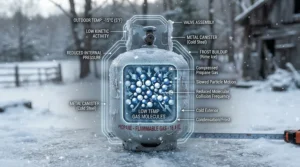
Vapour Pressure at Low Temperatures: What Happens Inside the Can
Here’s the science in one sentence: your stove works only while the pressure inside the canister beats the air pressure outside it. As the liquid cools, vapour pressure falls, and eventually the flame gutters.
The numbers explain why propane matters. Propane’s vapour pressure is around 850 kPa at 21°C, against roughly 170 kPa for butane at 10°C. Those are different temperatures, but the gulf is unmistakable. Vapour pressure at low temperatures is simply the fuel’s ability to keep pushing gas out of the can once it’s chilly.
The Appalachian Mountain Club’s explainer adds two details that catch people out. First, as propane burns off preferentially, the remaining mixture shifts butane-heavy, so a brand-new can may work in the cold but stop long before it’s empty. Second, vaporisation itself takes heat from the liquid, so the can cools even when the air is above the fuel’s boiling point. This is why a big flame in cool weather can defeat a perfectly decent blend.
Value Propane Butane Gas Canisters: Cost per Hot Breakfast
Value isn’t the price of a can. It’s the price of a successful boil. A cheap canister that stops at 2°C is expensive if it costs you a cold breakfast, a lost hour and a grumpy campsite.
Burn times help. Vango’s figures for its folding stove suggest roughly 35 minutes from 110g, 75 from 230g and 145 from 450g. Those are stove-specific manufacturer numbers, and a UK roundup puts full-power burn on a 230g can nearer 40–50 minutes. In both cases, larger cans usually cost less per gram, which is why value propane butane gas canisters tend to be the bigger cartridges.
| Product | Indicative range | Size | Value verdict |
|---|---|---|---|
| Coleman C500 | £5–£9 | ~440g | Best cost per gram in mild weather |
| GoSystem Premium Blend | £4–£8 | 170g / 350g | Cheap, but ratio unpublished |
| Campingaz CV470 Plus | £8–£14 | 450g | Fair if you own Campingaz kit |
| MSR IsoPro | £8–£12 | 227g | Pays for itself near freezing |
The bargain isn’t always the cheapest line. Coleman C500 is excellent value for cool weekends, while MSR IsoPro justifies its extra cost when nights drop toward freezing. Buy the cheap cartridge for the tail end of summer, and the pricier isobutane-propane can for the trip where failure would ruin it.
Autumn Camping Fuel Choice: A September-to-November Reality Check
Autumn isn’t one season; it’s three. My rule of thumb (analysis, not gospel) follows the calendar.
September: nights are mild, so almost any canister works, and Coleman C500 is the sensible, cheap option. October: nights drop into single figures with frost pockets in valleys, so aim for at least 30% propane or step up to an isobutane-propane can like MSR IsoPro. One UK guide describes an 80/20 butane-propane mix as good for spring and autumn, which fits this month well. November onward: any night forecast below 0°C calls for isobutane-propane, a warming plan and a spare can. One roundup notes that propane content starts to earn its keep as November mornings turn colder.
Your autumn camping fuel choice should also include a Plan B. A spirit stove such as a Trangia is unaffected by canister physics, because methylated spirits don’t lose pressure as temperatures fall. It’s slower, but for a frozen-Highlands emergency it beats a stove that won’t light.
Safety, Regulations and Storage Guide
Cold-weather camping tempts people into bad habits, and warming the tent with a stove is the worst of them. Around 50 people die and about 200 are hospitalised each year in the UK from carbon monoxide poisoning, according to Powys Teaching Health Board’s camping safety guidance. Not all of those are campers, but tents and awnings are unforgiving spaces. Never use a fuel-burning appliance to heat a tent, never leave a barbecue in a porch, and consider a camping-suitable carbon monoxide alarm.
Practical rules for canisters:
- Store them cool and ventilated, away from heat sources and out of direct sun.
- Never refill disposable cartridges, and never put propane into a light butane can.
- Check valve standards. Stoves and canisters sold in the UK and Europe follow EN417 for screw-thread cartridges, and it’s worth checking your stove’s own marking guidance.
- Dispose of empties sensibly. Recycling rules vary by council, so check local guidance before puncturing or binning cans.
Finally, check airline and Civil Aviation Authority rules before travelling; one UK roundup notes that pressurised gas canisters are prohibited in both hold and cabin baggage.

FAQ
❓ Where can I buy propane butane gas canisters in the UK?
❓ Can a Campingaz cartridge fit a screw-thread stove?
❓ Is winter gas worth paying extra for?
❓ How long does a 230g canister last?
❓ Can I refill or recycle empty canisters?
Conclusion
Choosing propane butane mix for cold weather camping comes down to a few honest trade-offs. More propane and an isobutane partner give you a wider comfortable temperature range. Butane-led cartridges are cheaper and bigger but fade sooner as the mercury falls. And no blend, however boldly labelled, will rescue a canister left cold all night.
If you camp near freezing, MSR IsoPro, Primus Power Gas and Jetboil Jetpower are the safest all-round bets, with the choice largely down to availability, size and stove. For mild-to-cool weekends, Coleman C500 and GoSystem Premium Blend stretch a budget, while Coleman C300 Xtreme and its −27°C promise deserve healthy scepticism. If your kit is Campingaz, Campingaz CV470 Plus is the straightforward answer, provided you stay above about −5°C.
Remember the essentials: check the label ratio, match the valve, warm the can, keep the flame modest and never cook in a sleeping space. Do that, and your autumn camping fuel choice becomes less a gamble than a plan.
Recommended for You
- Propane Butane Canisters Under £10: 7 Best Cheap Buys (2026)
- Butane Canisters For Camping Stove: 7 Best Picks (2026)
- Butane Canisters For Caravan Cooking: 7 Best Picks (2026)
Disclaimer: This article contains affiliate links. As an Amazon Associate, I earn from qualifying purchases. If you purchase products through these links, we may earn a small commission at no additional cost to you.
✨ Found this helpful? Share it with your friends! 💬🤗
