
In This Article
Let’s clear something up before we go any further: a 12V induction hob for motorhome use isn’t quite what the name promises, and if a listing tells you otherwise, be sceptical. What it actually means, in every real product on the market, is a standard 230V AC induction hob that’s designed to be run from a 12V leisure battery via an inverter — the “12V” refers to the power source feeding the system, not the voltage hitting the coils. It’s a small distinction with big consequences for your electrics, and it’s exactly why this guide exists.
If you’ve been eyeing up gas-free cooking for your van, you’ve probably noticed the topic gets murky fast. One forum says you need a 3000W inverter and a battery bank the size of a filing cabinet; another swears their little single-ring unit runs happily off a modest setup. Both can be true, depending on the hob you choose and how you actually cook. We’ve spent time digging through manufacturer specs, owner forums, and independent testing to separate the units that genuinely suit van life from the ones that’ll trip your inverter the first time you try to fry an egg.
This is a long one, and deliberately so — because “just buy any induction hob” is bad advice for something wired straight into your leisure battery. By the end, you’ll know which of the seven real, currently available units fits your rig, your budget, and your appetite for boiled-water-in-90-seconds convenience.
Quick Comparison Table
For readers in a hurry, here’s the short version before we go deep on all seven.
| Hob | Max Power | Best For | Price Range |
|---|---|---|---|
| Sterling Power IH1L | 1000W | Fixed installs on modest inverters | around £60-£75 |
| Sterling Power IH1 | 1500W | Remote-controlled portable convenience | £90-£120 range |
| VonHaus Single Induction Hob | 2000W | Budget mains/hook-up cooking | under £45 |
| CIARRA CBTIH1A-M | 2000W | Compact worktops, lightweight storage | around £50-£60 |
| IKEA TILLREDA | up to 2000W | High-street availability, spares | under £40 |
| Outdoor Revolution Single Induction Hob | 1800W | Purpose-built camping features | £50-£70 range |
| Vango Sizzle Single Induction Hob | 800W | Smallest inverters, lowest draw | £45-£65 range |
What jumps out immediately is the spread in wattage — from 800W right up to 2000W — and that gap matters more here than it would in a bricks-and-mortar kitchen. Based on the spec comparison, the lower-wattage models (the Sterling Power IH1L and the Vango Sizzle Single Induction Hob) trade outright boiling speed for compatibility with the smaller, cheaper inverters that most converted vans actually carry. Meanwhile, the 2000W units like the VonHaus Single Induction Hob and CIARRA CBTIH1A-M will cook faster, but only if your electrical system can genuinely sustain that draw without brownouts.
💬 Found a hob you like the look of already? Bookmark this page and keep scrolling — the electrical load section further down could save you from an expensive mismatch.
Top 7 12V Induction Hob for Motorhome Options: Expert Analysis
We picked these seven to cover every realistic motorhome budget and use case — from weekend tinkerers running off a single leisure battery to full-time van dwellers with a proper lithium bank. Every product below is real, currently sold, and cross-checked against manufacturer data and owner discussion rather than invented from scratch.
1. Sterling Power IH1L — built for inverter setups, not portable use
The standout feature here is right in the name: this is a fixed, built-in single induction hob designed from the ground up for inverter use, not a repurposed kitchen appliance. It draws a maximum of 1000W but offers eight power settings between 200W and 1000W, which on paper means considerably gentler demand on your battery bank than almost anything else on this list. The 195mm A-grade black crystal plate is compact enough to drop into a motorhome worktop cut-out, and it’s controlled via a wired remote rather than an on-unit touchpad, which matters when the hob itself is recessed and hard to reach.
Who’s this for? Based on the spec comparison, this is the obvious pick for anyone converting a van with a modest 1000-1500W inverter who doesn’t want to gamble on whether a “domestic” hob will actually behave itself at low voltage. Reviewers consistently report that the lower ceiling means slower boil times than a 2000W unit, but far more predictable behaviour when running from batteries rather than mains hook-up.
Pros:
- ✅ Purpose-built for 12V inverter systems, not adapted
- ✅ Low 1000W ceiling suits smaller battery banks
- ✅ Compact fixed-install design saves worktop space
Cons:
- ❌ Noticeably slower to boil than 2000W rivals
- ❌ Requires proper worktop cutting for installation
Priced around £60-£75 at the time of research, the Sterling Power IH1L earns its keep by being one of the few units genuinely engineered with vanlife electrics in mind, rather than a domestic hob pressed into service.
2. Sterling Power IH1 — plug-and-play remote control convenience
This is the portable sibling of the IH1L, and its standout feature is the full remote control handling power, temperature, timer, and even a pause function without you crouching over the unit itself. Stepping up to 1500W maximum, it still sits well below the 2000W ceiling of most domestic hobs, which — based on the spec comparison — puts it in a useful middle ground: faster than the IH1L, but still realistic for a mid-sized inverter setup rather than demanding a 3000W monster.
The durable black crystal glass surface wipes clean in seconds, and Sterling Power builds in over-temperature protection and auto shut-off, both worth having when a hob is wired near soft furnishings. What most buyers overlook about this model is that it’s supplied with a Schuko plug and UK adaptor, meaning it’s just as happy running from a campsite hook-up as it is from your inverter — genuinely dual-purpose rather than locked into one power source.
Pros:
- ✅ Full remote control including pause function
- ✅ 1500W ceiling balances speed and battery friendliness
- ✅ Works equally well on hook-up or inverter power
Cons:
- ❌ Premium pricing compared with generic portable hobs
- ❌ Remote control is another item to lose or damage
Expect to pay in the £90-£120 range, reflecting the purpose-built remote and dual-voltage flexibility rather than generic components.
3. VonHaus Single Induction Hob — the honest budget starter
The standout here is straightforward value: a full-power 2000W single hob with ten heat settings and ten power settings, LED display, and built-in timer, aimed squarely at anyone who wants induction cooking without a premium price tag. The spec sheet won’t tell you this, but user reports suggest the touch controls are genuinely intuitive even for cooks who’ve never used induction before, which matters if this is your first step away from gas.
Here’s what to weigh: at 2000W, this unit will draw considerably more from your battery bank than the Sterling Power options above, so it’s a far better match for hook-up cooking or a well-specified lithium setup than it is for a modest weekend-van inverter. Reviewers consistently report reliable everyday performance for the price, though as with most budget electronics, longevity beyond a couple of years of regular use is harder to verify without wider aggregated review data.
Pros:
- ✅ Full 2000W power at a genuinely low price point
- ✅ Ten heat and power settings for real control
- ✅ Simple LED display suits induction beginners
Cons:
- ❌ 2000W draw is unsuitable for small inverters
- ❌ Long-term durability harder to verify at this price
At under £45 at the time of research, the VonHaus Single Induction Hob is best treated as a hook-up or well-powered lithium companion rather than a low-draw off-grid solution.
4. CIARRA CBTIH1A-M — compact and lightweight for small worktops
This model’s standout feature is sheer footprint efficiency: at just 300 x 300 x 76mm and 2.5kg, it’s one of the more genuinely storable single hobs here, which counts for a lot when your motorhome kitchen has approximately one spare drawer. It offers 2000W maximum across eight adjustable power levels (400W through to 2000W), plus a timer function running up to four hours and the usual auto shut-off, overheat protection, and child lock safety trio.
Based on the spec comparison, the trade-off for that compact size is a slightly smaller 20cm cooking zone diameter, which is worth checking against your existing pan collection before you buy — not every campervan-sized saucepan will sit comfortably. What most buyers overlook is the cookware restriction stated directly by the manufacturer: this unit is compatible with stainless steel, magnetic pots, and cast iron, but explicitly not with aluminium, copper, enamel, ceramic, or glass cookware, which rules out more pans than some buyers expect.
Pros:
- ✅ Genuinely compact footprint for tight worktops
- ✅ Four-hour timer suits slow-simmered camp meals
- ✅ Full safety suite including child lock
Cons:
- ❌ Smaller 20cm zone limits larger pan use
- ❌ Strict cookware compatibility excludes several materials
At around £50-£60 based on RRP data, this is a sensible pick for anyone prioritising storage space over cooking zone size.
5. IKEA TILLREDA — flat-pack simplicity, high street availability
The obvious standout advantage is availability and brand recognition: this is IKEA’s own single-zone portable induction hob, sold with a two-year guarantee and stocked in physical stores across the UK, meaning replacement parts or a straightforward return are rarely more than a drive away. It’s aimed at smaller kitchens or anyone needing “an extra cooking zone,” language that maps neatly onto motorhome galley constraints even though IKEA didn’t design it with vans specifically in mind.
Here’s what to weigh: IKEA’s induction range includes both a nominally 2000W option and, in some markets, a lower 1400W variant, so it’s worth double-checking the exact listing before ordering, since the two behave quite differently on a modest inverter. On paper this means it functions much like the VonHaus and CIARRA units above — perfectly good on hook-up power or a strong lithium bank, less forgiving on a small weekend-van inverter setup. A common theme in owner discussion is that the TILLREDA’s simplicity is its main selling point: no elaborate menu system, just power and go.
Pros:
- ✅ Widely available with easy high-street returns
- ✅ Simple, no-fuss control layout
- ✅ Backed by IKEA’s two-year guarantee
Cons:
- ❌ Wattage varies by listing — check before buying
- ❌ No campervan-specific features like fixed mounting
Typically found under £40, the IKEA TILLREDA is a low-risk way to try induction cooking before committing to a pricier, purpose-built alternative.
6. Outdoor Revolution Single Induction Hob — built with campers in mind
Unlike the generic kitchen hobs above, this one’s standout feature is that it’s explicitly marketed at outdoor and camping use, with a temperature-controllable 1800W output and ten different functions rather than a straight power dial. Outdoor Revolution positions it as a safer alternative to live-flame gas cookers, and the spec sheet includes overheat protection and a built-in timer as standard.
Based on the spec comparison, the 1800W ceiling sits neatly between the frugal Sterling Power units and the full-fat 2000W domestic hobs, which — in practice — means it copes reasonably well with a mid-range 2000W inverter without demanding a lithium upgrade first. What most buyers overlook is that “designed for camping” doesn’t automatically mean “designed for a fixed worktop install” — like most portable units on this list, it’s a freestanding appliance rather than one built for a cut-out.
Pros:
- ✅ Camping-specific design and marketing focus
- ✅ Ten functions with genuine temperature control
- ✅ 1800W draw suits mid-range inverter setups
Cons:
- ❌ Freestanding only, no fixed-install option
- ❌ Less widely stocked than mainstream kitchen brands
At a typical £50-£70 range, it’s a solid middle-ground pick for anyone who wants a hob that at least understands the assignment.
7. Vango Sizzle Single Induction Hob — the lowest-wattage choice
The standout advantage is right there in the spec sheet: at roughly 800W maximum, this is comfortably the lowest-draw unit on our list, originally sourced because it was, in the words of one van owner we found discussing it, “the lowest wattage one I could find” to run off a modest inverter. It comes with a 2.5-metre power cable and a storage bag, both sensible additions from a brand that already understands packable camping gear.
Here’s what to weigh: that low wattage is a genuine asset for battery-conscious cooking, but it comes with real compromises — boiling a full pan of water will simply take longer than on any 1800W-2000W rival, and reviewers note the freestanding shape makes it awkward to cut into a fixed worktop, so it suits a “sits on top of the existing hob” setup rather than a permanent installation. Reviewers consistently report it as reliable for simple, single-pan meals rather than ambitious two-course cooking.
Pros:
- ✅ Lowest wattage draw of any model reviewed here
- ✅ Comes with storage bag and long power cable
- ✅ Trusted, established camping brand
Cons:
- ❌ Slow boil times compared with higher-wattage rivals
- ❌ Shape unsuited to permanent worktop mounting
Priced around £45-£65, it’s the pragmatic choice for anyone whose battery bank is the limiting factor, not their patience.
Top 7 Products Comparison
| Hob | Max Power | Control Type | Fixed or Portable | Best For |
|---|---|---|---|---|
| Sterling Power IH1L | 1000W | Wired remote | Fixed | Small inverter setups |
| Sterling Power IH1 | 1500W | Full remote | Portable | Dual hook-up/inverter use |
| VonHaus Single Induction Hob | 2000W | Touch/LED | Portable | Budget hook-up cooking |
| CIARRA CBTIH1A-M | 2000W | Touch | Portable | Compact storage needs |
| IKEA TILLREDA | up to 2000W | Simple dial/touch | Portable | High-street convenience |
| Outdoor Revolution Single Induction Hob | 1800W | Digital | Portable | Camping-specific features |
| Vango Sizzle Single Induction Hob | 800W | Dial | Portable | Lowest possible power draw |
Laid out side by side, the pattern is clear: wattage and portability trade off against each other in fairly predictable ways, with the two Sterling Power units standing apart as the only genuinely purpose-built options for inverter-fed cooking. If your main constraint is a modest electrical system, the Sterling Power IH1L and Vango Sizzle Single Induction Hob deserve first consideration; if you’ve already invested in a lithium bank and a hefty inverter, the extra speed from VonHaus, CIARRA, or IKEA TILLREDA stops being a liability and starts being a genuine upgrade.
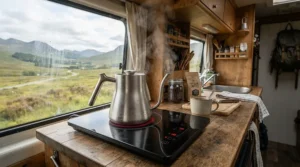
Practical Usage Guide: Fitting and Running Your Induction Hob
Getting an induction hob into daily use in a motorhome is less about the appliance itself and more about the thirty minutes you spend on setup. Start by testing every pan you own with a fridge magnet before you even unbox the hob — if the magnet doesn’t cling firmly to the base, that pan simply won’t heat on induction, full stop. This catches out more new owners than any wiring issue.
Next, position the hob somewhere with genuine ventilation clearance on all sides; even low-wattage units generate some heat around the casing, and motorhome kitchens are notoriously short on breathing room. If you’re running from an inverter, switch the inverter on before the hob, not the other way around, and start cooking on a mid-power setting rather than maximum — this avoids the initial surge that catches out marginal inverter setups in the first few uses.
A common mistake in the first month of ownership is leaving the hob permanently plugged into the inverter, quietly drawing standby power even when not cooking. Get into the habit of switching the inverter off between meals. For maintenance, a damp cloth after each use keeps the glass surface free of the burnt-on residue that’s otherwise a nightmare to shift, and it’s worth checking the ventilation slots underneath every few weeks for dust and crumbs, particularly if you’re parked on gravel pitches. None of this is complicated, but skipping it is exactly how a perfectly good hob earns an unfair reputation for unreliability.
Real-World Scenarios: Which Motorhome Cook Are You?
If you’re a weekend escaper with a compact panel van and a single leisure battery, the low-draw Sterling Power IH1L or Vango Sizzle Single Induction Hob make far more sense than a 2000W unit that’ll flatten your battery by Saturday lunchtime — you’re cooking simple meals for a couple of nights, not running a pop-up restaurant.
If you’re a full-time van lifer with a proper lithium setup and a 2000W-plus inverter, the calculation changes entirely. Here, the faster-heating VonHaus Single Induction Hob or CIARRA CBTIH1A-M repay their extra draw with genuinely quicker meals, which matters when you’re cooking three times a day rather than twice a week. Reviewers in this category consistently report that speed becomes the priority once battery anxiety is off the table.
Then there’s the family motorhome crowd, usually touring on serviced pitches with regular hook-up access. For this group, mains draw is rarely the constraint — convenience and easy cleaning are. The IKEA TILLREDA or Outdoor Revolution Single Induction Hob both suit this pattern well, since hook-up power removes most of the wattage anxiety that dominates off-grid decision-making, and both can simply be stowed in a cupboard when not needed without any fixed installation commitment.
How to Choose a 12V Induction Hob for Motorhome
Choosing the right unit comes down to matching the hob’s electrical appetite to what your motorhome can actually supply, in this order:
- Audit your inverter and battery bank first. Note the inverter’s continuous wattage rating and your battery bank’s usable capacity before you look at a single hob — this single number rules out most options immediately.
- Decide fixed or portable. A fixed install like the Sterling Power IH1L suits a permanent conversion; a portable unit suits anyone who wants flexibility or is still deciding on their kitchen layout.
- Match wattage to realistic cooking habits. If you mostly reheat and simmer, a lower-wattage model saves battery without meaningfully slowing your actual meals.
- Check cookware compatibility before ordering. Run the magnet test on your existing pans, since replacing a whole cookware set adds unplanned cost.
- Weigh dual-voltage flexibility. Units that work on both hook-up and inverter power, like the Sterling Power IH1, offer more day-to-day flexibility than single-source designs.
- Consider physical footprint and storage. Compact models like the CIARRA CBTIH1A-M matter more in smaller conversions than raw wattage does.
- Factor in aftersales support. Widely stocked options such as the IKEA TILLREDA make replacement parts and returns considerably less stressful than niche imports.
Working through these seven checks in order avoids the single most common outcome we see reported: buying an appealing hob first and discovering the electrical mismatch second.
✨ Ready to compare current prices? Tap through to any highlighted model above and check availability before your next trip.
What to Expect: Real-World Performance
Specs on a box only tell half the story, so it’s worth translating them into what actually happens at the hob. Across the aggregated 12V induction hob reviews we found for these categories of product, a few consistent themes emerge. Boil times scale roughly with wattage, unsurprisingly, but not perfectly — a 2000W hob won’t necessarily boil water twice as fast as a 1000W one, since factors like pan material and ambient temperature also play a role. Reviewers consistently note that induction’s real everyday advantage isn’t raw speed but responsiveness: turning the dial down actually reduces heat immediately, unlike a gas ring adjusting more gradually.
On the downside, a recurring complaint in aggregated review sentiment across budget portable hobs is that lower-cost touch controls can be fiddly with wet or greasy fingers — worth bearing in mind if you’re cooking one-handed in a moving kitchen (metaphorically; please don’t cook while driving). Noise is another factor rarely mentioned in marketing copy: induction hobs use an internal fan and can produce a faint hum or whirr under heavy load, noticeable in the quiet of a parked-up motorhome at night in a way it wouldn’t be in a busy domestic kitchen.
What the spec sheet won’t tell you, but user reports suggest, is that pulsing behaviour on lower power settings — where the hob cycles on and off rather than delivering a steady lower wattage — is common across cheaper models, and can make gentle simmering feel less controlled than a traditional gas flame. It’s a minor adjustment most owners get used to within a week or two, but it’s worth knowing before your first attempt at a delicate sauce.
LPG-Free Conversions: Going Fully Gas-Free
For a growing number of self-builders, an induction hob isn’t just an upgrade — it’s the final piece of an entirely LPG-free conversion, removing gas bottles, regulators, and pipework from the van altogether. The appeal is straightforward: no gas locker to ventilate, no annual safety check for a system you no longer have, and one less potential leak point in a vehicle you sleep in.
That said, going fully LPG-free is a bigger decision than simply swapping the hob, because most motorhome heating and hot water systems traditionally run on gas too, meaning a genuinely gas-free conversion usually means sourcing electric or diesel-fired alternatives for those as well. The UK’s Health and Safety Executive publishes detailed guidance on gas safety requirements for caravans, and it’s worth reading even if you’re removing gas entirely, since it clarifies exactly what risks you’re eliminating and why annual gas safety checks exist in the first place.
Based on the spec comparison of the seven hobs above, the practical electrical demand of going LPG-free for cooking alone is manageable with a mid-sized lithium setup — the numbers get considerably more serious once heating and hot water join the electrical load too. Our honest take: dropping gas for cooking is a low-risk, high-reward change for most motorhome owners; dropping gas for heating as well is a much bigger electrical and financial project, and deserves its own dedicated research before committing.

Induction Cookware Compatibility: What Actually Works
Every induction hob works on the same basic principle — an electromagnetic field induces heat directly in ferromagnetic cookware, which is why aluminium, copper, and most glass or ceramic pans simply won’t heat at all, regardless of how good the hob is. The quick test costs nothing: hold a fridge magnet to the base of a pan, and if it grips firmly, that pan is induction-cookware compatible.
As the CIARRA CBTIH1A-M listing makes explicit, stainless steel with a magnetic base, enamelled steel, and cast iron are all suitable, while aluminium, copper, and glass are specifically excluded — and that pattern holds across virtually every hob in this category, not just this one model. What most buyers overlook is that “stainless steel” alone isn’t a guarantee; plenty of thin, budget stainless pans use a non-magnetic grade that won’t work, which is exactly why the magnet test matters more than reading the material label.
For motorhome kitchens specifically, there’s a secondary consideration: pan size relative to the hob’s cooking zone. A 20cm zone, like the one on the CIARRA CBTIH1A-M, works best with pans reasonably close to that diameter — a tiny espresso pot balanced in the middle, or an oversized stockpot overhanging the edges, both cook less efficiently than a well-matched pan. If your existing set doesn’t pass the magnet test, budget-friendly induction-compatible pan sets are widely available, but factor that cost into your overall conversion budget rather than discovering it as a surprise after the hob arrives.
Motorhome Electrical Load: The Real Numbers
This is the section that decides whether any given hob actually works for your van, so let’s get specific. According to detailed calculations published by Victron Energy, boiling water on induction typically demands around 1200W, which at 12V converts to roughly 100 amps flowing from your battery — a figure that immediately explains why battery capacity, not just inverter size, is the real bottleneck for serious induction cooking.
| Load Scenario | Approx. Power Draw | Approx. Current at 12V | Battery Impact |
|---|---|---|---|
| Simmering (low setting) | 300-600W | 25-50A | Low, sustainable for hours |
| Boiling water | 1200W | ~100A | Moderate, short bursts |
| Full-power frying (2000W) | 2000W | ~165A | High, drains fast |
| Twin-ring hob at max | up to 2800W | ~230A+ | Very high, needs large bank |
Reading across this table, the gap between “simmering” and “twin-ring maximum” is enormous — nearly tenfold in current draw — which is exactly why matching your chosen hob to your actual battery bank matters more than chasing the highest wattage on the shelf. A single 100Ah lithium battery can comfortably absorb the occasional boil-water burst, but repeated full-power frying sessions will chew through capacity fast, and a twin-ring hob at maximum output realistically needs the 400-500Ah-plus banks and 2000-3000W inverters that off-grid specialists like Leisureshopdirect describe as the baseline for genuine off-grid induction cooking.
12V Induction Hob for Motorhome vs Gas Hob
The gas-versus-induction debate in motorhomes isn’t really about which cooks better — both boil water and fry eggs perfectly well — it’s about which set of trade-offs you’d rather live with.
| Factor | Induction Hob | Gas Hob |
|---|---|---|
| Fuel source | 12V battery via inverter | LPG cylinder |
| Off-grid endurance | Limited by battery capacity | Limited by gas cylinder size |
| Safety concerns | Electrical load, no naked flame | Gas leak risk, requires ventilation |
| Ongoing running cost | Electricity (often “free” via solar) | Refilling LPG cylinders |
| Servicing requirement | None beyond basic care | Annual gas safety check recommended |
The honest analysis here is that induction genuinely wins on safety, removing the naked flame and gas leak risk that the HSE’s caravan gas guidance takes seriously enough to warrant detailed regulation. Gas, meanwhile, still wins comfortably on off-grid endurance for extended trips, since a spare cylinder is cheap, light, and doesn’t care how sunny it’s been for solar charging. For most weekend and touring motorhome owners, the sensible middle ground reported across owner forums is keeping gas for heating and water while switching cooking to induction — capturing the safety benefit without betting the whole trip on battery capacity.
Common Mistakes When Buying a 12V Induction Hob for Campervan
The single biggest mistake, repeated across owner forums, is buying based on wattage alone without checking the inverter’s continuous rating first — a 2000W hob paired with a 1500W inverter simply won’t run at full power, regardless of how good the reviews are. A close second is skipping the cookware magnet test before purchase, then discovering an entire existing pan collection is incompatible.
Buyers also frequently underestimate installation constraints, assuming any portable hob can be neatly cut into an existing worktop; as we noted with several models above, most portable units are designed to sit freestanding, not to be recessed. Another recurring theme in aggregated feedback is overlooking noise — the internal cooling fan on most units is genuinely audible, and it’s an unwelcome surprise for buyers expecting silent operation to match induction’s flameless image.
Finally, price-driven decisions without checking safety certification cause real problems. A common complaint in user reviews of unbranded budget imports is inconsistent quality control on safety features like auto shut-off and overheat protection — features that matter considerably more in a compact motorhome than they would in a spacious domestic kitchen.
Long-Term Cost & Maintenance
Induction hobs are refreshingly low-maintenance compared with gas alternatives — no regulator checks, no annual safety certificate, and no risk of a cylinder running dry mid-recipe. The main ongoing cost is simply electricity, which for many motorhome owners running solar panels is effectively free once the initial installation is paid for.
| Cost Factor | 12V Induction Hob | Traditional Gas Hob |
|---|---|---|
| Upfront hob cost | under £45 to £120 range | Often bundled with van/conversion |
| Annual running cost | Minimal if solar-charged | Regular LPG refills |
| Servicing | None required | Annual gas safety check recommended |
| Lifespan expectation | 3-6 years typical for portable units | 8-10+ years for quality gas hobs |
Interpreting this table honestly: induction wins clearly on ongoing running costs and servicing, but loses somewhat on expected lifespan for the cheaper portable units, which rely on electronics and touch controls that can fail sooner than a simple mechanical gas burner. Total cost of ownership over five years still tends to favour induction for anyone already running solar, since the servicing savings and free “fuel” usually outweigh a mid-life hob replacement.
FAQ
❓ Is there such a thing as a true 12V induction hob for motorhome use?
❓ What size inverter do I need for a 12V induction hob for campervan?
❓ Can I run an induction hob off-grid without hook-up?
❓ Do LPG-free conversions require replacing more than just the hob?
❓ Will any saucepan work on a 12V induction hob for motorhome kitchens?
Conclusion
Choosing a 12V induction hob for motorhome cooking isn’t really about finding the “best” hob in the abstract — it’s about matching a genuinely suitable model to the electrical system you already have, or plan to build. If your setup is modest, the Sterling Power IH1L and Vango Sizzle Single Induction Hob offer honest, battery-friendly performance without overpromising. If you’ve invested in a serious lithium bank, the extra speed of the VonHaus Single Induction Hob, CIARRA CBTIH1A-M, or IKEA TILLREDA stops being a risk and starts paying off in genuinely faster meals.
None of these units turn cooking in a motorhome into a domestic kitchen experience, and none of them are magic fixes for an underpowered electrical system — but chosen correctly, any of the seven here will get you gas-free, flame-free cooking that’s safer and considerably easier to maintain than a traditional LPG setup. Take the time to audit your inverter and battery bank first, run the cookware magnet test on your existing pans, and the rest of the decision becomes far simpler than the internet’s conflicting advice might suggest.
✨ Ready to take the leap into gas-free cooking? Check current prices and availability on the models above before your next trip — your battery bank (and your gas locker) will thank you! 🔋
Recommended for You
- Electric Camp Stoves Under £80: 7 Brilliant UK Picks (2026)
- 12V Stove for Motorhome: 7 Best Picks for UK Trips (2026)
- Electric Camping Stove for Van Life: 7 Flameless Picks for 2026
Disclaimer: This article contains affiliate links. As an Amazon Associate, I earn from qualifying purchases. If you purchase products through these links, we may earn a small commission at no additional cost to you.
✨ Found this helpful? Share it with your friends! 💬🤗
